Dan Meyer

Total 1628 Posts
I'm Dan and this is my blog. I'm a former high school math teacher and current head of teaching at Desmos. He / him. More here.

Two Items On Flipped Learning

Scott Elias:

[Flipping your classroom] carries a load of assumptions, including (minimally) the fact that students (1) have access, (2) will bother to watch it, and (3) have the skills to process and make meaning of what they’re watching (note-taking, summarizing, and the ability to ask good questions about what they don’t understand for starters). In my experience, these skills often need to be explicitly taught and scaffolded for students.

Brian Stockus:

What is with the insistence on the lecture (direct instruction) model? Teachers appear to be loving the ability to offer more engaging, open-ended activities in class now that students are watching lectures at home. What was stopping these teachers from offering these kinds of activities before? Why do teachers think students have to be told what to do before they actually do any math?

I’ll Be On Al Jazeera’s The Stream With Sal Khan Tomorrow

I’ll be on Al Jazeera’s The Stream with Sal Khan tomorrow 10/2 at 3:30PM EDT as part of a segment on Khan Academy. You can watch live from their website if that’s what you’re into. I’ll update this post with the segment afterwards if that’s possible.

2012 Oct 3. Here’s a link to the entire broadcast. They give me two questions – one about the best use for those lecture videos in the classroom and the other comparing the Khan Academy model to math instruction in high-performing countries.

At first, Khan poses his lectures as a “first pass” or a “first scaffold” at new material. This is less effective and less engaging than a lecture posed in response to a precursor activity that sets students up to need that lecture and understand its context.

I pressed that angle in my second question and Khan then took a fairly agnostic approach to the instructional sequence. Basically, “do whatever works.”

Personalization is the point and Khan Academy has certainly figured out how personalize lecture delivery. But personalizing the precursor activity that sets students up to need those lectures is much, much harder. I didn’t get the sense from our exchange that that kind of personalization is anywhere on Khan Academy’s horizon.

[LOA] They Don’t Know Their Own Power

I was at South Dakota State University last week and I asked some future math teachers to define the word “abstract” in a sentence. All of them defined it as an adjective, not a verb. They were more aware of “abstract” as something you are, not something you do.

  • A thought or idea that cannot be made tangible or concrete.
  • Abstract is something that is different, non mainstream, and requires higher level thinking.
  • Anything that is out of the ordinary or requires creative thought.
  • A concept or idea that is not easily or not able to be put into concrete or physical terms.
  • Beyond the logical ways of thinking about problems and ideas.
  • Not concrete. Imaginary. Out of the box thinking.

John Mason, in a great piece called “Mathematical Abstraction as the Result of a Delicate Shift of Attention“:

When the shift occurs, it is hardly noticeable and, to a mathematician, it seems the most natural and obvious movement imaginable. Consequently it fails to attract the expert’s attention. When the shift does not occur, it blocks progress and makes the student feel out of touch and excluded, a mere observer in a peculiar ritual.

If they don’t understand their own power, how will their students?

BTW: Also great. Frorer, et al:

… we rarely find [abstraction] explicitly discussed let alone defined. You can pick up a book entitled Abstract Algebra and not find a real discussion of abstraction as a process, or of abstractions as objects …

[3ACTS] Taco Cart

This task is one possible response to this week’s check for understanding. It was a pile of fun to produce.

Release Notes

Real to me. My wife and I were on a beach recently and found ourselves in this math problem. This happens to every math teacher, I’m sure. We use our own product. We employ mathematical reasoning in our own lives in obvious and subtle ways. I’ve tried to discipline myself not to miss those moments, to instead write them down, photograph them, and turn them into a task where students experience the same dilemma my wife and I did.

Google Maps. The game here is to screenshot a bunch of tiles from Google Maps, align and stitch them together in Photoshop, and then fly around that large image in AfterEffects.

Use appropriate tools strategically. The sequels aren’t optional here. One sequel suggests that the cart will start moving towards you and asks “at what location will both paths take the same time?” The other asks for an even faster path than either of the two originally posed.

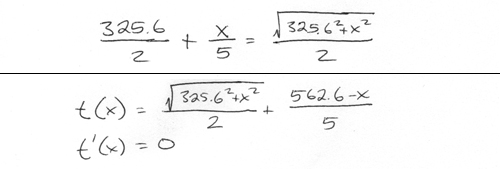
In both cases, I enjoyed setting up and solving the algebraic models.

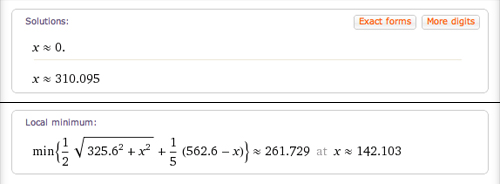
But as I contemplated solving one equation and finding the minimum of another, symbolic manipulation never occurred to me. Without any teacherly presence hovering over me, nagging me to rationalize my roots, the most obvious, practical solution was Wolfram Alpha – no contest.

A teacher at a workshop pulled off a similar move this week and felt embarrassed. He said he had “cheated.” Tools like WolframAlpha require us to come up with a more modern definition of “cheating.” (And of “math” for that matter.)

The ladder of abstraction.

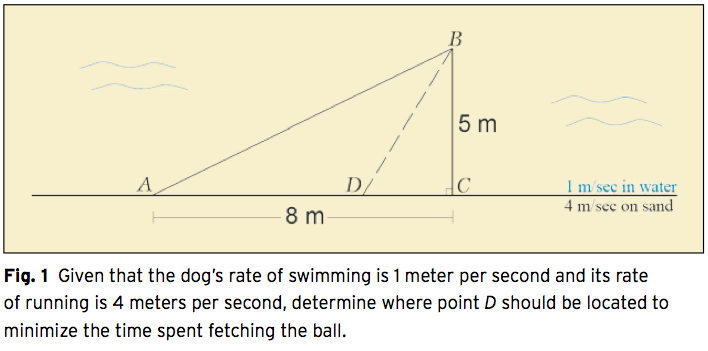
Referring back to the check for understanding, here are ways the original task had already been abstracted:

  • the dog and the ball are represented by points; their dogness and ballness have been abstracted away,
  • very little of the illustration looks like the scene it describes, for that matter; the water and sand are the same color; the image of a dog swimming after a ball has been turned into the remark “1 m/s in water,”
  • points have already been named and labeled,
  • important information has already been identified and given,
  • auxiliary line segments have already been drawn; the segments AB and BC and DC don’t actually exist when the dog is running to fetch the ball; they have been abstracted from the context later.

My version of the task starts lower on the ladder. You see the sand and the sidewalk. You see what it looks like to walk in each. They aren’t abstracted into numerical speeds until the second act of the problem, after your class has discussed the matter. I do draw a triangle on the video, which is a kind of abstraction. I didn’t see any way around it, though.

BTW. Andrew Stadel also has a nice task involving the Pythagorean Theorem and rates.

[LOA] Check For Understanding

Adapted from the May 2012 issue of Mathematics Teacher:

A dog is running to fetch a ball thrown in the water. Point A is the dog’s starting point, point B is the location of the ball in the water, and point D can vary. Given that the dog’s rate of swimming is 1 meter per second and its rate of running is 4 meters per second, determine where point D should be located to minimize the time spent fetching the ball.

Some questions to consider here:

  1. In what ways has this context already been abstracted?
  2. Can you de-abstract (recontextualize? concretize?) the context? Describe a task that would allow students to learn about the process of abstraction rather than just encounter its result.