Dan Meyer

Total 1628 Posts
I'm Dan and this is my blog. I'm a former high school math teacher and current head of teaching at Desmos. He / him. More here.

[LOA] Hypothesis #2: Paper Is A Problem

#2. Print-based tasks often obscure the process of abstraction.

I advanced a hypothesis in my last post that we don’t clue students into the everyday abstractions that come so easily and subconsciously to their teachers. We find it easy to represent contexts (applied or pure) with symbols, tables, line drawings, and coordinates, so we often glide over those processes, obscuring them in the process.

So it’s helpful to give students a concrete context and explicitly show them how to climb the ladder of abstraction at every rung.

For example, when I worked with teachers on Popcorn Picker last week, a task that starts without any mathematical abstraction whatsoever, just a video, I marveled at different times at our work on the board and on their papers. “There’s no popcorn here,” I’d say. “Where’s the popcorn? You took that video and said, ‘The color of the wall doesn’t matter. The actual items filling the cylinders doesn’t matter. The guy filling the cylinders doesn’t matter. This is all that matters.”
It should go without saying that if the contexts in your textbook are predigested with those symbols, tables, line drawings, and coordinates, we’re already in trouble. The context has already been abstracted and we can only hope that every student already understood how to apply that abstraction.

My hypotheses here is that this predigestion is a fundamental condition of print-based curricula and very hard to counteract. For example, here again is Pearson’s cell phone tower problem with a presentation that conceals the ladder of abstraction.
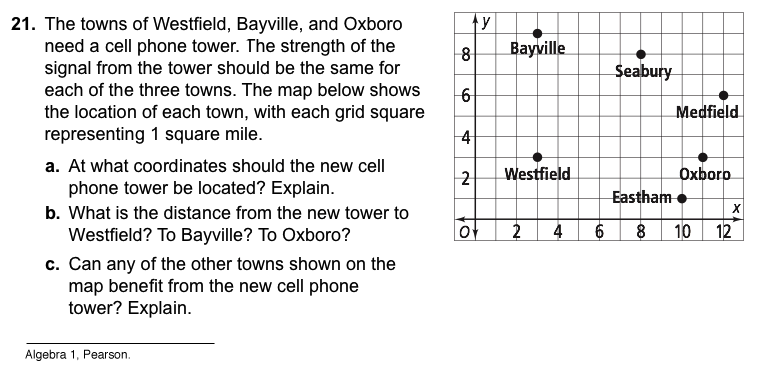
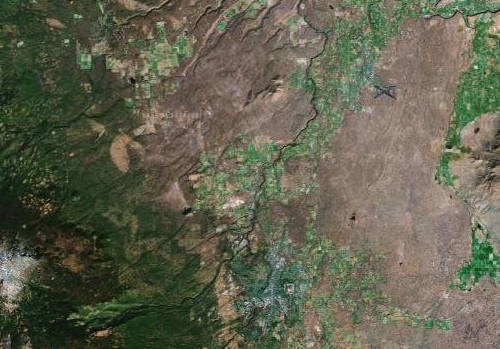
Let me offer a presentation that would reveal the ladder. We would start with the satellite view of the cities, a low level of abstraction.
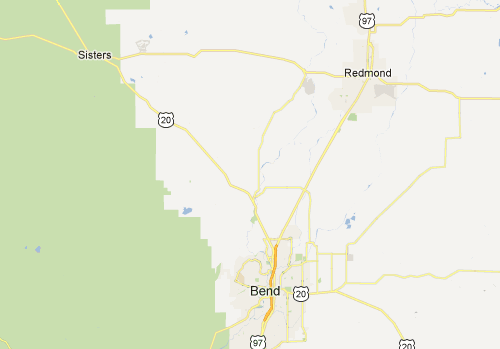
Then we’d move up to the ladder to a road map, clear-cutting forests, damming streams, getting rid of information that isn’t relevant to our question.
Then we’d abstract away most of that information, leaving behind three points on a plane with their labels.
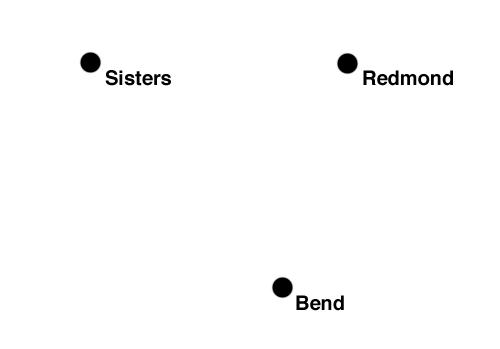
To talk about the location of those points, we’d put a coordinate plane beneath them.
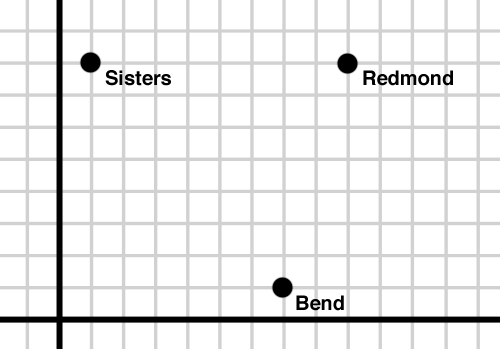
We’d consider each of those four frames separately. We’d move on to the next frame only after we had discussed the abstraction required to get us there.

With digital media, those four frames cost nothing but a few extra bits on a hard drive. But if I print each of those frames out on its own page and then bind those pages into a book and then mass produce that book, those four frames become very expensive and very heavy very quickly.

So instead, print-based curricula compress all those frames into one. They default to a very high level of abstraction and hope that everyone is already comfortable working at that level. It’s an expensive problem to fix in print.

This isn’t to say that print-based curricula isn’t great for a lot of things. This is just to say that making the ladder of abstraction clear to students isn’t one of those things.

2012 Sep 20. Brian Stockus starts a series on the issue.

Featured Comment

Brian Stockus, who works in the industry:

The other issue with print-based materials is that they can’t control the release of information very well. Generally a problem and any accompanying pictures or sample work are printed right next to each other. What if the person who wrote that problem wants the students to look at the sample work *after* they solve the problem for themselves? Well, it’s hard to make students do that when a sample solution is mere centimeters away from the problem.

Or in the case of the four images you suggest to use to help students abstract the cell tower problem. If they’re printed on the same page, the students can see all four steps at once which is inherently different than revealing one at a time and discussing each in turn.

This makes a case for the added value of digital tools in education. Not only is a video more dynamic than text, but you also have the ability to pause and rewind. Even using software like Powerpoint is more powerful than print in this regard because you can control when information is revealed. The same holds true for asking students questions on the computer using some sort of educational software. The instructional designer can control student movement so that an abstraction can be revealed in steps or after students have had the opportunity to think it through on their own first.

[LOA] Hypothesis #1: Be Explicit

I’m going to lay out five hypotheses over the next five days that will be the current tally of my writing, reading, thinking about the ladder of abstraction this summer. These should all be tested, contested, and generally kicked around.

#1: Teachers need to be explicit about the ladder of abstraction.

We represent towns with coordinates when our question concerns their location.

We represent data with tables because it keeps the data organized and sometimes reveals patterns.

We give points one capital letter and line segments two because it make them easier to talk about.

We turn real-world phenomena like trees and their shadows into right triangles when the tree-ness of the tree and the shadow-ness of the shadow don’t matter, when their height and length and and included angle are all we care about.

We climb the ladder of abstraction all the time. We teachers are good at that climb. We aren’t often explicit about the motivations and methods for making that climb.

We turn trees into line segments and cities into coordinates without so much as a word about that weird, violent stripping away of context. All of those implicit, elided abstractions in someone’s teenage years contribute to her adult sense that math is hopelessly abstract. We need to make these motivations and methods explicit.

“Let’s talk about these cities here. All we really care about is their location. Coordinates are a useful way of representing locations. Let’s lay down a grid so we can put numbers to those coordinates.”

Does it matter where you set the origin? Ask them. Then talk about it. I realize these kids are in ninth grade and should be totally adept at that kind of abstraction but let’s not assume that about them. Particularly when it just cost you an extra minute to have that conversation and make the abstraction explicit.

2012 Sep 18. Great line here from Frorer, et al, (1997):

And yet while abstraction in mathematics has some additional qualities or meaning, we rarely find it explicitly discussed let alone defined. You can pick up a book entitled Abstract Algebra and not find a real discussion of abstraction as a process, or of abstractions as objects.

Featured Comment

Erik:

I do not think use of the ladder metaphor is an admission that there is only a single way to get to certain understanding. I picture the ladder to mean that there is a path that I cognitively take to move along the spectrum of abstraction. This would allow room to climb a particular ladder to higher levels of abstraction and climb down another. The fact that there are multiple ladders to reach the same point does not invalidate the use of the ladder.

On another note, I think being explicit is enormously important especially if your goal as a teacher is to eventually make yourself useless to the students. Without revealing the undercurrents of your decision-making and assumptions, I think that you do not fully prepare them for life without you.

How I Spent My Second Year Of Grad School

This is ten months of grad school in ten minutes:

That video has me explaining the research from my qualifying paper, which is the culmination of a grad student’s second year at Stanford’s School of Education. It qualifies you, in the eyes of your advisers, to take on the much larger research project they call a dissertation.

The Experiment.

I showed two groups of students an image of a water tank. One group saw all the information and abstraction relevant to the question, “How long will it take to fill?” The other group just saw the question, “How long will it take to fill?” and had to request the information and develop the abstractions themselves. If you’re remotely aware of this blog’s obsessions, you can guess the research questions I asked about that experiment. (Watch the video!) Perhaps the most surprising outcome of the experiment (to me) was that the higher-achieving math students in the study really disliked not having all the information and abstractions in front of them.

If you’d like to read the paper, you can feel free. If you have some commentary or criticism that’d profit us here, you’re welcome to the comments.

A few other notes about the qualifying paper, my second year of grad school, and my next year of grad school:

On criticism.

Stanford gives great feedback. The school of education has several schools within it. My school, Curriculum and Teacher Education, does a great job preparing its students for the qualifying paper. In the spring of your first year, you take an introductory course. In the fall of your second year, you take a doctoral seminar that builds to a proposal for the qualifier. In my particular case, I had a qualifying committee that was generous with feedback when I needed it. I also developed the study while taking a course with Alan Schoenfeld at UC Berkeley. So my ideas and writing had as many as eight sets of eyes on them, as needed. (And that’s just faculty. My student-friends gave great feedback also.) That’s amazing and, from my understanding, kind of rare in doctoral programs. That criticism was occasionally contradictory, however, which required a certain discernment I haven’t really developed yet.

The criticism I remember most vividly: a) my weak review of the literature, b) the sense that I wasn’t really taking myself anywhere new with the study, and c) a claim about equity that had me reaching beyond my data.

Great classes I took.

  • Accelerated programming in C++. I had no business in an accelerated course in anything related to programming but I had a scheduling conflict and they weren’t putting the standard class online. It nearly ate me alive but spat me out a better programmer and granted me a great deal of sympathy for students who felt like idiots in classes that I taught.
  • Analysis of Social Interaction. With Ray McDermott, if that name means anything to you. If it doesn’t, read “Can We Afford Theories of Learning?“, which begins, “If American culture were an Internet, the domain name “learning” would be owned outright by the testing services that use it to feed the yearnings of parents and their schoolchildren.” So a great quarter, basically.
  • Front-End Programming in Javascript, HTML, and CSS, another course I took from afar and watched online. Patrick Young is one of the best lecturers I’ve had at Stanford and certainly the best I’ve had in the CS department. Really an invaluable course. I called my final project, “Better Online Math” and it’s the closest thing I have to a dissertation proposal.
  • Qualitative Analysis, with Pam Grossman (one of my advisers) and Sam Wineburg, who have taught together for decades, dating back to their time together at the University of Washington. Put these items under the heading “exceeded expectations”: a) the four assignments, b) the syllabus, c) their respect for our time.
  • Directed Research, for practical reasons. Make sure you write that one down, class of 2016-2017. There’s no excuse not to max out your units.

Papers I flagged as being particularly worthwhile.

What I’ll be doing my third year.

I have this image in my head from a movie from my childhood that I’ve forgotten. A man stands with one foot on each of two rowboats that are side-by-side. It seems like a good, fun idea at first but then the boats start to drift apart. His weight bears down on both boats, pushing them farther and faster apart until he falls in the water and we laugh.

One boat is christened “Grad School” and the other is “The Other Stuff.” The thing I can do to help myself right here is tie several cords from one to the other, committing myself to projects, papers, and talks that are researchable or that will, at least, inform my research. I just don’t have the time for a long stay in grad school but I may not have the skill to get a dissertation done quickly either.

So for the third year:

  • I’m still designing tasks for and consulting with publishers in the US and elsewhere.
  • I’ll be facilitating some workshops and speaking at some conferences.
  • I’ll be taking the winter quarter off to work with The Shell Centre in the UK. (Did you guys know they pilot their tasks five times before they release them. What new questions do they ask in each new pilot? Let’s find out this winter, okay?)
  • I’d like to submit a dissertation proposal at the end of this school year. Vegas oddsmakers are frowning at that one, though.
  • I’ve taken the required major coursework for the education doctorate but I need to complete several more courses in my minor emphasis in computer science. I’ll be taking as many of those as I can this next year, online as much as possible. As I narrow in on a proposal, I’ll take some appropriate methods courses also. (ie. if I plan to run an experiment, then something in experimental methods.)
  • I’ll continue to develop 101questions into the tool I need to be.

Of course, all of this has been and will be more fun with you guys tagging along, chirping comments and critiques at me as we go.

2012 Sep 13. Elaine Watson posts some thoughtful commentary on my qualifier.

Featured Comment

Bruce James:

What would you do with a doctorate degree that you are not already doing?

My answer.

Factor Dice

Kaleb Allinson, with a great end-of-class factoring exercise:

I tell my students that my dice add to 19 and multiply to 88 and ask them to guess my dice. I try to play this at the end of class for a week or two as I have time leading up to factoring. Then when they discover how to factor, this dice guessing skill is very helpful. They always realize what I’ve done and think I’m really tricky.

There are other ways to do this, of course, but the dice randomize the factors and I think that’s important. It says to the student, “Whatever algorithm you’re rolling around in your head right now – it’ll work for any whole numbers. The teacher isn’t putting her thumb on the scale. She’s giving you numbers she can’t control.”

Featured Comment

timstudiesmath:

Another extension is to ‘fake the dice results’ and have students determine whether or not there IS a solution to Kaleb’s problem; can they prove they have exhausted all possibilities?

Steven Leinwand for NCTM President

I voted for Steve Leinwand for NCTM President just now and I think you should do the same. He explains eight reasons for his candidacy on his website, which has this content license in the footer:

My mission is to promote progress in mathematics teaching and learning. Please use the material and resources on this site in any manner that facilitates the improvement of your mathematics curriculum instruction, assessment or policies.

So make that nine. Check your e-mail. Vote early. Vote often.

Featured Comments

Kelly Berg:

After the Professional Development I spent with him this summer, I would vote for him to be President of the Universe!!! Seriously… Everyone needs to vote for this guy!!!

Nathan Kraft:

I love Steve Leinwand. His video is amazing. His book is amazing. He has already influenced my teaching greatly and I can’t thank him enough. He’s got my vote!

Molly Olson:

He is so inspiring, funny, smart and thought-provoking. I appreciated his speech last year at the WMC Green Lake Math conference. I would vote for him too!

Andrew Stadel:

Can we write Steve in for the November 6 Presidential election too?