Category: anecdotes

Total 71 Posts

No-Drop Zones

From the #iPhone-game-as-metaphor-for-curriculum-design hashtag, we have Geared, which I purchased because I’m almost completely obsessed with little spinny things, a purchase which I almost immediately regretted.
Two reasons:

  1. The early levels are ridiculously easy. Not a serious problem in and of itself. The same is true of Flight Plan, which you’ll recall I rather liked.
  2. But game play gets harder only over a series of completely nonsensical contrivances. You’re dropping gears into a system, blitzing your way through easy. Then on level 21, as the game flips to medium, you’re confronted with “no-drop zones.” That’s really it. Everything else is the same. You’re arbitrarily excluded from routes you know would otherwise work for reasons that have nothing to do with the function of gears.
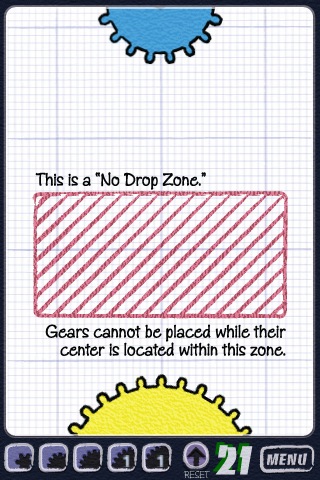
There’s no good reason to criticize an iPhone game from this forum except for the robust metaphor it offers for conceptual growth in math. Few textbooks get this right โ€“ and I include here the ones that do a pretty good job of being less helpful:

whenever possible, introduce new skills and new knowledge as the solution to the limitations of old skills and old knowledge.

Typical:
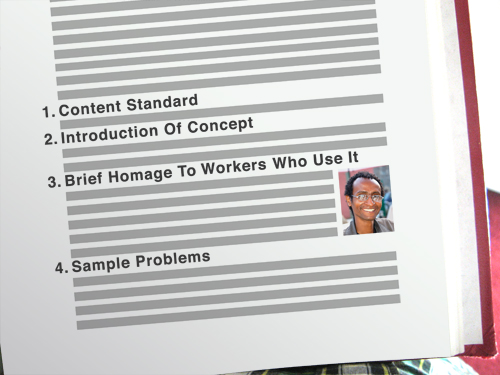
Better:
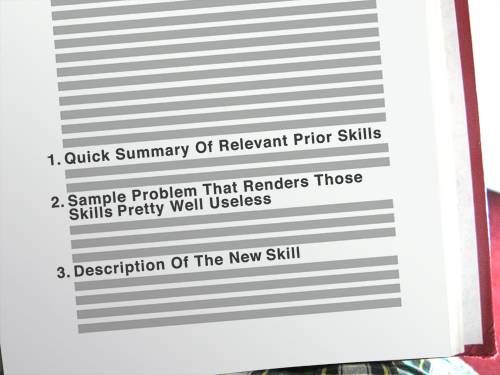
Please argue with me here but I don’t think my freshmen really care if career professionals use math in their jobs. This “career” concept is supremely abstract to most and therefore mostly useless to me as a motivator. I’ve found a much stronger motivator in a palpable sense of forward momentum, in a coherent skill set, in real, uncontrived challenges.

I’m teaching remedial Algebra for a fourth year now and the change I make to my curriculum far more than any other is to add this connective tissue.

You’re comfortable with a dot plot? Fine. Let’s put you in a place where a dot plot is tough to execute โ€“ say, a large data set with no mode and a huge range. That’s annoying. Then bring in the box-and-whiskers, the histogram, or whatever. I try not to introduce the next concept simply because it’s the next chapter in the book or the next bullet point on a list of standards or because it’s “what we’re learning today.” In other words, I try to stay away from the no-drop zones.


Ad Check

I can’t be the only person afflicted with these sidebar ads. The series is notable for taking guys who have at most 7% body fat and then Hulking them out even further through some form of isometrics or meditation or whatever. They doubled down on whatever game they’re running, though, with this particular before/after set. You have to imagine it animating back and forth between the two:

The deceit here is vaguely mathematical so I asked my first class of students, “What is it selling and how does it try to sell it?” Most identified the product as some kind of weight loss formula and/or protein shake. No one identified the deceit.

So I asked my next class, “What is it selling and how does it lie?” Many suggested we were looking at two different people here, which I said was false (with about 99% certainty). One student thought the ears were the giveaway, which is true, though not the giveaway he thought they were.

I guess I’m curious a) if you notice the deceit and b) if there’s any way to translate that deceit into an actionable math unit?

Update: Yeah, it’s the distortion, which is about 17% too wide in the first image and 17% too tall in the second image. Should it worry me that none of my students caught it?

Here are my estimations of the undistorted images.

Graph: effectiveness of ad v. percent distortion.

[Update: Holy cow. They fixed the proportions in the latest ad buy.]

Compass & Straightedge

Summer school right now involves six hours of Geometry instruction followed by three hours of planning for the next day’s Geometry instruction, which basically leaves me fully tapped for tweeting, blogging, smiling, anything but sleeping. I’d say something laced with regret here but the fact is I enrolled some truly incredible students who challenge me and crack me up for the better part of those six hours. These kids make for light work.

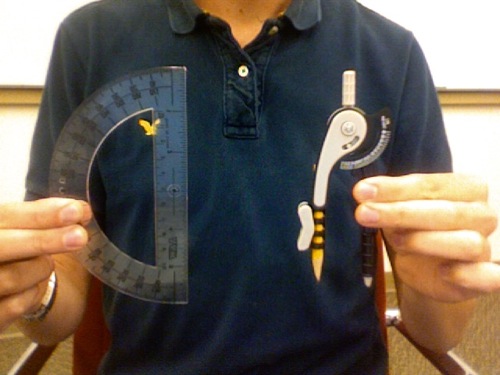
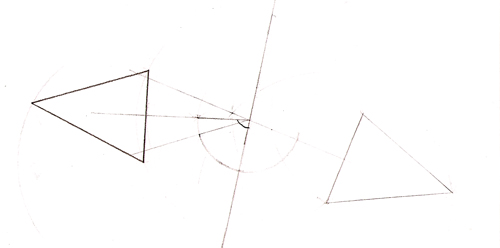
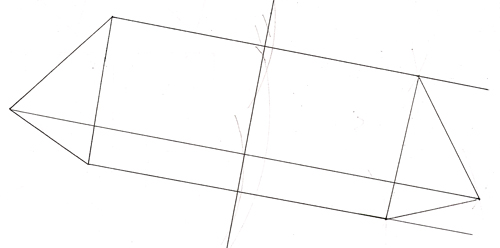
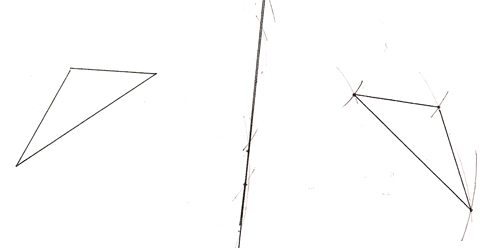
Their proficiency does cause its own kind of trouble, though, because my strongest and weakest students space themselves out dramatically over six hours, requiring all kinds of differentiation. My favorite recent method, particularly with today’s investigation of reflections, is to say, “okay, now do that with just a compass and straightedge.”

I had a method in mind but several students each did me one better.

One student made kind of stunning use of SSS congruency. Another dripped sweat all over the page constructing perpendicular bisectors, copying angles, copying sides in an incredible (but functional) mess. Another used the method I chose but did it in three fewer arcs.

I have five more days to enjoy this.

[BTW: I have determined that at least 20% of this is garbage.]

The First Day Of Summer School

Five uninterrupted hours of Geometry differentiated between credit recovery students and enrichment students turns out to be exactly as easy as everyone predicted it would be. After misjudging time-on-task about a dozen times and grossly overestimating our ability to construct an orthocenter by Just Playing With It, I did something at the end of class that I didn’t hate.

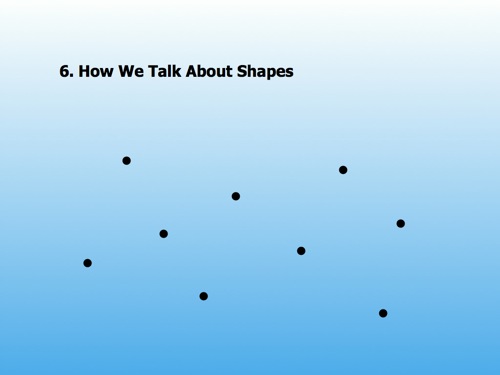
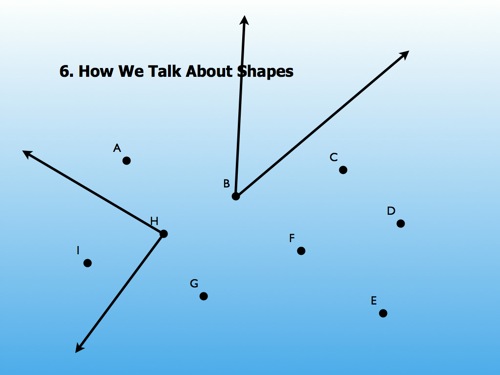
I put up this slide and asked Mika to pick a point out. I asked her to tell Jason across the room which point she was thinking of. She stumbled and stammered a bit. “It’s sort of to the left of the one that’s near the center,” etc.

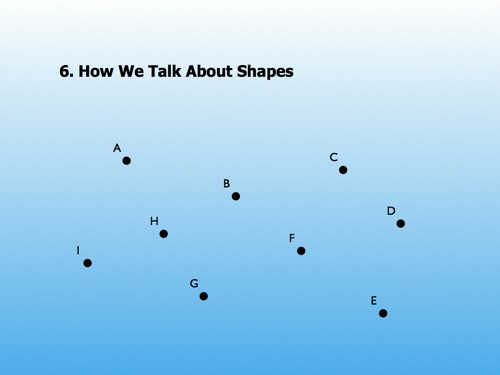
And then I added labels.

And it became a little clearer why we label points. Mika relaxed. Everything looked easier.

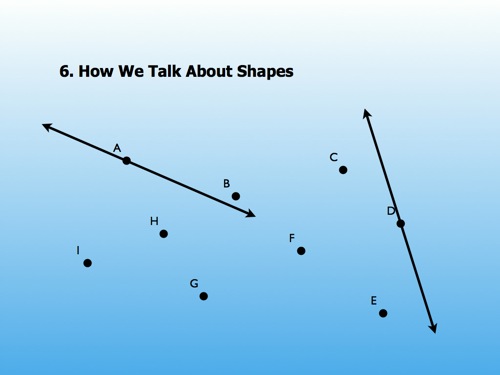
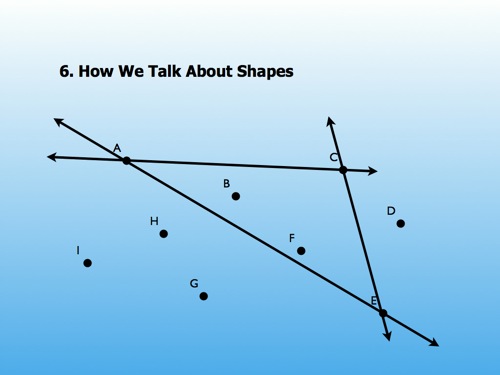
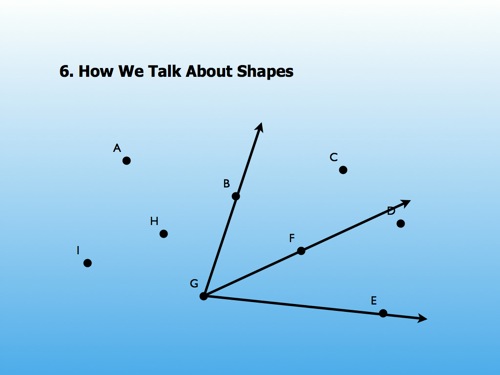
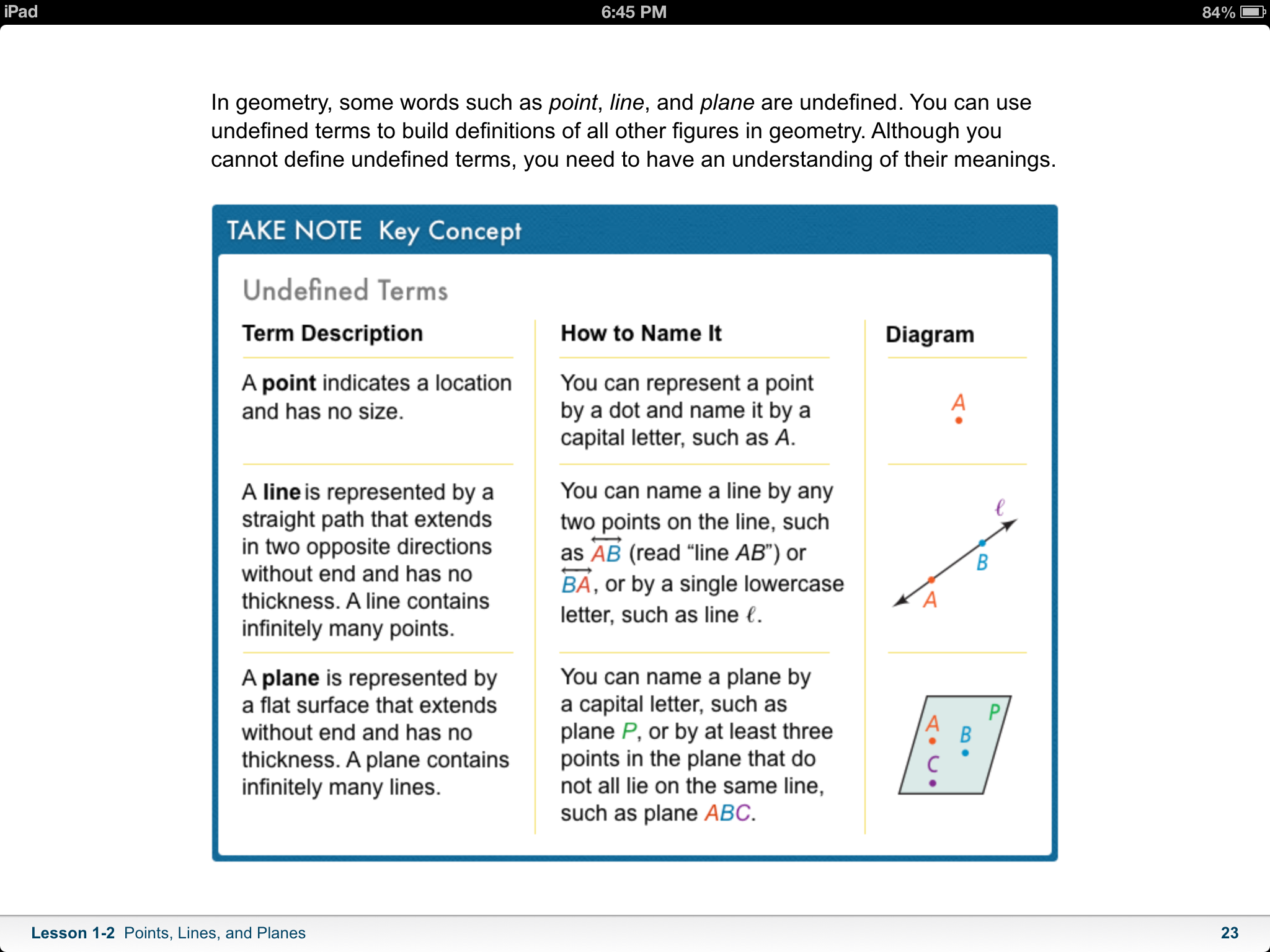
In 2007, I told my students that we name lines using two letters and I gave several examples. Today, I asked Mike how he would tell Kelsie across the room which of these lines he was looking at. First, it was easy.

Then it was difficult.

The same went for how we name angles.

This math thing is easier to approach if I ask myself, what about this concept is useful, interesting, essential, or satisfying, and then work backward along that vector, rather than working toward it from a disjoint set of scattered skills. There is probably a book I should read somewhere in all of this.

Postscript

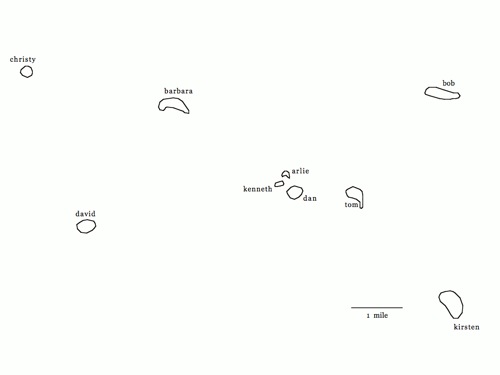
Also: I didn’t hate our opening exercise in which I gave each student a) a compass, b) a straightedge, and c) a map of the Meyer family’s South Pacific archipelago, Meyeronia, and d) five questions. [pdf]

  1. How many miles is it from Kenneth to Christy?
  2. Which island is farther from David? Barbara or Christy?
  3. List all the islands that are three miles from Kenneth.
  4. Find a location in the water that is the same distance from Tom & Bob. How many are there?
  5. Find a location in the water that is the same distance from Tom & Bob & Kirsten. How many are there?

Download

Flavors:

2012 Nov 24. Of course you could just take the concept straight on โ€“ defining the terms and defining the notation. No one would have any idea what purpose that notation served or why you’d need two letters to define a line. The concept would be just something else to memorize. But you could do that.

How I Roll

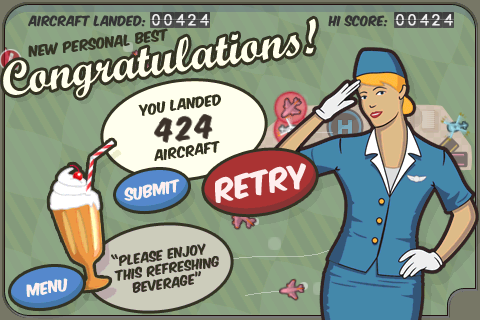
At 21h23 last night, Nate Gravelle, a student of mine, commented to let me know he had demolished my Flight Control high score. He attached a screenshot:

At 7h30 this morning, I spent ten minutes of useful prep time digitally fabricating my own high score:

At first he swears I’m lying. Then I dupe him with the screenshotWhich, side-by-side with the real deal, looks pretty sad. and he fumes for a second, then swears he’ll top me. I doubt he’s looked up from the iPod Touch he’s tucked beneath his desk since school began.

Let’s keep this between you and me, ‘kay?