- In what two ways will your male teenage students spend their free time and disposable cash this weekend?
- How much does it matter if you don’t know?
Category: anecdotes
Total 71 Posts
At the start of the year you’ll recall we completed this geometric personal survey, tossing likes and dislikes into trapezoids, circle sectors, etc, and drawing self-portraits. At the start of the year I turned ’em all into PDFs. ‘Cause you never know.
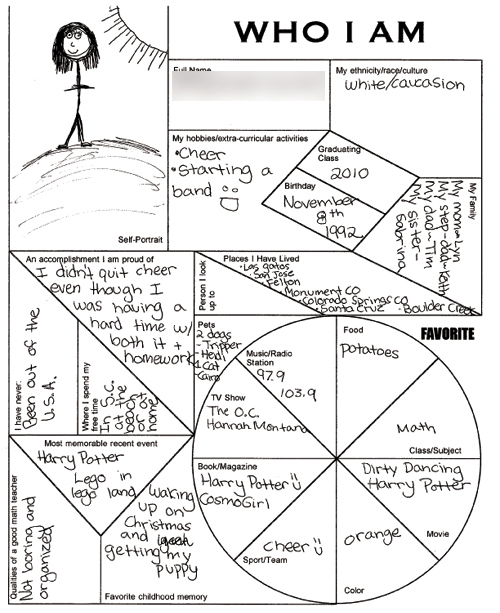
Today, eight months later, I tossed their self-portraits back at them and asked them to guess student from caricature.
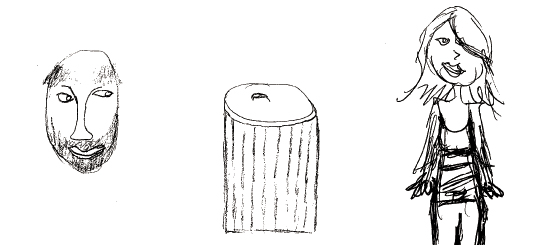
Some of them, we decided, were fantastic facsimiles of the real deal. Some of them reflected a student’s character better than her appearance. And others not even the original artist recognized.
Really fun, actually, though a really great teacher probably woulda had his students write some new-school-year resolutions and then review ’em here in the second half of the year. I’m not him.
Mean, median, and mode are each important, each easily mistaken for the others, and, depending on context, misleading or completely meaningless.
I came across a scenario yesterday which highlighted their differences and limitations a little too perfectly:
- Consider every human being in the world.
- List each person’s total testicles.
- What is the mean, median, and mode of that list, and what do they mean?
Is this even worth the trouble? If you aren’t trying to shock or pander to or titillate your students, are testicles fair game? ‘Cause the implications and extensions are really awesome here.
Like: the average human being has one testicle.
Or: the median number of testicles is either zero or two depending on gender majority.
And: the median and the mode will be the same number except under a few (also awesome) conditions.
How do I avoid panicking my principal here?
[via Jim Ray’s cool tumblog]
My response to the question, “Should 11th and 12th grade be made non-compulsory?” is over at Authentic Education, following an anecdote from my high school years which probably exceeds the bounds of good taste.
I’m not subversive enough to send our kids on their way after tenth grade, but I’m willing to declare the four year plan outdated. Split it in half and dedicate the second part to broader experiences than an analysis of Chaucer’s Canterbury Tales or preparation for College Board exams.
Get them into community college electives and job shadow programs. Get them a home room mentor, someone to show them how to execute a business plan, to teach them how to contact community leaders, and to ensure that they always always always put a lookout on Mr. Albrecht’s door.
Selected responses to my question: what external factors correlate to your teaching satisfaction? (Or dis-, as was my particular situation.)
-
Benjamin Baxter: Music
For example, if I’ve had a good day, I’ll listen to Gordon Goodwin, Dr. Demento, classic rock or Richard Nixon’s speeches. If I’ve had a bad day, I’ll listen to Sammy Davis, Jr., Cake, The Decemberists or Alexi Murdoch.
-
TMAO: Blog Output
I think I got a negative correlation thing going. The rougher things get, the more virtual ink gets spilled.
-
Sarah Cannon: Time Spent On Phone
The worse the day, the longer I need to debrief and the more likely I am to call a friend to distract me from planning the next day.
-
Stephen Humphrey: Family Time
And the great thing is it’s a leading indicator by about six months; if I’m reducing my hours at home, I can know that my job satisfaction is going to be in the gutter in half-a-year—plenty of time to fix it now that I recognize the indicator and look for it.
-
Jackie B: Interpersonal Communication
If I’m joking in the math workroom or with kids in the hall or after school, things are going well. If they aren’t going as well as I’d like, I’m brooding.
-
Dina Strasser: Unspeakable, Frankly
And now I will drown some kittens. Excuse me.