Category: classroomaction

Total 43 Posts

Great Classroom Action

Brian Miller posts a smorgasbord of applied proportions activities, each of which poses students as crime scene investigators. He also gives purpose to the skills he wants to teach by fitting them inside a larger, more enticing question:

The basic premise is as follows: I show the Bone Collector clip first. I tell them we need to figure out the shoe size of the killer because we need to make sure that the killer is not in the room. Then I concede that I realize they are not trained investigators. Thus I tell them that over the next couple days we will be doing some investigator training, to get them ready to take on this case.

In some recently consulting, I was asked how to make to make trig identities less of a slog. I didn’t hesitate to send along Section 2 of Sam Shah’s worksheet. Section 2 really needs its own post. Briefly: watch how he sets students up for a major cognitive conflict as they all graph (seemingly) different trig functions only to compare and find out they’re exactly the same. “Okay, are you all graphed? On the count of three there will be the big reveal. One … TWO … REVEAL! Whoa. Really? REALLY? Yes, really.” (I don’t think I’ve seen anybody else pull off Sam’s worksheet persona, which is some kind of cross between “reality TV host” and “Vegas lounge act.”) The point of the worksheet isn’t practice. It isn’t instruction. It collects student hypotheses about a discrepant event which they’ll be working on “as we go through the next few days.” If math class were a movie, Sam’s worksheet would be the trailer.

Julie Reulbach encourages us to “save the math for last” in a very nice modeling activity. But questions like “what do we need here?” are modeling. They are math. Is it more accurate to say, “Save the computation for last?”

Never before had “test points” seemed so obvious to them. Test points were not just random points, they meant something. They told a story. The next day, when we finally got to the actually inequality lesson, foldable, and then homework, the students really understood the need for a test point. They also easily understood the horrific workbook word problem.

Bruce Ferrington asks students “What is my area?“:

My chief interest here is to look at how the kids are going to approach this question. I want to see if they can come up with any short-cuts that will speed up the calculations, so they don’t have to cover their entire body in 1cm grid paper and count out each square. Look what they did!

2013 Mar 22. Sam Shah wrote up his thinking behind the worksheet.

Featured Comment

Julie Reulbach:

Maybe, save the “procedures” for last? You know, the actual lesson with the steps and the summary of all of the rules they discovered but didn’t realize it.
Great Classroom Action

130226_1

Cathy Yenca offers her student “two sheets of paper, some tape, a ruler, a calculator, and a little bit of breathing room” and the two of them make math happen:

Clearly, the student was delighted that his calculations matched what happened in the video. I said to him, “E., so you learned a little something about volume today, eh?” His response, without hesitation: “Always go with the fat one.”

Rachel Kernodle posts a clever illustration of inverse functions.

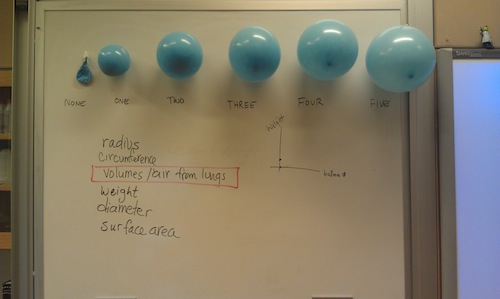
Sam Shah shares his struggle to make related rates interesting and finds some solutions:

Then I asked our esteemed volunteer to use one breath to blow up the first balloon. Taped it up. Again, for two breaths. Taped. Et cetera until we got a total of six balloons taped. Then I asked what things are measurable in the balloons. Bam. List.

Bruce Ferrington asks, “How Tall Is Our Class?” a question which is surprisingly involved:

So, how were we going to measure the height of a class? Well, the kids came up with three suggestions.

Great Classroom Action

130212_1

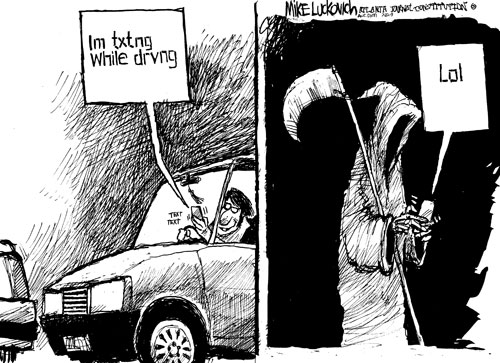
Frank Noschese’s Texting While Driving:

How far does your car travel while you drive and one-handedly text “LOL” to your friend? Kids were immediately engaged. They asked questions like “How fast am I driving?” and “How long does it take to text?” I told them to assume whatever speed you wanted, we’d share out later.

Nik Doran’s Mini Feltron Project:

I set them first to the task of collecting information about how many text messages they sent over the course of a few days, and then we jumped into the idea of recording more about yourself over the Christmas holidays. I got on board as well. I anticipated some students would not have collected the data (and was unfortunately not proven wrong) so they get use my super boring data. What I did not anticipate was this.

Liisa Suurtamm & Jessica Drake’s Orangiest Orange Juice:

Although I have tried this problem several times with teachers and students and am not surprised when many of them guess which solution is the “orangiest” — I am still surprised at the variety of strategies that people use to prove this and how rich the discussion is. In this particular class the common theme in the strategies that the students used was the need to make something the “same” in order to compare. Some adjusted their ratios to find the amount of water needed for 1 cup of orange juice, others turned everything into percents so that they “were all out of 100”³ and it would be easier to compare, some drew circle graphs so that their “whole” looked the same. What was nice is that many students recognized this similarity in their solutions even though they looked quite different.

Mr. Owen’s Contagion:

Generalize it! We then discussed a general form for the equation. They needed to make a connection between the R-0 number from the video and the multiplier they used to generate their charts. As soon as I brought up the question, they noticed that it was just (1 + R). At this point, my head almost exploded from awesomeness.

Great Classroom Action

Avery Pickford’s Truly Group Project:

So our crazy new idea? We’ve put together four open ended, challenging probability games. Eight groups of 3 or 4 will spend tomorrow working on one of these games (2 groups for each game in each class). On Tuesday, groups will rotate and work on a different game, starting where the previous group left off.

Mr. Owen’s amazing work with ActivePrompt:

Since that was too easy, I next told them to create two more parallel lines that were neither vertical nor horizontal. They pretty quickly realized that it was all about slope. Their idea was to assign everyone a number and then have them go up and over by that amount (1,1) (2,2) (3,3). The real genius idea (only one class did it this way) was to translate that first line up using the rule (x , y) —> (x , y+1).

I originally figured the “create two parallel lines” ActivePrompt to be a great team building activity and little more. Mr. Owen’s class completely surprised me. Must read.

Kyle Pearce’s Detention Buy-Out:

In the video, three administrators from Tecumseh Vista Academy K-12 School are interviewed and propose individual options for students to avoid serving detentions by paying the administrators according to their buy-out offers.

Julie Reulbach’s Barbie Bungee jump:

There is nothing more exciting then seeing seeing if your Barbie is going to come crashing to the ground. The students learned so much and we ALL had a blast!

Watch the clip. Get excited about how excited kids are to see the results of their calculations verified outside of the textbook’s answer key.

Featured Comment

Andy:

My Algebra class worked on the detention buy out problem today, and they loved it. The discussions were great, and the students did not even realize they were using Algebra.

Great Classroom Action

121216_1

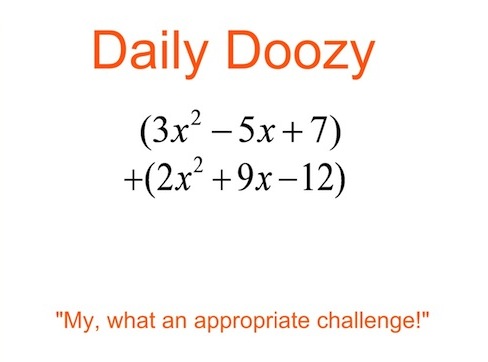
Matt Vaudrey’s Daily Doozy.

I’ve been faithfully naming the “Learning Goal” with each class for several years now. And frankly, it doesn’t inspire. Yawn. Instead of (actually, in addition to) this, I’ve added the Daily Doozy to my pre-lesson routine.

This a really profound shift and it deserves a discussion that’s longer than this capsule allows. He illustrates the Daily Doozy on polynomial addition, also, which underlines a point I don’t make often or well enough: after you have enough experience with variables and numbers, pure math becomes real-world math.

Cathy Yenca’s How Much Per Gallon illustrates Matt Vaudrey’s Daily Doozy in an applied context:

I “set the stage” by grabbing the water bottle from my desk, and asked, “Have any of you ever bought that colored, flavored liquid stuff to put in your water? Is it good?” A wave of opinions came crashing toward me, as students expressed their love for or disgust of the product. “How much do you think a gallon would cost?”

Carol Rogers uses two photos and a perfect question to illustrate the power of arrays.

Jonathan Claydon illustrates one way to put student teachers to use in his implementation of Log Wars:

Anyway, rumor is that kids love this game so I was optimistic. I took the cards that Kate Nowak links to and modified them a little bit to make a better distribution of numbers (most of the cards in their sets evaluate to 2). I finished with a set of 40 logs, printed them on mailing lables and had my student teacher affix them to index cards that had been cut in half. I gave each color group their appropriate color deck of cards. We had a brief demo and then I let them loose.

PSA: Unless you explicitly aim for anonymity in your blogging, do you, your students, and your career a favor by putting your real, full name somewhere on your blog’s home page. The weirdest, coolest opportunities come from having your real, full name attached to your great blogging. I find a lot great bloggers voluntarily (and probably unwittingly) giving up those opportunities.