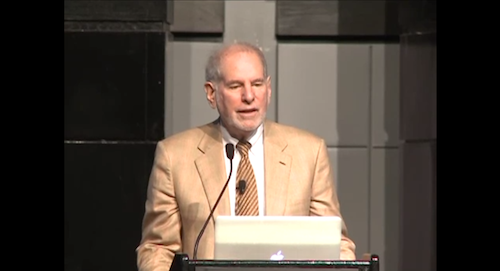
On April 19, 2013, the third day of NCTM’s annual meeting in Denver, Uri Treisman gave a forty-minute address on equity that Zal Usiskin, director of the University of Chicago’s School Mathematics Project, called the greatest talk he’d ever heard at the conference in any year. Stanford math professor Keith Devlin would later call it our “I have a dream” speech. At least one participant left in tears.
I’ve personally seen it three times. I got the video feed from NCTM and the slides from Treisman. I then spent some time stitching the two together, resulting in this video. His message is important enough that I’d like to use whatever technical skills I have, whatever time I have, whatever soapbox I can stand on, to help spread it.
If you’re interested in equity, you should watch it.
If you’re interested in teacher evaluation, you should watch it.
If you’re interested in school reform, you should watch it.
If you’re interested in charter schools, you should watch it.
If you’re interested in understanding which student outcomes teachers can control and which they can’t, you should watch it.
If you’re interested in the trajectory of math education in the era of the Common Core State Standards, you should watch it.
If none of those conditions apply to you, well, I can’t imagine the series of misclicks that brought you to my blog. Watch it.
Here’s a fair enough summary from Treisman himself:
There are two factors that shape inequality in this country and educational achievement inequality. The big one is poverty. But a really big one is opportunity to learn. As citizens, we need to work on poverty and income inequality or our democracy is threatened. As mathematics educators … we need to work on opportunity to learn. It cannot be that the accident of where a child lives or the particulars of their birth determine their mathematics education.
That was his destination and the talk took only three stops along the way:
- What did education reform groups like Achieve, the Gates Foundation, et al, recommend in their “Benchmarking for Success” document in 2008?
- How does TIMSS and NAEP data contradict or clarify those recommendations?
- What should we actually do about equity, as teachers and citizens, if those recommendations prove unfounded?
Highly Quotable
- [A]s math people we know that if we’re going to work on a problem, we have to formulate it clearly. And as math people are wont, we need to swaddle ourselves in the numbers and the data because that’s what gives math people direction, strength, and courage.
- Let’s look at “Benchmarking for Success” and see its analysis of the problem. Then let’s look at the data and see how it actually lines up with what we know today. And then let’s see where we need to go to really enact the vision of NCTM for equity.
- So the notion was: “Let’s focus on teachers as the central driver of reform and rethink how we evaluate teachers.” They had the view that teachers were the single most important in-school factor in student achievement. And math people know that was just an artifact of the way they modeled the problem.
- I’m now going to show you two graphs that I don’t believe anyone in the math community has seen. It’s the PISA data disaggregated by child poverty rates.
- About one half of students who go from high school to college are referred to remediation and mostly developmental math. Fewer than a quarter of those students will ever get a credential. Those students are more likely to end up with debt than a credential. [..] Those remedial programs are burial grounds for the aspirations of students. And it’s mostly math that’s the key trigger. 35,000 students in California two years ago repeated a developmental course for the fifth or greater number of times. So no one can say those students don’t have persistence.
- So states — where you go to school —Â are a profound influence on what you actually get to know.
- Low income student scores in Texas were the top in the country in 2011. It’s really good for Texas to be the top of the country. Because whenever Texas does something well, everyone else is positive that they can do better. When Massachusetts is at the top, people go, “Ah, it’s just Massachusetts.”
- Again, two and a half years difference in opportunity depending on where you happen to go to school. This is something that, as a math teaching profession, we can influence. Poverty is something we need to work on as citizens. Opportunity to learn is something we need to work on as math educators. That’s a core message for this talk.
- So you would think that charters would fix this. Almost all the charters in Texas produced 0% of students who are college-ready. There are a few of them —Â one KIPP, one YES Prep, one IDEA, one Harmony — that are pretty good. Most of them are well below the public schools. So this theory of Achieve, NGA, CCSSO, Race to the Top, that charters were the answer? Not so clear when you actually climb into the numbers. The reverse looks true.
- When you visit most math classrooms it’s like you’re in a Kafkaesque universe of these degraded social worlds where children are filling in bubbles rather than connecting the dots. It’s driven by a compliance mentality on tests that are neither worthy of our children nor worthy of the discipline they purport to reflect. That is the reality. That’s something that we as math educators can control.
- What this shows is that the current theory about school improvement — that charters, Common Core, value-added measures of teaching are going to solve the problem — is profoundly wrong. That doesn’t mean we can’t use the Common Core powerfully to reboot our systems but it’s not the solution to the basic problems of schooling.
- Guess what? Poverty really sucks. It’s incredibly hard. All the lifespan studies going back to the 1920s show that poverty and youth is a very hard force. We need to build fault-tolerant schools and systems if we’re actually going to address equity.
- Just think about it. The great majority of our children finish our schools positive that there’s a whole list of things they’re not. They come out of schooling believing they’re not mathematical, they’re not artistic, they’re not philosophical, they’re not athletic. And these self-imposed beliefs undermine your sense of personal freedom, the font from which all freedoms come.
- You have to remember that when the Common Core was created, they didn’t come to NCTM. They got David Coleman to write it and he brought his friend Jason Zimba to do the math. They did not come to NCTM. It’s time for us now — the professional societies — to talk about what standards should be and how to reshape the Common Core so that it reflects our best practice knowledge of schooling. Hard message, but a necessary message.
- What is the determinant of whether you have a high-skill job in the US? Overwhelmingly it’s mathematics. It’s the single biggest factor in upward social and economic mobility. It’s our beloved subject. It would be wonderful if it were music instead of math. Think how great the country would be if everyone were striving to learn to play an instrument instead of factor quadratic equations but the fact is it is our discipline that is the primary determinant.
Featured Comments
Bill McCallum, chair of the CCSS math writing committee, responds:
A beautiful speech by Uri and a great contribution by Dan to put the slides with the video.
However, the quote about how the Common Core was written garbles the history badly. Here is a summary of the process.
CCSSO and NGA appointed a work team of about 50 people–educators, mathematicians, teachers, policy people–and asked me to lead it. They also appointed a writing team of 3 people–Phil Daro, myself, and Jason Zimba–to draft the standards. We solicited progressions documents from selected individuals or groups in the work team. The three lead writers produced a first draft based on these progressions. There was also a feedback group of about 20 people. You can find the pdf with the names of all these people by googling “Common Core State Standards Work Team”.
Minor iterations of the standards were circulated to the working team for comment and critique, of which there was an abundance. Major drafts (about 3 or 4) were circulated to the feedback group and the 48 participating states, which also produced a huge amount of commentary. Finally, a public comment period starting in March 2010 elicited about 10,000 comments, of which we looked at every single actionable comment.
There were also numerous organization reviews, including one by NCTM. I spent a weekend in DC with a team from NCTM listening to their concerns, which resulted in significant changes to the standards. Jason and I also spent a weekend with teachers from AFT, one team for each grade band, who gave us detailed feedback that also resulted in changes to the document.
For more context, take a look at Jason’s Ed Week interview with Rick Hess.
Michael Pershan calls into question the data behind one of Treisman’s conclusions:
I’m now going to show you two graphs that I don’t believe anyone in the math community has seen.
That slide with PISA data is missing a bunch of countries. Where’s Japan? Where’s Hong Kong? Singapore? Canada?
All of these countries do well on PISA even though they have considerable child poverty. I put together a fuller picture of the data in this post, with links to the data that (I think) Treisman used.