Category: contest

Total 44 Posts

My Annual Report

Here’s a pdf. Also each image below is very clickable.

I reckon I could drop a few thousand words on either end of the process – either the introspective or the technical – and I probably won’t resist too much in the days to come. Suffice it to say right now, though, that both ends were a lot more challenging and a lot more satisfying than anything I’ve done with design in a long time.

Let’s see your years.

You Just Put Your Lips Together

Regarding this new contest, Ken writes:

What if I’m all ‘thinking about design’, but saddled with an inability to convert thought to creation?

Mr. K replies with the implicit mantra of this contest and of my Information Design course:

Don’t do it to win – do it to do it. I suspect the problem isn’t whether you can do it at all, but whether you can do it well enough that you’d feel comfortable showing it to anyone else (much less the world). You’re not going to get to that point if you don’t take the first step.

So throw the data into excel. Have it draw a graph. Decide what you hate about the graph, and fix that. Already you’ll be ahead of 80% of the data presenters out there.

A few founts of information, if it helps get this process moving for you:

Contest: Your Annual Report

[Update: the final contestants & the winners]

The judges are pleased to bring you this blog’s second design contest. May you find this assignment, first and foremost, an opportunity for reflection and self-diagnosis at the end of 2007. The prizes and competition are secondary and incidental. They exist only to push forward the amateur designer who seems most inclined towards professional design.

Instructions

  1. Design information in four ways to represent 2007 as you experienced it. This can mean:
    • four separate PowerPoint slides with one design apiece,
    • one JPEG with four designs gridded onto it,
    • an Excel spreadsheet inset with four charts,
    • etc.

    Feel free to use pies, bars, dots, bubbles, sparklines, stacks, or designs of your own construction.

  2. Submit your designs. Either:
  3. Post your reflections either:
    • in the comments here, or
    • at your own blog.

Illustrative Examples

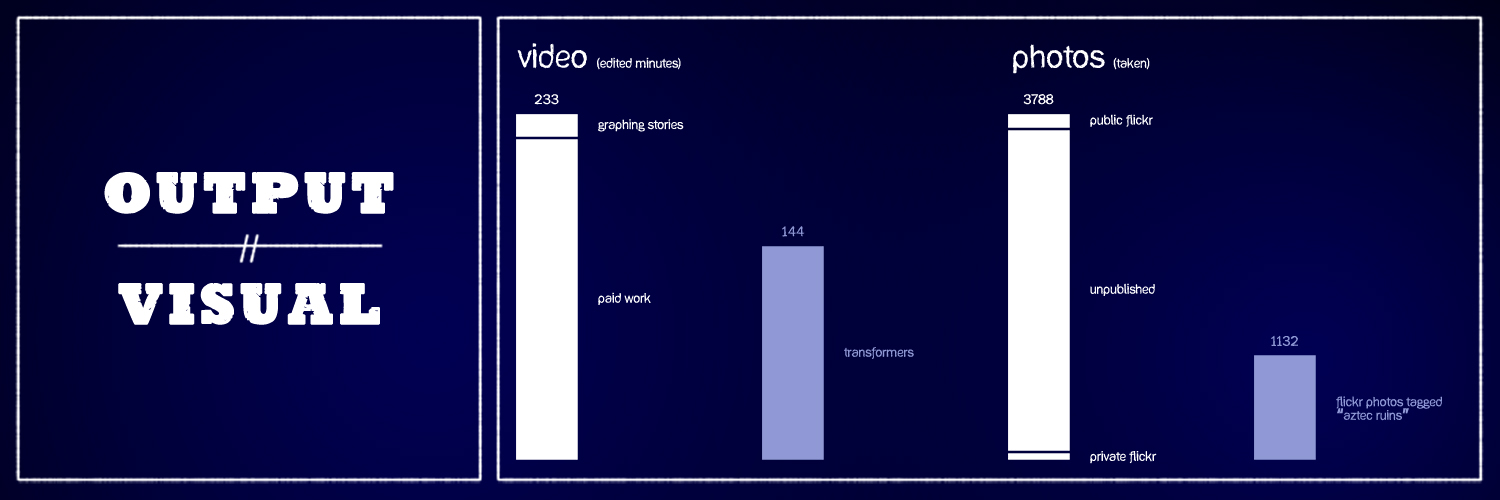
  1. This slide, representing my music intake over 2007, comprises two designs, a bar chart and an ordered list:
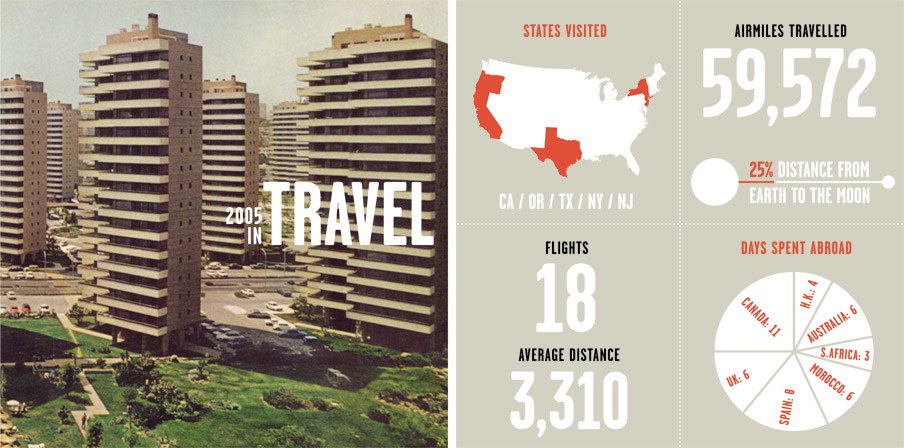
  2. This page, representing Nicholas Felton’s travel habits in 2005, comprises four designs.

Deadline

  • Sunday, January 13, 23h59, Pacific Standard Time

Judges

Prize

Legal

  • You own your slides, though we’ll post them here (attributed) and, in all likelihood, pick several apart.

How We Got Here

  1. The 2006 Feltron Annual Report, Nicholas Felton
  2. The 2005 Feltron Annual Report, Nicholas Felton
  3. Who Is Nicholas Felton?, Dan Meyer
  4. Information Design: Syllabus, Dan Meyer
  5. The New Division of Labor, Levy and Murnane
  6. The contest organizer’s raving conviction that assignments like these will be essential to math and language education in the 21st century.
  7. The contest organizer’s nagging suspicion that, in ten years time, his raving conviction will look either eerily prescient or (more likely) totally obvious.

Who Is Nicholas Felton?

You and your family sent out a Christmas postcard. Jose Vilson blogged his year-end reflection. Corporations and businesses also play your game, issuing annual reports to their shareholders, detailing their rises and falls, quantifying successes and qualifying failures, telling the stories of their fiscal years through pictures, words, and charts.

Nicholas Felton is an individual, a graphic designer, but he takes the corporate route, obsessively tracking his vital statistics throughout the calendar year,

  • where he ate,
  • where he traveled,
  • media he consumed,
  • media he produced,
  • text messages he sent,
  • e-mails he received,
  • etc.,

issuing one of the design world’s most bespoke articles at each year’s end.

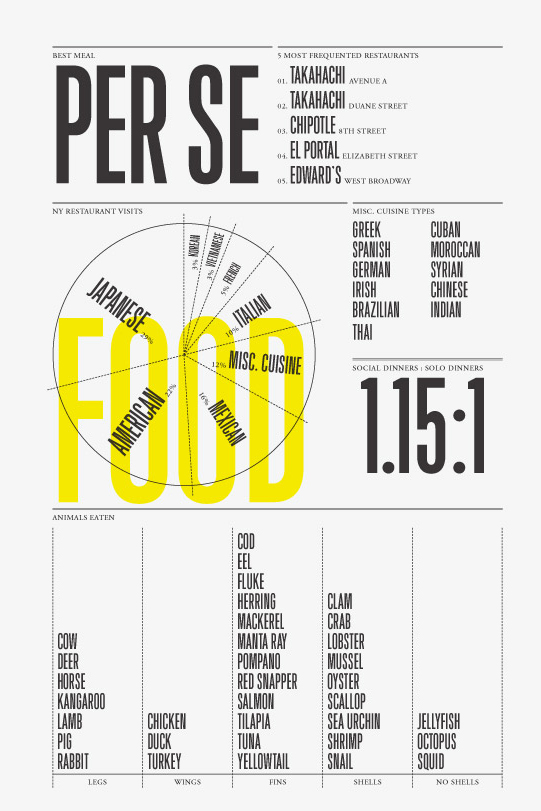
You are a shareholder in his life and flipping through his annual report is not an optional assignment for dy/dan readers. The 2006 edition, for example, includes information design grails such as this page of pie charts, ordered and unordered lists, detailing the food he ate over 2006:

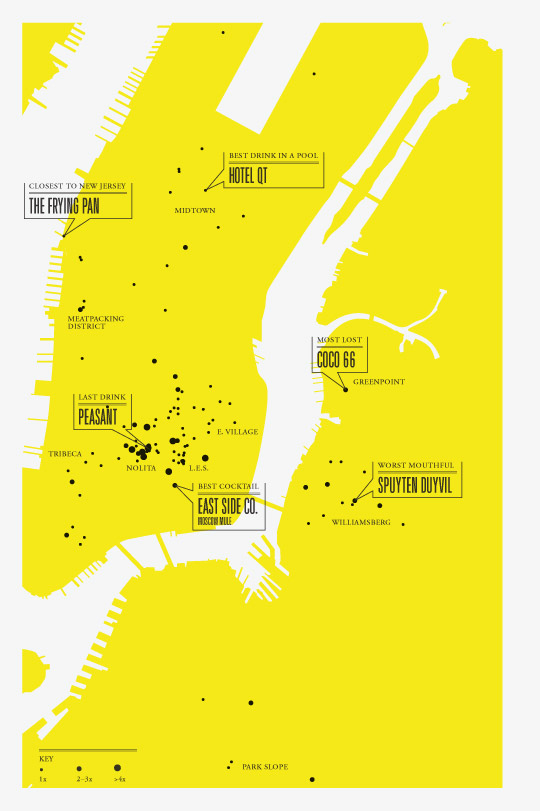
or this scatter plot of drinks he consumed throughout the year:

Nicholas Felton stands alongside Andrew Kuo as a patron saint of my Information Design course. Both make their idiosyncratic preferences and activities accessible to large populations through a) articulate self-reflection and b) precise mathematical structures.

So do you see it? Do you SEE how this brings us all together? Math & Language? Old School & New School? Do you have another math class on your master schedule that’ll spawn as many writers and designers as engineers and statisticians?

All you School 2.0, future of learning, 21st-century educator-types, please, please, come back. I’ve found the flag I can fly for you. This flag. And I need you to get crazy about it with me.

So Hold Onto Something

This Is Bad

I have eight of my favorite people at my place for the new year, twenty-two more on the way, two game consoles hooked into digital projectors, a bathtub with beer on ice, great weather, but I can’t get my mind out of the classroom.

The Preoccupation

Among the ages I teach, math has changed very little in the last quarter century and certainly at nowhere near the pace of technology or (more importantly) my kids’ creativity.

So for the last year I’ve been building a course from scratch, connecting a lot of loose, fun material, grafting it on the back of your standard Algebra 1 curriculum, infusing the whole thing with visuals from start to finish, and then personalizing it, setting expectations such that, by the end of the course, every student will have the same skill set but entirely different work portfolios depending on personality and preference.

Furthermore, the course lives in the intersection of English and Math. It depends as much on articulate self-reflection as it does on mathematical computation.

My White Whale

I haven’t met another math teacher as consumed by information design as I am, as convinced that it can invigorate a subject that most students find irrelevant, and maybe that’s because I’m the crazy one here, playing a lanky Captain Ahab to a white mathematical whale.

Who Is Nicholas Felton?

But I don’t think so and here, at the year’s end, a guy named Nicholas Felton has offered me the single piece of tape which fastens together hundreds of techniques and web links and my mind won’t. shut. down.

So it’s about to get Very Busy around here. I’ll soon post a loose-limbed course syllabus which will precede an explanation of Nicholas Felton’s enormous (and most likely oblivious) contribution to math education which will precede our winter design contest, which will be at least as fun as the last one and certainly more challenging.

In all of these, your participation is requested.