Ian Garrovillas attended my spring session in Oakland on integrating digital media into a math classroom and kinda missed the point. His take-away:
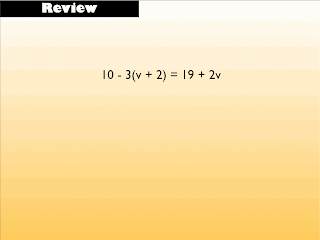
[Halloween] was Friday, a review and quiz day. Rather than merely putting up review questions on the board that our class could try and discuss, I interspersed screen shots of scary movies…
I let the image sit on the screen for a mere 3 or 4 seconds, acting as if I was unaware, before I moved onto the next slide. Got a few students with it. Lovely.
The conversation in my ILC recap has taken a few predictable turns, namely the one where I expect too much of presentations, that I need to lighten up on the presenters. I don’t know how to relax my standards or if that’s even a good idea. I do know how to distill everything I have ever enjoyed about any presentation into two steps. I don’t care what your presentation covers; if you manage these, I will love it.
Unless your presentation is billed as “beginner-level” don’t include information I can easily Google. What I mean is, while I know nothing about Photo Story, it was painful spending seat-time on a tutorial for adding narration to Photo Story, which is Google’s top result for the same query. I can get that anytimeThis was the most dissonant element of ILC. Half the presenters told me not to tell my kids stuff their steroidal smart phones could tell them. The other half were doing the opposite..
Instead, cover the stuff I can’t Google, that stuff that makes your presence worth my district’s money and my time. Here’s an easy outline: a) why Photo Story; what problem were you trying to solve? should I care about that problem? b) what complications did you encounter while implementing Photo Story? how did you overcome them? c) what did you learn?
This particular outline forces you to reckon with audience expectations and puts you in a position to satisfy them. It would have improved fourteen of the eighteen presentationsNone of which were about Photo Story, okay? I attended at ILCThough this outline is useless if you turn your back to the audience and read aloud from a slide titled “What I Learned.”.
or: My First Ed-Tech Conference
also: My Last Ed-Tech Conference
I’m back now from the Innovative Learning Conference in San Jose, CA. When I first bumped into Alice Mercer, she said, “This doesn’t seem like your kind of thing.” She’s either right, and I’m just the wrong person for ILC, or else ILC should have stepped its game up in a lot of ways. Obviously, I’m biased toward the latter. Either way, I shouldn’t have missed class time for this.
Therefore, a brief preface of ILC’s good stuff and then my best advice for the presenters there. If you’re reading this and you presented at ILC, obviously I’m not talking about you, or your session, etc., and hopefully you all realize by now that I reserve my harshest criticism for myself.
Preface
It was nice meeting Collette, Rushton, Alice, Gail, and some other folks; CUE organized the conference well, with the right number of sessions per day (five) at the right length (an hour, though some presenters didn’t earn ten minutes); the catered lunch was fine, just fine.
That Said
In order to earn one seat-hour from a few dozen people, your presentation needs either:
a compelling personality behind it;
expertise, the sort of expertise DFW wrote about, the kind that has such a tight conceptual grasp, it can explain itself from any side, from any angle, from a macro- or microscopic lens;
a compelling narrative, something with an antagonist, with obstacles to overcome, even if they’re just stubborn network administrators; this is why I pinned my talk on math methods (back in the day) to a fictional student and gave her a photo;
illustrative, complementary visuals; video, PowerPoint, handouts, makes no difference to me so long as they’re pretty and useful;
empathy for audience expectations, the sort of clairvoyance where you know what your audience is wondering, what it’s waiting to see.
Fourteen of eighteen presentations I attended couldn’t manage one of those.
There was the usual PowerPoint plague, presenters standing for thirteen minutes stock-still in front of a bulleted slide, that flat text often describing a highly visual conceptThere is no excuse for describing student video production with text bullets. Show video!, those bullet points often disregarding basic mechanical Englishie. If you’re going to shame yourself with bullet points, they should read (eg.) “Noun; Noun; Noun; Noun” not (eg.) “Noun; Noun; Noun; Past-Tense Verb.”.
As a guy who teaches compulsory Algebra to kids who have hated Algebra, I don’t see how fourteen presenters managed to blow a scenario where an audience volunteered to attend their sessions. Where the audience is interested in the session (provided the presenter didn’t falsely bill it). Where the audience is pulling for the presenter. Where the audience is eager to be dazzled, fed, or inspired.
ILC was like walking into eighteen car dealerships, pockets bulging with cash, declaring to every salesperson, “I’m here to buy,” and discovering that fourteen of them couldn’t close the sale.
Equivocations
I don’t mean to be overly particular but what I saw this weekend was visual- and verbal illiteracy at a high level. I saw fourteen educated professionals put styrofoam on a plate, convinced it was steak. I want no part in that sorry transaction. I want to produce and consume the best I can while I still can.
I’m speaking at CMC-North in Monterey this December on how not to ruin entire classes with visual illiteracy. I realize it’ll serve me right to have some punk kid out there in the audience, snarking about me on his blog and on Twitter.
All I can do is hold myself to this same standard.
Promoting Quality
If you’re cool with some profanity and if you’re even a little invested in the state of online gaming, check out this presentation from NY Tech Meet-Up. It did more to inspire, educate, and illustrate in five minutes and change than did the median presentation at ILC 2008.
[BTW: Updated the supporting graphics for clarity.]
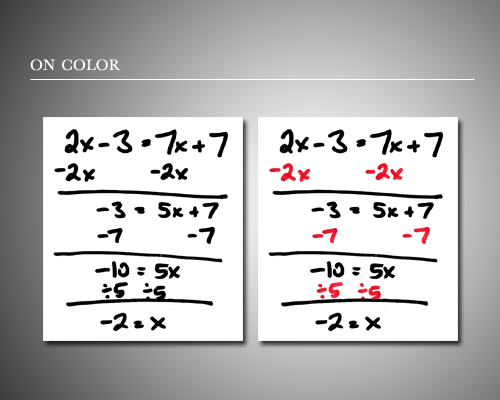
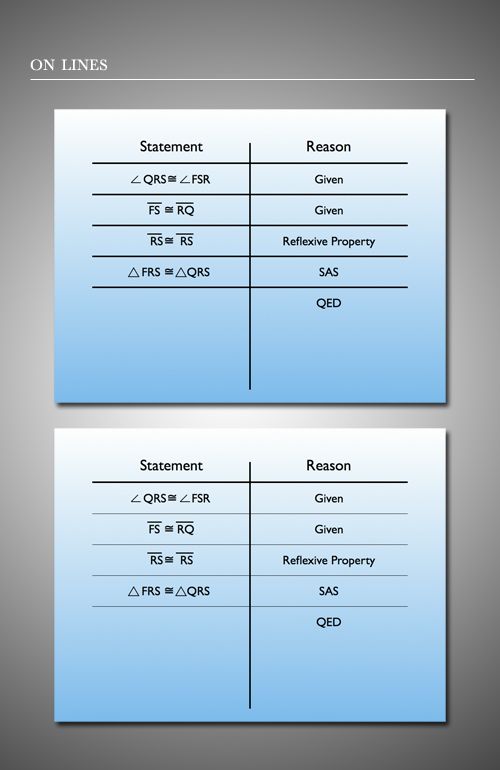
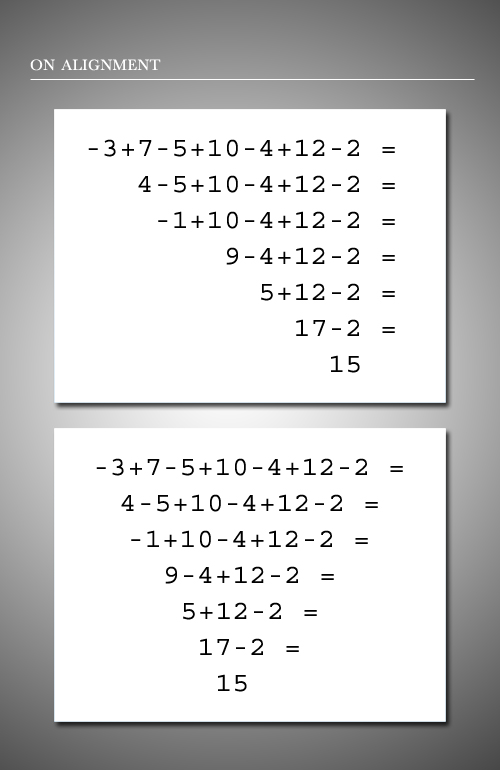
In trying to teach really difficult material – so, math, or any math-based science, I guess – the look of the material rivals the material itself for importance.
The weird thing I realized while breaking several traffic laws on the way to work this morning is that there are no large design decisions. Even when the look of the thing changes drastically – from one field to its inverse, for example – the decision was small, the action simple.
Which Is Clearer?
Why It Matters
This makes graphic design a defining aspect of my teaching philosophy, something indicative of the larger whole. My enthusiasm for design points at my belief that small decisions lead to exponential gains, that the sum of my small color, opacity, and alignment choices will lead to a huge net win for my kids, that the math will be exponentially clearer, that we’ll unwaste huge stores of time.
Video Is King
Therefore, if I had unlimited time and capital to create a curriculum, I’d use video, because with video, you make those incremental decisions thirty times every second. If those decisions are made carelessly, of course, the result will be utterly disastrous, turgid, limp, and boring –Â a medium unearned – as I’m sure you’ve witnessed. The inverse is also true, though, and that awareness is now taking me down some interesting paths.
Among other guiding principles for this Internet timesuck I call dy/dan, this has been the enduring hope: that if I’m as transparent as possible, as honest as possible, and if I upload as many supplemental materials as possible, then you and I can turn losses into wins.
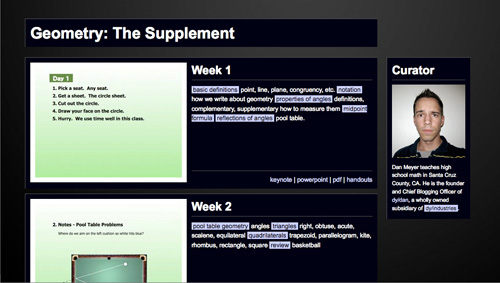
So yesterday I posted my entire Geometry curriculum online: geometry.mrmeyer.com.
The whole year. 1.94 gigabytes. Every lesson plan. Every handout. 2,144 slides – flavored in Keynote, PowerPoint, and PDF.
I hope you can use this or, at least, that you know someone who can use this, in which case, please pass it along.