a/k/a My Qualified Disaster
a/k/a The Trouble With Tech
previously on dy/dan
We started with four variables (text messages, beers per day, etc.) which we tracked for 2.5 months in quad-ruled notebooks attempting to transform the quotidian details of our lives into extraordinary infodesigns a lá Nicholas Felton.
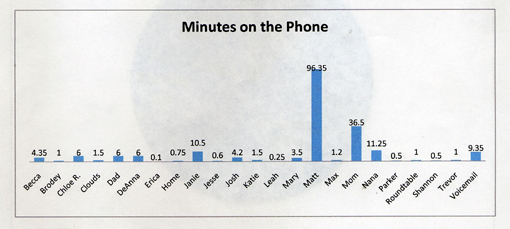
This was a departure for me. A tech-driven, student-led, design-infused mathematical project. Things went wrong.
This is a comprehensive autopsy of our Feltron Project. I post it here, in its entirety, a) for my own review next year, b) for your criticism. If you aren’t in the mood for the full, bone-by-bone dissection, please scan down to the section headed What Really Happened. These are problems I don’t know how to solve.
The Lesson Plan
a/k/a What Was Supposed To Happen
- We selected variables.
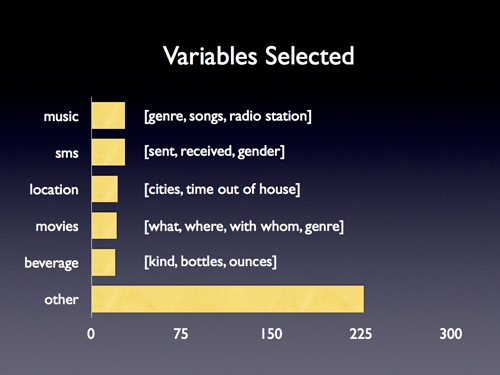
- We discussed them, making them more interesting (disaggregating “hugs per day” into “boy hugs” and “girl hugs”) and more manageable (tracking “fast food I eat” instead of “what I eat”).
- We tracked them for ten weeks, checking ourselves for consistency every two weeks, and then we stopped.
- We spent one hour marveling over Nicholas Felton’s annual report, dissecting it for meaning, identifying the mathematical operations (average, maximum, minimum, sum) and the mathematical forms (pie chart, line graph, histogram, stacked bar graph, map) he used.
- We spent six hours entering our data into Excel sheets.
- We spent two hours teaching and deriving ten facts of our lives using average, maximum, minimum, and sum functions in Excel.
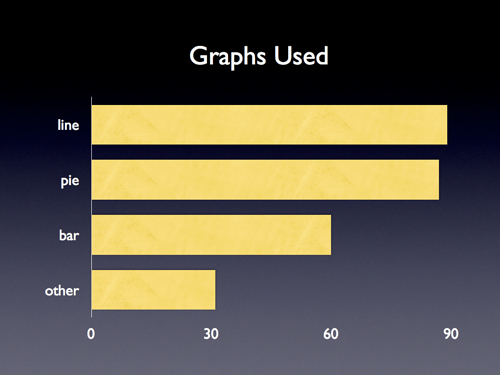
- We spent two hours teaching and deriving four graphs of our lives using pies, lines, and bars.
- Raw facts and graphs in hand, we spent thirty minutes discussing and distilling Felton’s graphic design savvy into the two principles I thought my freshmen could reproduce with crayons and paper if they had nothing else:
- colors, Felton uses a two-color design (shades of black, shades of blue) which, apart from distinguishing his hierarchy (titles in black, data in dark blue, accents in light blue, etc.) keeps down costs when designing for a large print run.
- grids, the kind your eyes can’t see but which your brain loves, the kind which imposes order on what would otherwise be a completely disordered data set, so while Felton jumps from music to movies to drinks you know where to find everything.
- We spent another two hours in class tying up loose ends in Excel and then a week designing our Feltron Projects.
What Really Happened
a/k/a Help.
- Only 55% of my students submitted the final Feltron Project
Controlling for age: 48% of freshmen and 63% of upperclassmen completed the project. . - Many of the other 45% stopped tracking early in the project, which meant assigning them review work, new work, or busy work while everyone else worked in Excel.
- Those who kept up with the project quickly staggered their progress (based on pre-existing computer ability, typing speed, and attendance) which saw me dashing between desks, explaining and re-explaining the same procedures over and over again.
- Our mobile computer lab a) comprised just fifteen laptops, and b) was available for check-out only once a week, c) if that.
- Kids lost work. I had them send their Excel files to themselves and then download the attachment the next day. Trouble was kids sent old files to themselves or they named files computer arsenic like “<<xxxx….davidsfeltronz!!!….xxxx.xls>>” which put both Excel and Gmail into simultaneous cardiac arrest
For the record, I originally sought GoogleDocs out for this project but they maxed out at something like fifty rows where we needed hundreds. . - I overestimated my students’ computer fluency. Name it: locating saved files, opening programs, using a trackpad, using modifier keys, sending e-mail. These tasks all required constant, patient re-explanation. Missed that mark by a country mile
There were exceptions, naturally, but Digital Immigrants™ outnumbered Natives™ at 15:1, many of which Natives one day, I have little doubt, will grow up to be edubloggers. . - None of them had used Excel before. Ever. Many didn’t have it at home. One triumph of this project – recognized by a lot of students – is that my kids are now somewhere in the top quintile of Excel users. This will doubtlessly prove useful again in their lives – not in the when-will-we-ever-use-this-in-real-life? sense, like they won’t be able to find food or shelter without Excel, just that it will open up a lot of interesting opportunities.
What Mattered
a/k/a Grading
- Faithful Tracking
- Interesting Findings
- Clear Design
Students ranked themselves on a ten-point scale across each index. Given how deeply we had immersed ourselves in exemplary work over two-and-a-half months, with only a few exceptions, I gave them exactly the grades they felt they deserved.
What I’ll Do Next Time
a/k/a If There Is A Next Time, Obviously
- Host screencasts online demonstrating essential Excel procedures
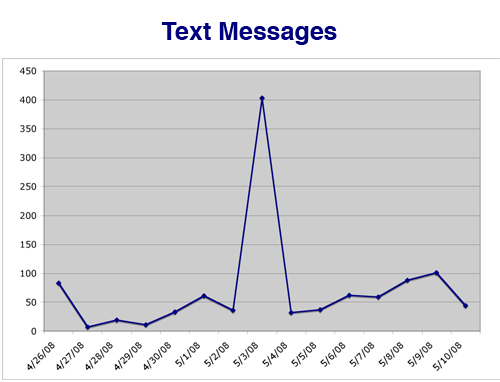
incl: sorting columns, using formulas (avg, min, max, sum, countif), saving/sending work, creating new sheets, filling down the date. . - Strengthen our analysis. A student’s text message graph plunged for a week when her parents confiscated her phone and spiked when she pulled a boyfriend in May. Students positively thrilled to see those connections but we didn’t build any of that analysis into the project grading. Should’ve.
- Employ a Kuropatwa-esque rubric to better inform kids what constitutes “clear design” or “faithful tracking.”
- Discuss design in greater depth, incl.
- showing them what my own Feltron would look like with rangy, mean grids or spasmodic colors;
- showing off the good and bad from this year’s class;
- comparing/constrating Khoi Vinh’s approach to grids and David Carson’s insane anti-grids;
- showing them Aesthetic Apparatus’ beautiful work in just three-or-fewer colors;
- compare 3D graphs alongside 2D hoping a lot of students will reconsider the choices they’ve made in life.
- Make a more obvious point of my own Feltron Project. Playing along with your students isn’t even optional here. I made sure I ran through the collection process with my students (for empathy, if nothing else) but I should’ve made a larger point of my own struggle and process.
- Find collaborators. This was insane. I should not have gone at this alone
Any takers? .
Students On Feltron
Just do a month.
–JG, smart; we’ll multiply a month by 12 to extrapolate for a year.
Everyone should track the same thing because it’d be really cool to see which people are like you.
–BP, also smart; resolved, then, that we’ll select three variables independently of the class and then select a common classroom variable for the fourth.
I like the chalang. It feels like I acopolished something hard and it made me feel good.
–BS, sic sic sic; whose mother, in an IEP meeting, said of his Feltron notebook, “He carries it everywhere.”
Felton On Feltron
Nicholas Felton consented to an e-mail interview on his process which will appear in this space tomorrow.
Gallery
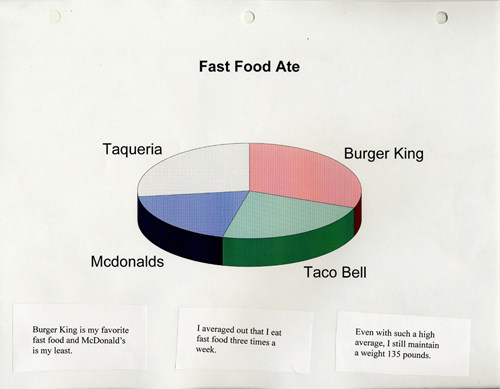
I have installed student work – everything from awful to exemplary, but mostly exemplary – into a Flickr set.
Handouts
- Feltron Project Outline
- Nicholas Felton Analysis Sheet
- Excel Chart Illustrations
- Excel Formula Sheet
- Map Infograph Template
- Final Review Sheet
To Conclude
This was a different, necessary kind of insanity for me to finish my fourth year teaching even a little eager for a fifth. The price tag was steep. To accommodate this time-sucking project-based learning, we skipped a third of our logic unit in Geometry and fully jettisoned last year’s Platonic Solids project.
If I weren’t already guzzling away at this barrel of standards-based Kool-Aid, I’d write something agitated and truly inexcusable here about curriculum narrowing or the time cost of NCLB, but I remain convinced we need to settle on a list of necessary skills and then decide horse-in-front-of-cart-style on the best tools and projects to teach them
There are twenty-four hours. No exceptions. I’m uncertain Feltron was the best use of our time.
I put Feltron to rest now, surely the weirdest assignment I’ve concocted in a four-year career. I post this here to solicit the usual gallery of critique and construction but also because, at some point in this whole blogging thing, I forgot how else to end a project if not with rigorous and public self-critique.