#5: Kids care less about context – “real world” problems – than they do about problems that start at the bottom of the ladder. “Real world” is a risky bet.
Real World
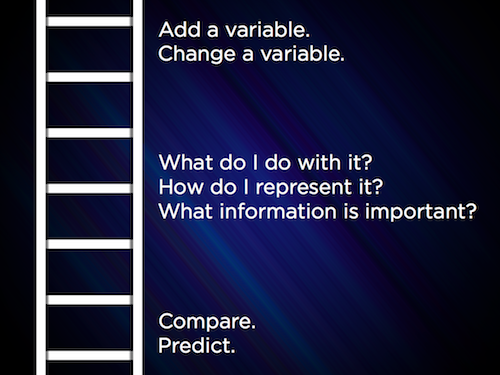
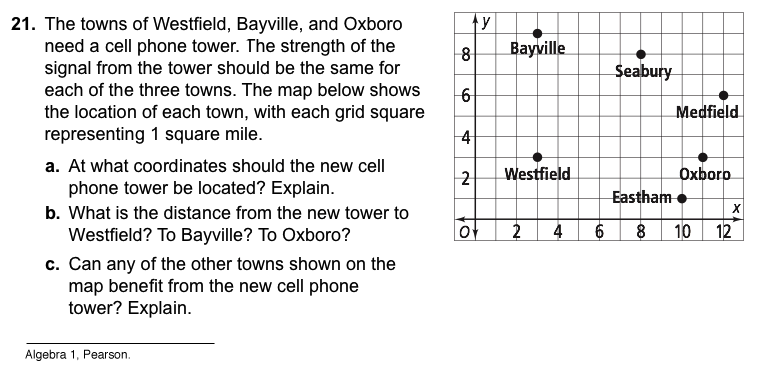
Here is a “real world” problem:
The caterers Ms. Smith wants for her wedding will cost $12 an adult for dinner and $8 a child. Ms. Smith’s dad would like to keep the dinner budget under $2,000. Ms. Smith would like to invite at least 150 guests to her wedding. How many children and adults can Ms. Smith invite to her wedding while staying within budget?
There is nothing to predict. Nothing to compare. The important information has already been abstracted. The question has been fully defined. The problem, as a whole, has been stretched tight and nailed to a board. The student’s only task is to represent the important information symbolically and then apply some operations to that representation.
And so hands go up around the room. The students attached to those hands say, “I don’t know where to start.” The task has hoisted them up to a middle rung on the ladder of abstraction and left their feet dangling in the air. Students are frustrated and disengaged in spite of the “realness” of the task.
Fake World
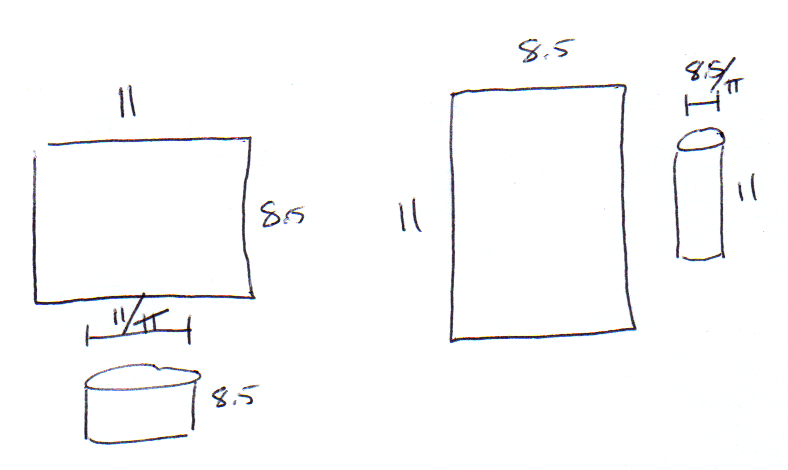
Meanwhile here is a “fake world” problem:
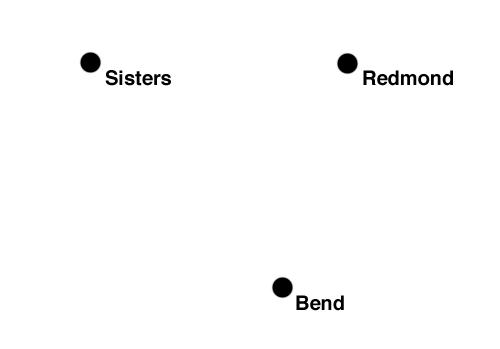
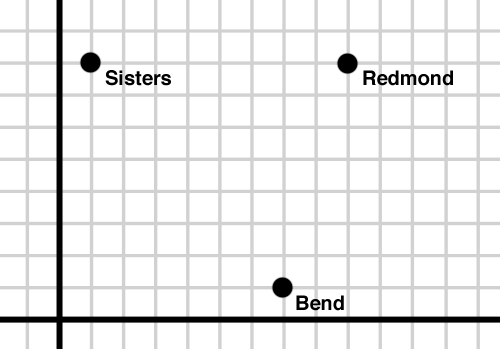
Here are questions you can ask at the bottom of that task’s ladder:
- What are the new percents? Write down a guess.
- Which quantities change?
- Which quantities stay the same?
- What names could we give to the quantities that are changing?
These questions include students in the process of abstraction. Each student guesses the new percents and is consequently a little more interested in an answer. Students aren’t just asked to accept someone else’s arbitrary abstraction [pdf] of the context. They get to make their own arbitrary abstraction of the context. (Why ABCD? Why not WXYZ?) All of these tasks prepare them to work at higher levels of abstraction later.
Solution
My preference is a combination of the two –Â a context that is real to students and a task that lets them participate in the abstraction of that context.
But I can’t tell you how many conversations I’ve had with teachers (veteran and new) and publishers (big and small) who tell me the fix for material that students don’t like is to drape some kind of context around the same tasks. Rather than expanding and enriching their tasks to include the entire ladder of abstraction, they insert iPads or basketballs or Justin Bieber or whatever they perceive interests students.
Real-world math is a risky bet. Bet on the bottom of the ladder. Here are some of those bets:
- With the wedding task above, the teacher can ask students to pick any combination of children and adults they think will work. Any combination. 100 kids and 50 adults? Fine. Now tell me how much it costs. We’re all invested for a moment in a problem of our own choosing. Then we assemble student work side-by-side and notice that we’re all doing the same kind of calculations. Then we say, “All your work looks the same. What’s happening every time?” The students are participating in the symbolic abstraction.
- Louise Wilson is using the images and videos on 101questions to give students practice just asking questions about a context. Asking questions is the assignment. Getting answers isn’t.
- Andrew Stadel is giving his students daily practice with estimation, another task at the bottom of the ladder.
We ask our students to work most often at the top of the ladder and the result is a pervasive impression that a successful math student is a student who can memorize formulas and implement them quickly and correctly. Those are, of course, great and useful skills, but mathematicians also prize the ability to ask good questions, make good estimations, and create strong abstractions. These are skills where other students may excel. There is unrewarded excellence in our math classrooms because we have defined excellence narrowly as being good at abstract skills. You can only find (and then reward) that excellence by betting on the bottom of the ladder of abstraction.