My response one year ago to a commenter who said I was always recommending that math teachers apologize for the abstractness of math:
Abstraction doesn’t make math harder. Abstraction makes math possible.
S.I. Hayakawa, 71 years earlier, in Language in Thought and Action:
The invention of a new abstraction is a great step forward, since it makes discussion possible …
So that’s interesting.
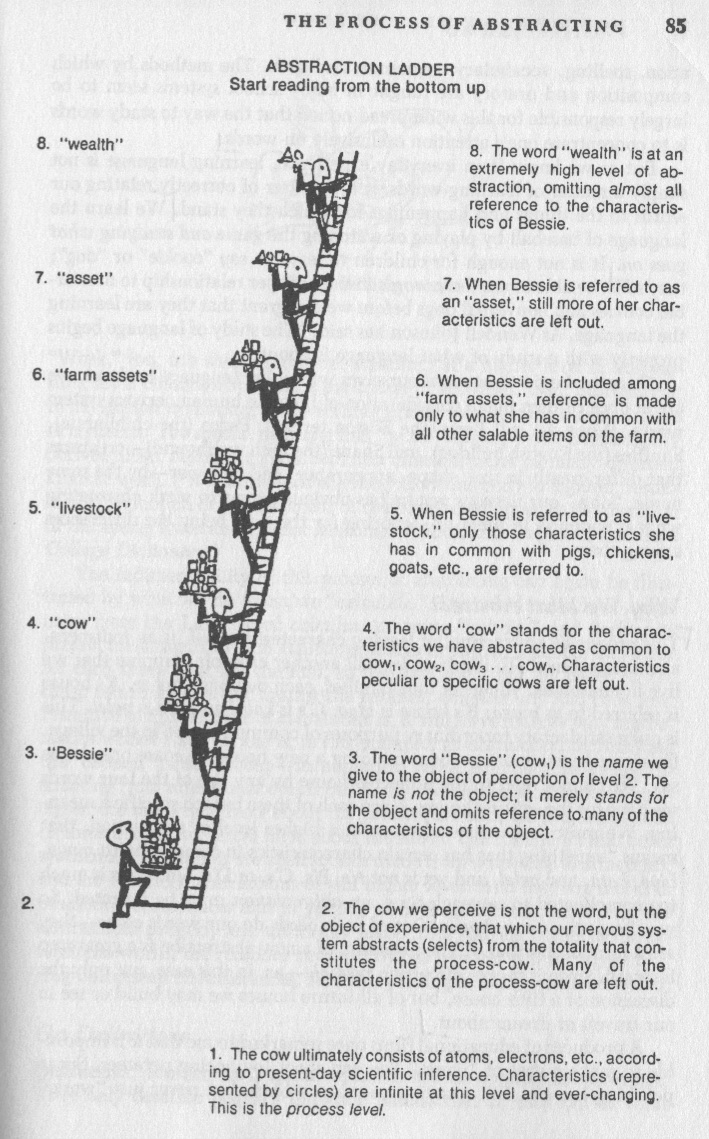
Here is a scan of the eighth chapter of Hayakawa, called “How We Know What We Know.” If this series ever turns into a dissertation proposal, odds are extremely high I’ll pull in one or more of the following excerpts:
Our concern here with the process of abstracting may seem strange, since the study of language is all too often restricted to matters of pronunciation, spelling, vocabulary, grammar and such. The methods by which composition and oratory are taught in many schools seems to be largely responsible for this widespread notion that the way to study words is to concentrate one’s attention exclusively on words.
Is it useful to draw a line from that excerpt to school mathematics instruction? Swap “pronunciation, spelling, vocabulary, grammar, and such” for “calculation and symbolic manipulation.”
We learn the language of baseball by playing or watching the game and studying what goes on.
I’m drawing a line to this post.
This process of abstracting, of leaving characteristics out, is an indispensable convenience.
As many commenters in the last installment pointed out, “abstract” is both a verb and an adjective, though it’s usually the adjective that people complain about. My working theory is that if we help students manage the verb better, the adjective will seem less threatening.
Hayakawa notes that the word calculate derives from the Latin word calculus which means “pebble.” Sheepherders would put a pebble in a box for each sheep that left the fold.
Each pebble is, in this example, an abstraction representing the “oneness” of each sheep –Â its numerical value.
Hayakawa gets explicit about mathematical abstraction:
Our x’s and y’s and other mathematical symbols are abstractions made from numerical abstractions, and are therefore abstractions of still higher level. And they are useful in predicting occurrences and in getting work done because, since they are abstractions properly and uniformly made from starting points in the extensional world, the relations revealed by the symbols will be, again barring unforeseen circumstances, relations existing in the extensional world.
… and the metaphor of the ladder:
The fundamental purpose of the abstraction ladder, as shown both in this chapter and the next, is to make us aware of the process of abstracting.
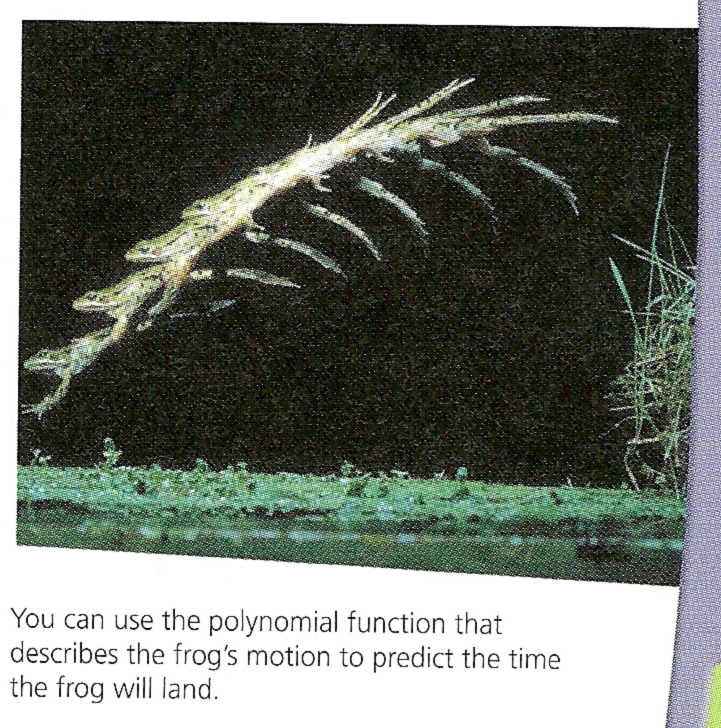
So here is another tentative thesis: secondary math instructors are generally less aware of the process of abstracting than their colleagues at younger grades. Students at the secondary level are generally assumed to be comfortable with mathematical abstraction so their teachers spend a great deal of time at higher rungs of the ladder. Secondary math curricula also tends to disregard lower rungs on the ladder, instead pointing weakly at concrete representations of other things. (eg. “Here’s a frog. You can use the polynomial function that describes the frog’s motion to predict the time the frog will land. Got that? Okay, now let’s do some work with polynomials.”)
But as the abstraction ladder has shown, all we know are abstractions. What you know about the chair you are sitting in is an abstraction from the totality of the chair. [..] The test of abstractions then is not whether they are “high-level” or “low-level” abstractions, but whether they are referable to lower levels.
Everything is abstract. Everything is more abstract than something lower on its ladder and less abstract than something higher on its ladder. The chair you’re sitting in is not concrete.
Hayakawa quotes Wendell Johnson who coined the term “dead-level abstracting,” a term which is so useful it’d get an entry in the official lexicon of this blog if this blog had an official lexicon:
Some people, it appears, remain more or less permanently stuck at certain levels of the abstraction ladder, some on the lower levels, some on the very high levels.
See earlier reference to secondary math instructors.
It is obvious, then, that interesting speech and writing, as well as clear thinking and psychological well-being, require the constant interplay of higher-level and lower-level abstractions, and the constant interplay of the verbal levels with the nonverbal (“object”) levels. [..] The work of good novelists and poets also represents this constant interplay between higher and lower levels of abstraction. [..] The interesting writer, the informative speaker, the accurate thinker, and the sane individual operate on all levels of the abstraction ladder, moving quickly and gracefully and in orderly fashion from higher to lower, from lower to higher, with minds as lithe and deft and beautiful as monkeys in a tree.
He would have helped me out a bunch if he had inserted “math teachers” between “novelists” and “poets,” or at least given us a spot in the tree next to the monkeys.
2012 Jul 25: My favorite author came to mind just now. In Shipping Out [pdf] David Foster Wallace abstracts over all the micromanaged comforts of a luxury cruise and finds existential despair at the top of the ladder. He does an excellent job shimmying up the ladder from ground-level to the stratosphere and back down again, sometimes within the same paragraph and all while keeping the reader along for the ride.
Featured Comments
When my students complain that I’m smarter than them, I counter that I’m just at a higher level of misunderstanding.
I didn’t really learn to understand abstract-as-a-verb until I got it from the computer programming folks, via the How to Design Programs book (free at http://htdp.org if you’re interested). That process is one of the few times in my adult life when I felt like studying one thing made me significantly smarter.