This is somewhere in the neighborhood of What Can You Do With This? except I have no idea what to do with it.
Reaching a beach in Trinidad, [Jennifer Figge] became the first woman on record to swim across the Atlantic Ocean – a dream she’d had since the early 1960s, when a stormy trans-Atlantic flight got her thinking she could don a life vest and swim the rest of the way if needed. – Associated Press, 2009 February 8
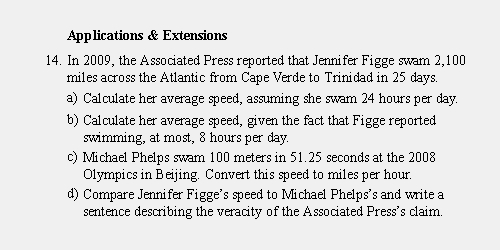
Figge swam 2,100 miles from Cape Verde to Trinidad in 25 days, sleeping nights on a catamaran that drifted alongside her.
Sort of. Outside Magazine has printed a retraction.
I know this is worth our class time because a) the situation is objectively interesting, and b) the situation is inherently mathematical. I don’t know how to maximize its interest to my class or how to make the mathematics as rigorous as possible.
Here is a hazy look at how I plan this sort of activity. Please step in at any point to save me from myself.
-
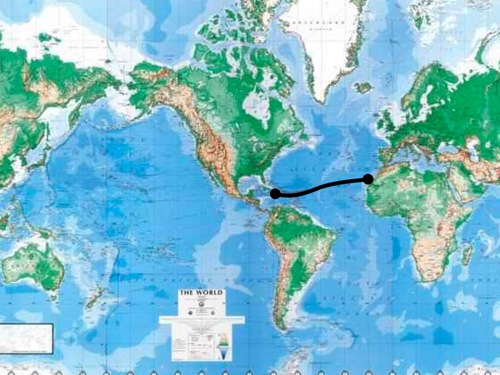
I’ll tell them that a woman has claimed a distance swimming record. I’ll ask them to guess which body of water she crossed. I will project a world map on the wall. Somebody will eventually suggest the Atlantic, a suggestion which other students will shout down as impossible, at which point I’ll confirm it.
-
I’ll ask them what route they would choose across the Atlantic. Each of my students is a pretty quick study in contract law and will find the loophole or shortcut if one exists. I’m not sure how many of them will find Figge’s exact shortcut, however, which had her swimming between two of the closest islands on opposite sides of the Atlantic. I’ll pass out world maps on paper so that the students can draw on themduhn duhn DUHN..
-
I’ll ask them how long they think it took Figge to cross the Atlantic. At this point I’m positive they’ll ask the right questions (how long was she swimming each day? was she swimming all day, every day?) at which point I’ll quote the relevant passages from the AP report. (She swam, at most, eight hours in a day.) I will give the distance between the islands only when they request it.
-
I’ll challenge their guesses. “I don’t think a human can swim that fast.” They will either have to defend their answers or alter them.
-
We’ll sample some data points for comparison – Michael Phelps’s 100m gold medal at the Beijing Olympics (4.4 miles per hour); Petar Stoychev’s record-setting swim across the English Channel in 2007 (3.02 miles per hour); then there’s Figge’s presumptive trip the Atlantic (10.5 miles per hour).
Again, we lower the mathematical framework onto this situation slowly, only as the kids give me the nod to bring it closer, only as they invest themselves into the problem in small ways like guessing the route or the duration of the trip. Bonus exercise: imagine how efficiently your textbook publisher would crush the life out of this problem.
I’m running out of ways to illustrate my frustration with curriculum design’s status quo. Time to get the jihad going, I guess.