Category: tech contrarianism

Total 133 Posts

Udacity Talks A Huge Game

Sebastian Thrun:

I just want to congratulate you. You’ve actually in these three classes learned pretty much as much as any of my Stanford students learn in my specialized AI classes on robotics when it comes to robot perception. In fact, you’ve learned pretty much what there is to know when it comes to being a successful practitioner in robotics.

I have no way of evaluating the truth of those claims, but the numbers beggar belief. If Thrun has managed to do in three weeks what previously took him ten in Stanford’s classrooms, that raises a few possibilities:

  1. Thrun wasted a lot of time in his Stanford classrooms.
  2. Thrun covered the same quantity of material in his Stanford classrooms but the quality of that coverage declined.
  3. Thrun is exaggerating.

My bet is some combination of two and three. It’s just awfully hard to get anything for nothing, and transferring lectures from the classroom to the Internet doesn’t buy much time.

2012 Sep 10. A blogger writes about the Udacity statistics course:

As if the content-based problems noted above weren’t enough, running throughout Thrun’s presentations is a routine, suspiciously hard-sell call for how stellar the class was and how much you, the viewer, have learned.

Vi Hart v. Sal Khan

Timon Piccini mashes up one of Sal Khan’s lectures with one of Vi Hart’s indictments of lectures and the result is difficult to watch:

Of course, Khan went on to hire Hart, a partnership which could be yielding all kinds of fruit. If anybody has noticed Khan innovating on his format since he picked up Hart, drop me a line in the comments.

Featured Comment

Mr. Bombastic:

The KA lectures may or may not be effective in helping people with math, depending on your idea of โ€œhelpingโ€. The KA problem sets are almost certainly going to give many students the impression that they know and understand something that they do not. Naive teachers may be taken for a walk along this primrose path as well. For that reason I think the problem sets could be quite destructive. I donโ€™t object to checking for mastery, but KA doesnโ€™t even come close to having assessments that measure mastery.

2012 Mar 24. James C. points out this collaboration.

I Would Have Loved Khan Academy In Eighth Grade

Not to make my my position overly complicated, but I would have loved Khan Academy as an eighth grader, when I was first learning algebra.

My twin sister and I were homeschooled up until ninth grade when the difficulty of math outstripped my mom’s ability to teach it to us. So we ordered a stack of VHS tapes featuring Leonard Firebaugh and his whiteboard. I can’t believe I’ve never connected his videos to Khan Academy until now.

Those videos were boring but I was grateful for them because the alternative was nothing. So let me say that I completely understand the enthusiasm you’ll find from homeschool parents in the comment threads of any given report on Khan Academy. (The religious homeschoolers offer Khan their prayers in addition to their thanks, and I understand that too.) When Mark Halberstadt thanks Khan for helping him clear hurdles to study electrical engineering at Temple, I don’t have anything in me except gratitude for the fact that something existed for Halberstadt where once there was very little.

I was grateful for Leonard Firebaugh because the alternative was nothing. But better than nothing and better than Leonard Firebaugh were the classrooms of Messrs. Selim, Cavendar, Bishop, and Whipkey, where we did math more than any one person talked about it, where I had to unlearn and relearn a lot of Algebra I thought I had mastered. You couldn’t combine the two. You couldn’t pause the doing of mathematics and then turn us over to watching someone else do mathematics for upwards of ten to twenty minutes. It would have been a collision of two hostile worlds.

Sal Khan On 60 Minutes

Sanjay Gupta, introducing Khan Academy:

Take a moment and remember your favorite teacher. Now imagine that teacher could reach, not thirty kids in a classroom, but millions of students all over the world. That’s exactly what Sal Khan is doing on his website Khan Academy.

If your favorite teacher did anything other than lecture for 10-20 minutes continuously, though, Khan Academy may seem like several steps in a different direction.

Students Don’t Like The Videos

60 Minutes reported the quantity of videos Khan has produced and the time and effort it took to make them. It didn’t report the efforts some students take to avoid watching them. Here’s a white paper from Stanford’s d.school:

We were surprised to find that students preferred to teach themselves or each other through the practice problems and hints rather than watching the Khan videos.

My own classroom observations confirm theirs and a Khan Academy employee confirmed both: kids watch videos as a last resort after exhausting other efforts, some of which don’t look much like “learning.”

Pivoting From The Flipped Classroom

That is a critical design challenge for Khan and his team as they put distance between themselves and the “flipped classroom” model he promoted in his TED talk a year ago.

Then:

And the teachers would write, saying, “We’ve used your videos to flip the classroom. You’ve given the lectures, so now what we do … ” โ€“ and this could happen in every classroom in America tomorrow โ€“ ” … what I do is I assign the lectures for homework, and what used to be homework, I now have the students doing in the classroom.”

Last night:

I kind of view [the flipped classroom] as a step in the direction. The ideal direction is using something like Khan Academy for every student to work at their own pace to master concepts before moving on and then the teacher using Khan Academy as a tool so that you can have a room of 20 or 30 kids all working on different things but you can still kind of administrate that chaos.

This is a enormous expansion of the Khan Academy vision. No longer is the message, “Do the basic skills with Khan Academy outside the classroom to free up time for projects and higher-order thinking inside the classroom.” That message raised a lot of interesting questions which are now moot. (eg. “Why are video lectures the best way to learn basic skills? Why are we separating basic skills and higher-order thinking? Who decides which is which?”) Now Khan Academy is the classroom. Kids come into class, sit in front of a laptop, put on headphones, and pick up where they left off from the last class. The teacher monitors the class dashboard and offers coaching when necessary. If you think I’m extrapolating too much from Khan’s remarks, the same Khan Academy employee confirmed that vision to my Stanford team a few months ago.

We could argue whether or not that kind of future for our math classrooms is depressing and dystopian but all available evidence indicates that kids won’t put up with it. I’m curious what changes, if any, Khan will make in response to the evidence that kids don’t like watching his videos.

BTW: The strangest editing decision CBS made last night.

BTW: Edtech Hulk has the vibe surrounding Khan Academy and the just-announced TED-Ed exactly right.

2011 Mar 13. Sue Van Hattum e-mailed to suggest that the middling student reception to his videos explains Sal Khan’s hiring of Vi Hart and Brit Cruise, both of whom do good work with video. I think that’s plausible.

2011 Mar 14. I Would Have Loved Khan Academy In Eighth Grade.

2011 Mar 14. Welcome, EdSurge readers. Let me point out that EdSurge rebuts [amended below] the d.school’s report that kids make efforts to avoid watching Khan’s videos (confirmed by a Khan employee and my own observation) with no stronger evidence than a) an iPad app released by Khan Academy this week and b) a Gates Foundation op-ed. We’re all playing on Team Student Learning here. It does nobody any good to paper over bad news. Let’s figure out the nut of the problem and fix it. Take it as a design challenge for EdSurge’s design-minded readership.

2011 Mar 14. I misinterpreted EdSurge as rebutting my case. According to their editor, that wasn’t their intent. Here is the item in its entirety:

THE FUTURE OF EDUCATION: That’s how CBS 60 Minutes–like so many others–billed the Khan Academy in its feature of Salman Khan last weekend. Such great PR has Dan Meyers on his feet, pointing to studies that say students don’t actually like watching Khan videos. Dan also notices a discourse shift from emphasis on flipped classrooms to a model where the Academy is the classroom. His take: “all available evidence indicates that kids won’t put up with it.” Khan clearly feels otherwise, particularly as it is now offering a collection of ipad apps. A cogent argument in favor of blended learning is set forth by Stacey Childress of the Gates Foundation in the Harvard Business Review. It’s among the most read pieces in the issue. Full disclosure: EdSurge has received support from the Gates Foundation for our beta website.

It’s Called iBooks Author, Not iMathTextbooks Author, And The Trouble That Results

When we parted, I described the depressing character of the McGraw-Hill Algebra iBook. Since then, I’ve had a chance to review Pearson’s offering in the same category and, in every way that interests me today, it’s every bit McGraw-Hill’s equal. (In a blind taste test, the only way to tell Pearson from McGraw-Hill is that Pearson includes more embedded multiple-choice quizzes and fewer videos.)

My question, again: what could have been done here? Were the publishers’ ambitions stifled by Apple’s iBook Author tool, which couldn’t accommodate the vast scope of their designs? Or did the publishers lack ambition, and we’re still waiting for a band of enterprising math education bloggers to quit yapping about how awful everything is and release their own curricula with iBooks Author?

Unsatisfyingly, the answer is “a little bit of both.”

Let’s set aside some of our perennial complaints about math curricula. Yes, they are prone to all kinds of mathematical errors. They pander to kids with snowboarders and breakdancers and whatever else a middle-aged publishing executive thinks kids think are cool. They are written by committees who may never meet, who consequently lack any organizing principles to ensure that the goals of one chapter adhere to those of the next.

We could fix all of those problems in a print product. The problems that are most intriguing to me to me are the ones that are endemic to the print medium. Those are the problems that a digital platform like iBooks Author should help us solve. Here’s a monster:

Textbooks rush to the highest level of abstraction on a context as quickly as possible.

That isn’t a statement about the balance of pure math and applied math in our curricula. Both kinds of problems require abstraction. I’m saying that print products spend very little time letting students decide what features of a pure or applied context are fundamental and which are forgettable. I illustrated this process for applied math last week but the same is true of pure math:

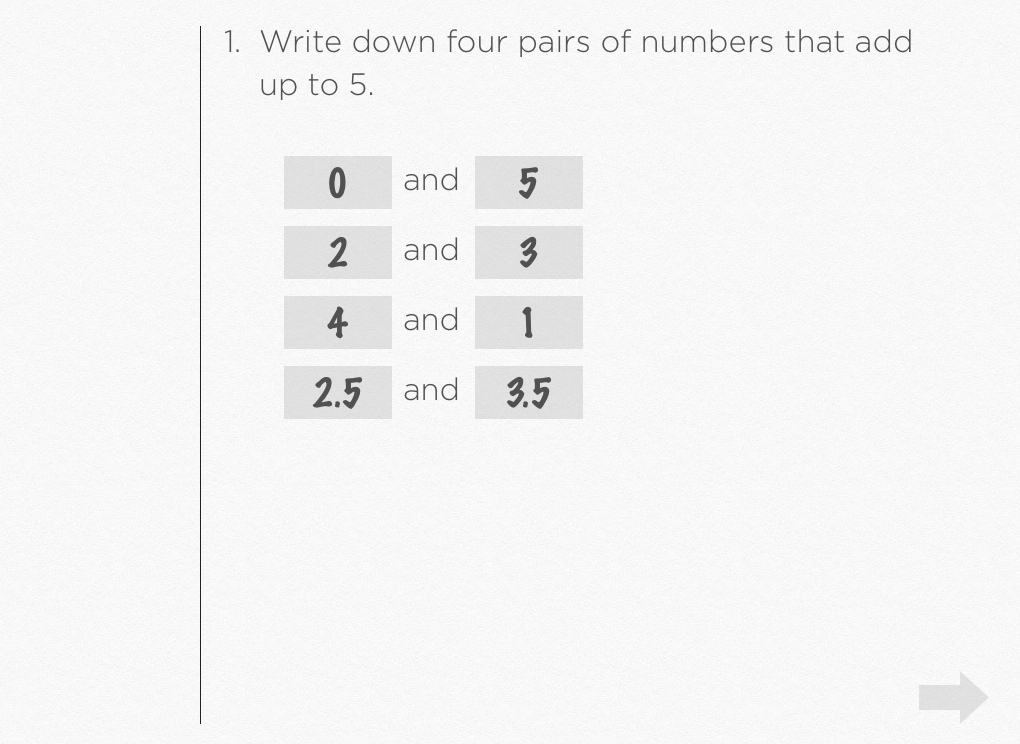
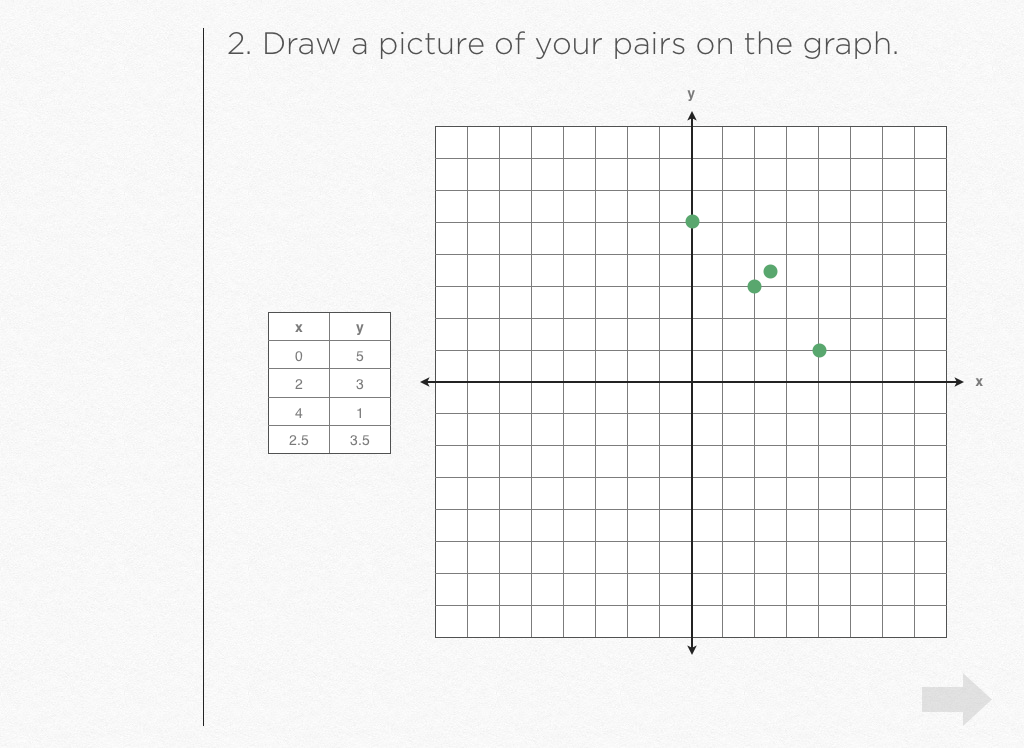
Tell me two numbers that add up to five. Now find me three more pairs of numbers that add up to five. How could we draw a picture of those pairs of numbers? What would that graph look like? Would the points be scattered around randomly? Would there be a pattern?

Print products don’t let our students participate in that abstraction. They just do it. They define x + y = 5 and they describe its graph. They have to, really. The textbook serves a useful purpose as a reference text. At some point, it must define the vertex form of a parabola. It must describe the graphs of equations in standard form. It isn’t enough that the all of those formulas live online in different places. Internal coherence matters.

But textbooks also want to be instructional materials. They want to set up activities and ask questions that help students learn the vertex form of a parabola and learn how to graph equations in standard form.

Those two goals โ€“ the goals of a reference text and the goals of instructional materials โ€“ cut across each other. On one page you have the textbook asking you interesting questions about shadows and similar triangles. On the opposing page, it fully answers those questions and explains how to apply similar triangles to shadows. It’s like watching a suspenseful movie on one half of the screen while the ending loops over and over again on the other half.

It’s an enormous problem. It makes math too simple for some students by doing important work for them. It makes math too intimidating for others, by introducing math in its most abstract form. That enormous problem results of the limitations of the printed page. Paper is expensive and heavy so you have to make the most of it.

iBooks Author goes some distance to help us fix that problem, to resolve the tension between the textbook as a reference text and the textbook as instructional materials but the publishers either didn’t have the same sense that this was a problem or they sensed the problem and were uninterested in solving it. You can add a new page to your textbook in iBooks Author at the cost of zero dollars. Another page in iBooks Author adds zero pounds to your student’s backpack. The publishers could have afforded to let those problems unfold and breathe, but they didn’t want to or didn’t know how.

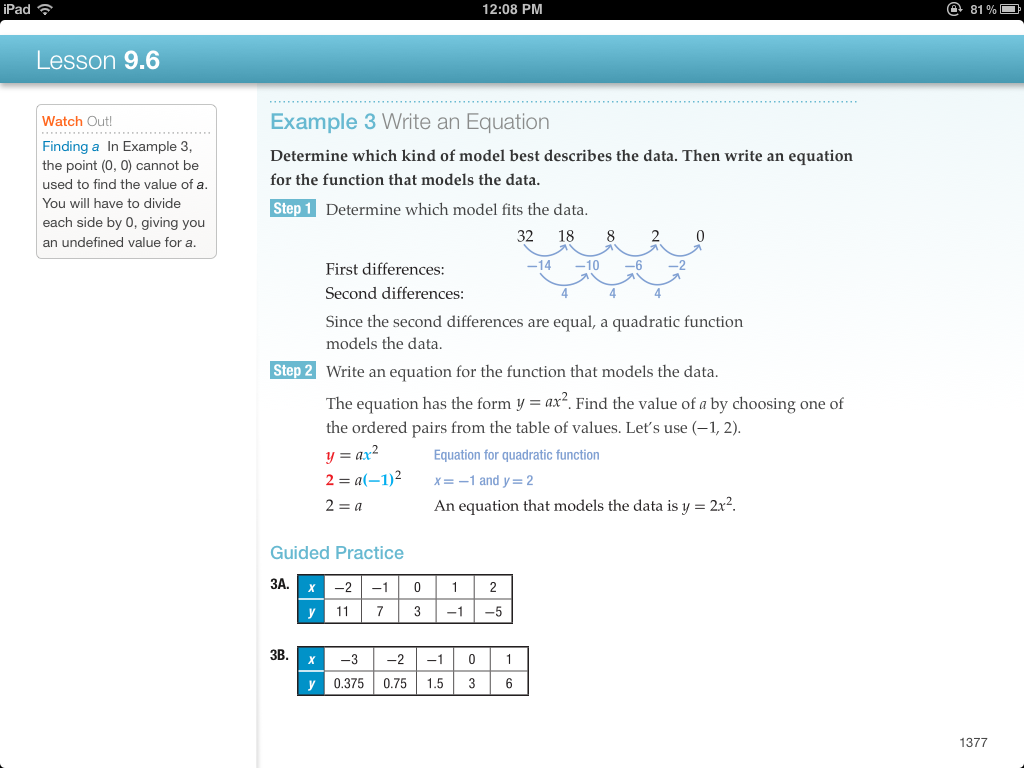
Watch how easy this is. Start with this problem from McGraw-Hill:

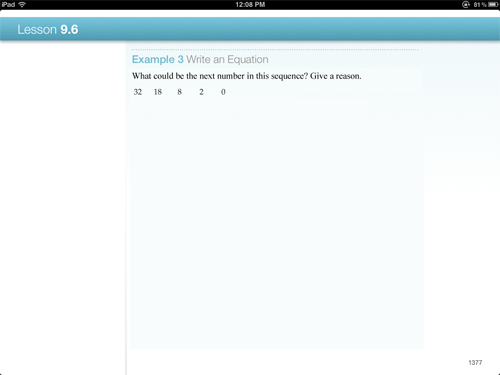
It’s abstracting the problem right in front of students, finding the first and second order differences. Put all of that on the next page. Start this problem with the sequence 32, 18, 8, 2, 0, and ask them:

What could be the next number in this sequence? Give a reason.

Students get the opportunity to look at the numbers and notice that they’re decreasing and then notice that the decreases are decreasing. You have the same high ceiling for exiting this problem. It’s on the next page. But you’ve lowered the barrier to entry for several more students and given everybody the chance to develop some number sense.

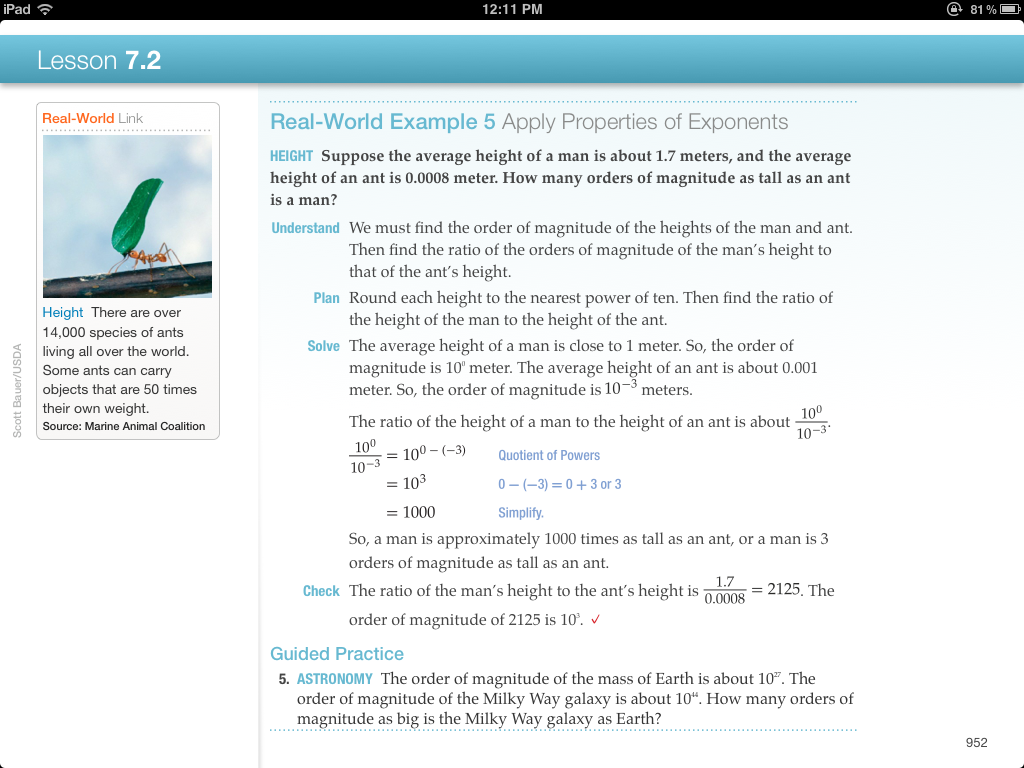
And that was pure math. Applied math is even easier:

Push all that abstraction onto the next page. Start here:

Suppose the average height of a man is about 1.7 meters, and the average height of an ant is 0.0008 meter. What are different ways we can compare their two heights?

Let me invent a few student solutions:

  • The man is a lot taller than the ant.
  • The man is 1.6992 meters taller than the ant.
  • The man is 2,125 times taller than the ant.
  • The man is three orders of magnitudes taller than the ant.

Part of the process of abstraction is to decide what makes some of those responses more useful than others? Students need to see that the first isn’t precise enough; the second doesn’t indicate the relative difference between the man and the ant (ie. the ant could be 10 meters tall, provided the man is 11.6992 meters tall); the third, under some circumstances, is more precise than you need (ie. the relative size of planets); and the fourth, under other circumstances, is just right.

Again, we’ll get to the reference material on the next page. But the only reason for including the reference material on the same page as the instructional material is to accommodate the cost and weight of paper and ink, all of which are totally irrelevant to the production of an iBook.

In that respect, iBooks Author solves a huge problem, but it doesn’t solve it well enough to be worth my while to develop for it. The best textbook I could design with iBooks Author is still one that I’d have to modify heavily for use in the classroom.

Here is the kind of page you can design in iBooks Author (jumping off our recent discussion):

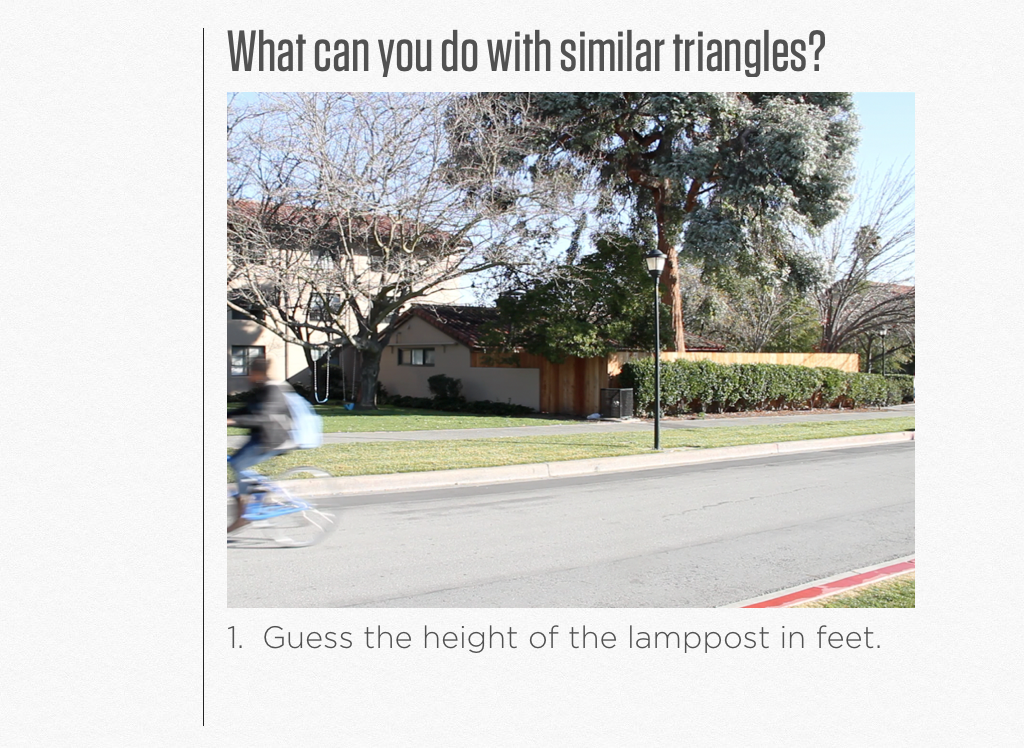
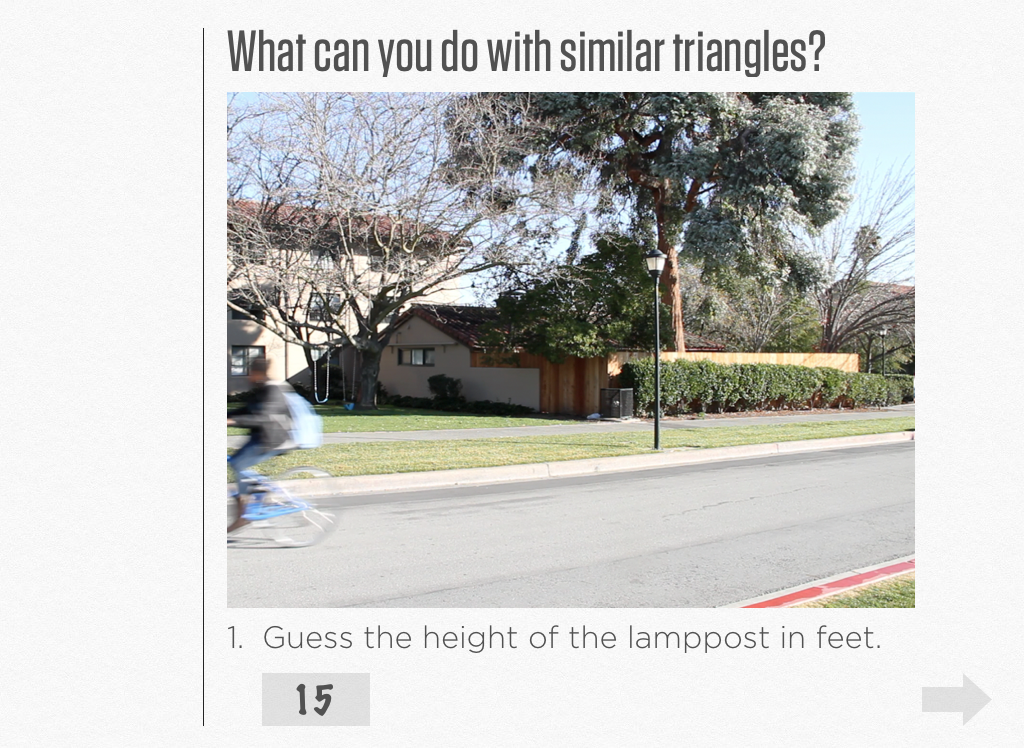
But here’s the kind of page I need:

You see the difference? I’m not just asking the question to engage students. I need to know what they think. I need to know if they even have the first, most concrete clue about the height of lampposts. It’s curious that even though students own their iBooks forever (ie. they can’t resell them or give them away), they can’t write in them except in the most cursory ways.

Even curiouser, these iBooks could all be wired to the Internet and wired to a classroom through iTunes U, but they’d still be invisible to each other. Your work on your iPad cannot benefit me on mine.

Check out how awesome that could be:

Again: low barrier to entry. The student’s answers from the last screen prepopulate the table in the next.

The student might sense that one of those points was incorrectly chosen and check her work. Or maybe the student wasn’t expecting any kind of pattern to emerge so she’s nonplussed by the haphazard, non-linear arrangement of her points.

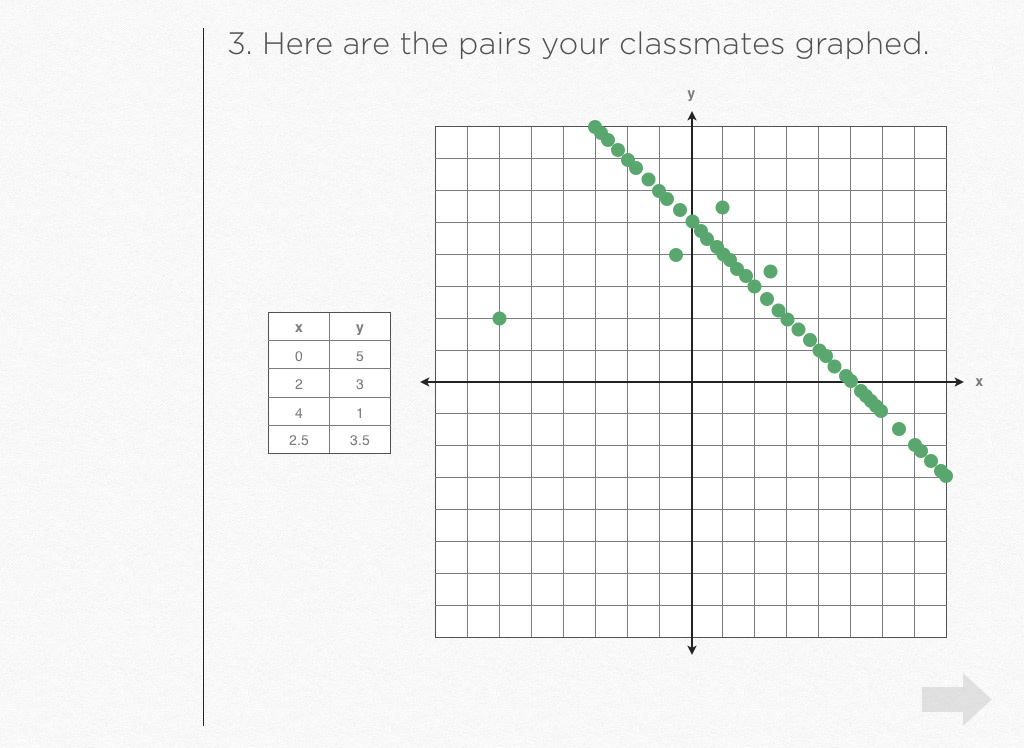
So then we pull in every point chosen by every student in the class and we finish the abstraction, examining points that deviate from the pattern, assigning variables to the pattern, giving the pattern a name, then creating and identifying other similar patterns.

Print textbooks are powerless to facilitate that moment right there. Teachers can’t facilitate it, not at anywhere near the speed and ease I’m suggesting. iBooks Author can’t facilitate it either, but if it could โ€“ if it had some kind of “Q&A” widget that lived alongside its other widgets and basically copied all the options from Google Forms โ€“ I’d find the platform difficult to resist.

But iBooks Author doesn’t exist for the pleasure of math education publishers or even education publishers. “This is about Apple versus Amazon for who will sell digital literature in the future,” says Audrey Watters. “This isn’t really about textbooks.”

iBooks Author serves publishers, period. It’ll help you publish your Firefly fan fiction, your autobiography, or your Nana’s recipe collection. It’s extremely useful, broadly speaking, which inevitably means that, narrowly speaking to math education publishers, it’s much less useful.