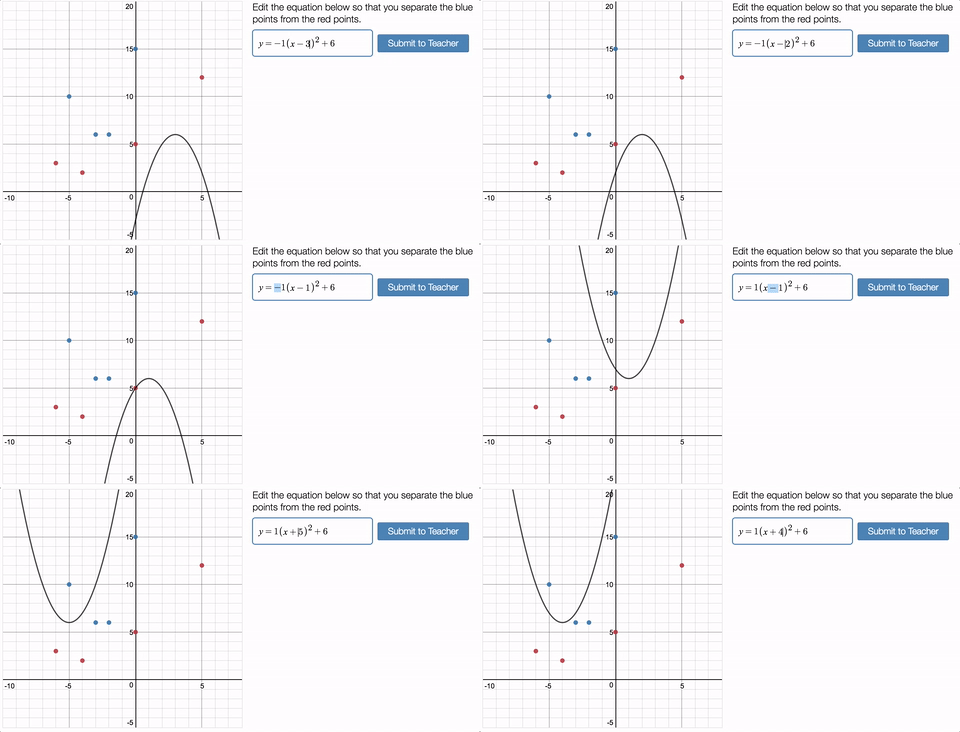
Chris Lusto calls for a GitHub for lesson plans:
To say that the community repository model has done wonders for open source software is a massive understatement. To what extent that success translates to curriculum I’m obviously unsure, but I have randomly-ordered reasons to suspect it’s appreciable.
I attended EdFoo earlier this year, an education conference at Google’s campus attended by lots of technologists. Speakers posed problems about education in their sessions and the solutions were often techno-utopian, or techno-optimistic at the very least.
One speaker wondered why teachers spend massive amounts of time creating lessons plans that don’t differ all that much from plans developed by another teacher several states away or several doors down the hall. Why don’t they just build it once, share it, and let the community modify it? Why isn’t there a GitHub for lesson plans?
I’m not here to say that’s a bad idea in theory, just to say that the idea very clearly hasn’t caught on in practice.
Exhibit A: BetterLesson, which pivoted from its original community lesson repository model to a lesson repository stocked by master teachers and now to professional development. (Its lesson repository is currently a blink-and-you’ll-miss-it link in the footer of their homepage.) The idea has failed to catch on with secondary educators to such a degree that it’s worth asking them why they don’t seem to want it.
Our room at EdFoo was notably absent of practicing secondary teachers so I went on Twitter to ask a few thousand of them, “Why don’t you use lesson download sites?” (I asked the same question two years ago as well.) Here are helpful responses from actual, really real current and former secondary teachers:
Nancy Mangum:
Using someone else’s lesson plan is like wearing a friend’s underwear. It may do the job but ultimately doesn’t fit quite right.
Jonathan Claydon:
Their wheels aren’t the right size for my car.
Justin Reich:
Linux works because code compiles. Syllabi don’t compile. If I add a block/lesson, I never know who it helps.
Bob Lochel:
I don’t require a script, just decent ideas now and then.
Grace Chen:
I’m not sure they solve for the problems they think they’re trying to solve. It takes time to read / internalize / modify others’ plans.
David Wees:
It’s challenging to sequence, connect, plan, and enact someone else’s lesson.
Mark Pettyjohn:
The plan itself is the least important element. The planning is what’s critical.
2016 Jun 11. Dwight Eisenhower:
In preparing for battle I have always found that plans are useless, but planning is indispensable.
In sum: “Small differences between lessons plans are enormously important, enormously time-consuming to account for and fix, and whatever I already have is probably good enough.” It turns out that even if two lesson plans don’t differ all that much they already differ too much.
Any lesson sharing site will have to account for that belief before it can offer teachers even a fraction of GitHub’s value to programmers.
2016 Jun 8. Check out Bob Lochel’s tweet above and Julie Reulbach’s tweet below. Both express a particular sentiment that the nuts and bolts of a lesson plan are less important than the chassis. (I don’t know a thing about cars.)
I was chatting with EdSurge’s Betsy Corcoran about that idea at EdFoo and she likened it to “the head” in jazz music. (I don’t know a thing about jazz music.) The head contains crucial information about a piece of music —Â the key, the tempo, the chord changes. Jazz musicians memorize the head but they’ll build and develop the performance off of it. The same head may result in several different performances. What I want — along with Bob and Julie and many others — is a jazz musician’s fake book — a repository of creative premises I can easily riff off of.
(Of course, it’s worth noting here that many people believe that teachers should be less like jazz musicians and more like player pianos.)
Featured Tweets
Featured Comments
Chris Lusto:
There seems to be a general distrust of “other people’s lessons.” Which I get. But nothing about this model would change the extent to which you do or do not teach other people’s lessons, or the fidelity with which you do it. Again, the whole thing that got me thinking in this vein was the problem of managing, in some kind of coherent way, all the changes that teachers already make as a matter of course. If you’re starting with an existing curriculum, then you’re using other people’s stuff to some extent. And once you alter that extent, it might be nice to track it, for all sorts of reasons. Maybe classroom teachers don’t find that interesting, but somebody in the chain between publisher and implementer certainly does. Not totally sure who the best target audience might be.
Jo:
As an elementary math coach I don’t want a repository of lesson plans either but my teachers long for one. However, when given pre-written lesson plans they’re not happy with them—for all the reasons listed above.
The hardest thing about elementary math is that most elementary teachers go into teaching because they love reading and they want to share that. They rarely feel that way about math. So, they want a guided lesson that will teach the requisite skills. Unfortunately, it doesn’t work for them any better than it works for secondary teachers.
Even in elementary it’s the process of planning that’s important. My brain needs to go through the work of planning—what leads to what, what is going to confuse the kids, what mistakes are they likely to make, what false paths are they likely to follow. The only way to deeply understand the material and how to present it is to plan it. The only way to truly understand the standard is to wrestle with what it really means.
Planning is the work; teaching is just the performance.
Ethan Weker:
I get a lot out of reading other lesson plans/approaches to teaching/ideas, and steal activities fairly regularly, but my actual lesson plans aren’t copies of others’. It’s more like they’re inspired by what other people do. This is where the artistry of teaching comes in.
Brandon Dorman:
I get it — we don’t want a repository of lessons, but what happens once those lessons get downloaded and re-worked? Right now there isn’t a way to see derivatives of those lessons, which could be very important.
Stephanie:
Brandon, I love that idea. Recipe websites do this – what can be substituted for what.. how can different teachers with different ingredients, different tools and in different places.. these are good parallels for the teaching world.
2016 Jun 13. Mike Caulfield offers an illustration of the value of planning relative to plans.