Rocketship CEO John Danner went on record with EdSurge. The Learning Labs aren’t leaving.
Online learning is integral to our model…The Learning Lab is not going away, rather we are working to integrate its key components directly into our classrooms under the guidance of our incredible teachers and staff…I think Merrow probably just happened to focus on an isolated incident and wanted to bring it up as it is always a valid concern with online learning. We continue to work on the data integration piece and this pilot doesn’t change the importance of that. Our teachers continue to get more robust data from the Learning Lab and are eager for us to work towards a fully integrated and real-time system.
Jason Dyer notes that this doesn’t really address NewsHour’s criticism:
Is the complaint from the PBS interview really about “teacher interface” or even “data”?
Meanwhile, on his blog, Danner writes a post called “Kids learn when they are solving problems,” in which he laments the state of online learning and basically outs himself as a radical constructivist.
When you are in a school, I think it becomes very clear when learning happens. Students who are working on a problem that they can solve learn by trying to solve the problem and receiving prompts and insights from peers or the teacher when they make mistakes. This eventually helps them get over the hump and be able to solve similar problems with a lot less mental effort. That’s learning. This happens thousands of times a day in well run classrooms. For whatever reason, we have really lost this truth in online learning.
All of this makes Danner, and Rocketship, really hard to pin down. But there’s a lot to like here and even more that’s interesting.
One of the most fascinating pieces to come out of the winter break was this segment from PBS NewsHour’s John Merrow on the Rocketship charter network.
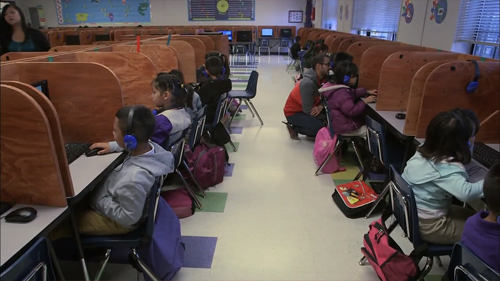
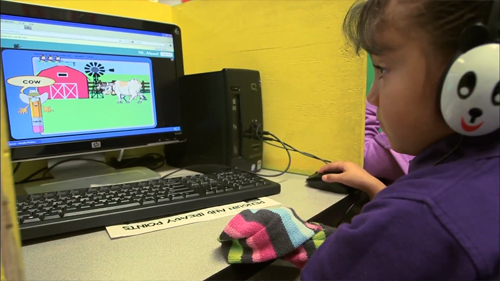
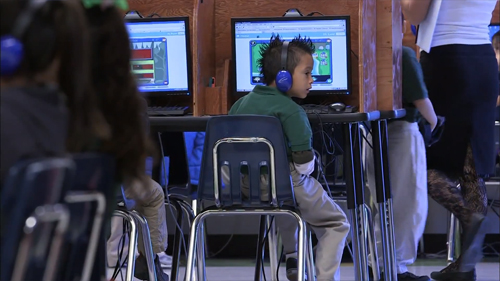
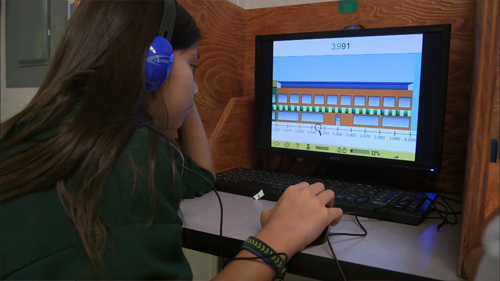
The video distills into ten minutes all the most interesting angles on Rocketship – its high parent involvement, its high teacher salaries and professional development, its morning “launches,” and the segment pays special attention to Rocketship’s “Learning Labs,” which Merrow describes as “lots of computers and kids, no teachers.” (Watch that part of the segment.)
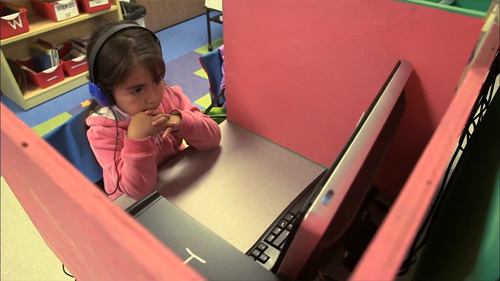
This aspect of a lot of charter and for-profit schools should make us all very uneasy. Rocketship can afford to pay its teachers more because, for one hour each day, the students are plugged into computers, boxed into cubicles, and tutored intermittently by low-skill, hourly-wage workers. Rocketship spruces up its lab with lots of primary colors but it can’t shake comparisons to a call center.
This is “differentiation,” says John Merrow, and it’s true that the students are working on different tasks, but at what cost? The students don’t interact with their peers or their teachers. The math program, ST Math, isn’t bad but computers constrain the universe of math questions you can ask down to those which can be answered with a click and graded by a computer. The promise of personalization, of perfectly differentiated education, has forced Rocketship to make dramatic concessions on the quality of that education. It’s a buffet line where everyone chooses their own flavor of the same gruel.
Merrow’s documentary team wasn’t persuaded of the Learning Lab’s merits:
The Learning Lab saves schools lots of money but there’s just one problem: they’re not really working. A problem we saw is that some students in the lab do not appear to be engaged. They sit at their computers for long periods of time, seemingly just guessing.
What’s remarkable is that the Rocketship staff is also unpersuaded of the Lab’s merits. One principal says, “If I had to guess, I’d say you come back in a year, you won’t see a Learning Lab.” Another says, “Next year we’re thinking of bringing the computers back to the classroom.”
This isn’t any kind of small pivot, something Rocketship can gloss over with a sunny press release. Throughout Merrow’s segment, the teachers, the principals, and the charter CEO all spoke of their commitment to innovation. We should commend them for innovating away from technology when it’s ineffective, especially given their particular location (Silicon Valley) and time (2013). That just isn’t easy.
BTW: Mike Caulfield suggests that personalization is hostile to the kind of whole-class conversation we know to be valuable:
Indeed, structured classroom discussion has one of the highest effect sizes in Hattie, much higher than mastery learning. But it’s really difficult to have a classroom discussion (or group activities that foster student discussion) without some level of shared experience and knowledge. I’m curious if this fact might lie behind much of the surprising failure of computerized adaptive learning systems.
Online learning is integral to our model…The Learning Lab is not going away, rather we are working to integrate its key components directly into our classrooms under the guidance of our incredible teachers and staff…I think Merrow probably just happened to focus on an isolated incident and wanted to bring it up as it is always a valid concern with online learning. We continue to work on the data integration piece and this pilot doesn’t change the importance of that. Our teachers continue to get more robust data from the Learning Lab and are eager for us to work towards a fully integrated and real-time system.
I read something from the http://edtechnow.net/ blog recently that really struck a nerve — a quote from William Cory, Assistant Master of Eton, who wrote in 1861:
“You go to school at the age of twelve or thirteen and for the next four or five years you are engaged not so much in acquiring knowledge as in making mental efforts under criticism.”
It’s that ‘mental efforts under criticism’ piece, that structured classroom discussion where your thoughts are challenged where higher order learning takes place.
It’s important to assess thing like this not only in terms of how effectively they teach math, but also in terms of what they teach children *about* math. The learning lab teaches children that math is a solitary activity, wherein one clicks at things on a computer until the computer approves.
Not only should we be concerned about what students are learning about math based on this experience but what they are learning about computers as well. I’m sure the majority of schools are not doing a much better job of offering elementary students the opportunity to use computers as more powerful tools rather than skill-practice machines, but most don’t have kids doing so quite this much. If we want students who will explore, innovate, challenge ideas, we have to help them see more possibilities than simply answering questions and being told right or wrong.
One simple filter, Jungian type, tells us that over half of all children aren’t going to be energized by an hour at a computer screen. Extraversion and Introversion in personality type terms involve how we are energized. All of us can do both, but one is preferred and the other is draining. Further, even if the Introverts like the computer lab, they still need the stimulation of discussion, learning to express their ideas and question those of others. Since a good portion of school is still set up for more Introverted activities, adding interventions that require more Introversion makes it a very, very long day for the Extraverts—and they just might start talking and moving when you least want them to.
“The learning lab teaches children that math is a solitary activity, wherein one clicks at things on a computer until the computer approves.”
Perhaps not TERRIBLY different from the way many math classes operate, if you simply substitute “teacher” for computer in the second instance so that we have, “Math classes teach children that math is a solitary activity wherein one writes or says the answers to computations until the teacher approves.”
Out of character, writing this sort of stuff is *hard*. It’s hard for actual live human beings to understand how students are modeling the math in their head and respond accordingly. Poor Jennifer [DreamBox’s computerized teacher-avatar – dm] just repeats her instructions. If I were a student who didn’t understand place value, I might walk away from this unsure about my own multiplication facts, that were good.
Jennifer might help me more if she knew about some common errors (and maybe that sort of thing is going on in the background, invisible to the student?). Like Dan, I don’t want to be a luddite, and if the computer is better than people, we should go for it. But computers have a long way to go.
Much of teaching is empathy — being able to see the world through the eyes of a person who doesn’t know the things you know. It’s being able to communicate with someone who sees the world differently than you do. There are a thousand ways that live, in person communication can cultivate and encourage that empathy in teachers. For programmers who are at arms length, cultivating that empathy is double difficult and important.
Jennifer just asked me if I’d like to continue working, ’cause it took me a while to write this. I think my answer would be “no”?
So just as you imagined this hypothetical student in a DreamBox lesson, I think it’s valuable to imagine this same student entering a classroom without the support of a technology like DreamBox:
The multiplication standard algorithm is a fifth grade Common Core standard, so let’s assume the student is a fifth grader who doesn’t understand place value. This student transfers into a new school and math class on the day after the teacher introduced the algorithm. Does the teacher know the student doesn’t understand place value? If not, how will that information be acquired? Once it’s known that the student lacks place value understanding, should the teacher continue teaching the algorithm lesson even though the student is clearly not ready for it? If not, what does the student do during math class?
Too often, the student is taught the algorithm right then because there are simply too many logistical and resource constraints that limit what even the best teacher is able to do in that situation. It’s no certainty that the student will meet grade level standards by the end of the year, and the inherent challenges of this reality end up being a huge strain on both teacher and student. I’m empathetic to both of them. And the tens of thousands of others in the same situation. These are the teachers and students we’re trying to help.
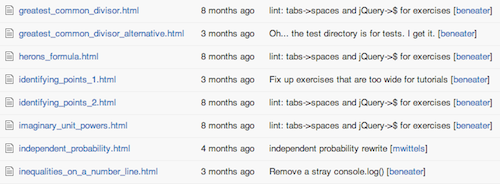
It’s great, first of all, that Khan Academy has all their student exercise code on GitHub for everybody to see. I don’t know any other adaptive system that does that. I figured there had to be a better way to reward them for that transparency than the criticism and judgment I’m about to post here, so I made them a badge also.
Their code illustrates the different ways good math teachers and good programmers try to figure out what students know.
In each of the dozen files I’ve reviewed, Khan Academy first generates some random numbers that meet certain criteria. In the proportions assessment, they call for three random unique integers between 5 and 12. No decimals. No negatives. No zeroes.
var numbers = randRangeUnique( 5, 12, 3 );
Then they use those numbers to generate exercises. With proportions, they insert an “x” randomly into that list of numbers. The final order of that list determines the proportional relationship that students will have to solve.
numbers.splice( randRange( 0, 3 ), 0, "x" );
But good teachers are more than random number generators. They create exercise sets that increase in difficulty, that ask students to demonstrate mastery in different contexts, all because proportions are conceptually difficult but procedurally simple. It’s extremely easy for students to get by on an instrumental understanding of proportions alone. (eg. “All you hafta do is multiply the two numbers that are across from each other and divide by the number across from the x.” Boom. It’s badge time.) It’s especially easy when the only thing that changes about the problem is the random numbers.
But forget good teachers for a minute. Let’s look at the bar set by various standard-setting organizations. Here is what you have to do to demonstrate mastery of proportions on a) Khan Academy, b) the California Standards Test, c) the Smarter Balanced Assessment.
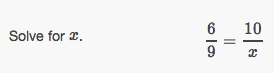
Khan Academy
You’ll do a handful of problems just like this, with different random numbers in different places.
California Standards Test
Smarter Balanced Assessment
The difficulty and value of the assessments clearly increases from Khan Academy to the CST and then Smarter Balanced. (I’m hesitant to guess how well a student’s score on the Smarter Balanced Assessment will correlate to all her practice on Khan Academy.)
Here we find a difference between good math teachers and good programmers. The good math teacher can create good math assessments. The good programmer can make things scale globally across the Internet. The two of them seem like a match made in math heaven. Just get them in a room together, right? But the very technology that lets Khan Academy assess hundreds of concepts at global scale – random number generators, string splices, and algorithmically generated hints – has downgraded, perhaps unavoidably, what it means to know math.
2012 Dec 13. Peter Collingridge points out in the comments that Khan Academy has a proportions assessment comparable to the California Standards Test. If they have anything similar to the Smarter Balanced Assessment, please let me know.
So using the devices for something that I would like to take 5 minutes usually takes 15-20, with the associated distractions of attention and loss of momentum. It seems like with all the preparation in the world, I can’t get these interludes to take less than 15 minutes, and I can’t ever, hardly ever, get it so every single student can participate. And mind you, I am not a noob at this stuff. At the risk of sounding hubristic, I’m probably one of the more experienced classroom-tech-deploying teachers you are likely to meet. And everytime I’m like, “Oooh, we need a device for this part,” I’m also like, “Crap. Is there any way I can avoid this?”
This is a huge problem and if you’re a technology coordinator, this is your huge problem.
The difficulty of setting up and configuring these devices for a teacher’s own, personal learning is dwarfed by the difficulty of doing the same at classroom scale. It’s so difficult that highly competent educators like Kate would rather find another solution. That’s before you even look at the bottom 99% of computer-using educators.
At the very least, I hope anecdotes like Kate’s will put to rest specious comparisons to cash registers for grocers, CAD software for architects, and Bloomberg terminals for stock analysts. They aren’t even in the same universe of access and usability.
I’ve been basically leaning toward tools which can either be installed on every kids computer easily, or which get shared via a link. Nothing else. The time from sharing the tool to using the tool is minimal in both cases, which helps reduce associated problems with task transfer.
Here follows an example of one of the problems with classroom tech. I am the guy in my school that is supposed to make the tech work. We purchased 60 iPads (not my idea). The administrator had planned that the teaching strategy would involve an app called AirServer which allowed iPads to project through a PC. AirServer was very non-cooperative so of course the usage plan took a digger. The teachers would not make teaching plans with tech that was not reliable. I now have a lot of unused iPads. Proper field testing would have solved a lot of time and money. But iPads in education are the cool thing so away we went. No testing, no significant teacher training and no curriculum writing or planning. From my reading this scenario does not appear to be uncommon.
The simplest thing, “Take a picture of one of the proofs you just wrote and email it to me.” turns into twenty minutes of troubleshooting cameras that don’t work, and picture files we can’t find in order to attach them, and how to login to your school email account.
This isn’t an exhibit of doing mathematics or of technology enabling a classroom. This is an exhibit of an entire classroom spending time and administrative capital accommodating the limitations of computers, of technology disabling a classroom.
The tools need to get out of the way. When I use the Internet to communicate these words across time and space, I’m not consciously aware of all the technologies that facilitate that communication. They are out of my way. Computers are a natural medium for communicating words. In Kate Nowak’s class, the tools are consciously in the way.
Over the past couple of months I’ve heard “yeah, that’s cool, but I can do the same using x, combined with y and converted using z, backing onto Dropbox” far too many times.
With plain text, we go to a computer first to type it. Many of us have noted how he hardly ever handwrite anything longer than a phone number or address these days. The same can’t be said for math notation. Some can write math using LaTeX but that is far from ideal. Even mathematicians who are LaTeX experts do not handwrite it on paper or a whiteboard. They use standard math notation.