Category: uncategorized

Total 483 Posts

Developing The Question: Needs Improvement!

This is a series about “developing the question” in math class.

I’m proud of Graphing Stories. That was the first math lesson that drew in any serious way on my video editing hobby. That was the first math lesson that alerted me to the enormous value in sharing curriculum with teachers on the Internet.

I’m unhappy with the project now. I look at it and see the product of a math teacher who is eager to get to the answer of how to graph a real-world relationship and less interested in developing the question that leads to that answer.
140814_1

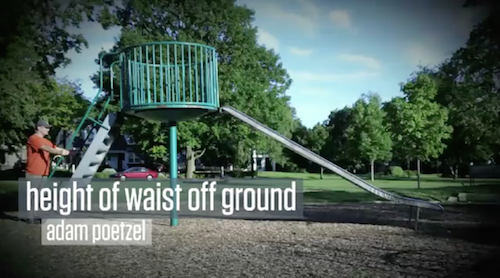
If you watch Adam Poetzel’s graphing story, in which he slides down a playground slide, here’s what you’ll see:

  • A title announcing the quantity we’ll be recording: “height of waist off ground.”
  • A gridded graph that shows the scale you’ll use. It runs up to 10 feet.
  • A video of Adam sliding.

None of this is Adam’s fault, of course. That’s my editing.

Here’s how I’ve been doing a better job developing the question lately in workshops.

  • I play the video of Adam sliding.
  • I ask participants to tell their neighbors everything they saw. “Don’t miss a detail,” I say, and I’m always surprised by the details participants recall.
  • I play the video again and I ask the participants to tell their neighbors their answer to the question, “What quantities could we measure throughout the video?” People suggest all kinds of possibilities. Speed, distance from the left side of the screen, height, temperature.
  • Then I tell them I’d like them to focus on Adam’s height. I ask them to tell their neighbors in words what happens to his height over time.
  • We share some descriptions. People compliment and critique one another. Then I point out how difficult it is to describe his height over time in words alone.
  • Only then do I pass out the graphs.

The difference is immense. It takes an extra five minutes but participants are much better prepared to make the graph because they’ve spent so much time thinking about the relationship in so many informal ways. So many more participants walk away from the experience feeling like valued contributors to our group because the questions we’ve asked require a wider breadth of skills than just “graph relationships precisely.”

That’s the benefit. Again the cost was only five minutes of class time.

The most productive assumption I can make about any question I pose to a student is that a) there are questions I could have asked earlier to develop that main question, b) there are interesting ways I can extend that main question. In other words, I try to assume the question I was going to ask is only a thin middle slice of the corpus of interesting questions I could have asked. Tell yourself that. Maybe it’s a fiction. Maybe you use the entire question buffalo every time. It’s a useful fiction in any case.

Next: Let’s make a resolution.

BTW: Kyle Pearce got here first.

Featured Comment
Everything Harry O’Malley said.

Developing The Question: Good Work!

This is a series about “developing the question” in math class.

Curmudgeon has taught math and science for thirty years and runs the Math Arguments 180 blog, an indispensable source of interesting prompts and questions.

Here are three images he’s posted in the last month:

140813_2

In nine classes out of ten, you’ll find a teacher ask her students to calculate the area of those shapes. Maybe Curmudgeon would ask his/her students to calculate their area also. That’s a fine question. But Curmudgeon does an excellent job developing the question of calculating area by first asking:

  • What is an easy question we could ask about the shape? A medium difficulty question? A hard question?
  • What is the best way to find the area of the shape?
  • What combinations of addition or subtraction of figures could you use to find the area?

Each question develops the next question. Earlier questions are informal and amorphous. Later questions are formal and well-defined. They all develop the main question of calculating area. They all make it easier for students to answer the main question of calculating area and they make that main question more interesting also.

This technique runs back to my workshop participant’s advice that “you can always add but you can’t subtract.” Once you tell your students your question, you can’t ask “What questions do you have?” Once you tell students what information matters, you can’t ask them “What information matters here?” Once you tell them to calculate area, it becomes very difficult to ask them, “What shapes combined to make this shape?”

Tomorrow: Why Graphing Stories does a pretty lousy job of developing the question.

Preparation: If the main question is “sketch this real world relationship,” what are ways we could develop that question?

Developing The Question & Why Students Don’t Like Math

This is a series about “developing the question” in math class.

In his book Why Students Don’t Like School, Daniel Willingham writes:

One way to view schoolwork is as a series of answers. We want students to know Boyle’s law, or three causes of the U.S. Civil War, or why Poe’s raven kept saying, “Nevermore.” Sometimes I think that we, as teachers, are so eager to get to the answers that we do not devote sufficient time to developing the question. But as the information in this chapter indicates, it’s the question that piques people’s interest. Being told an answer doesn’t do anything for you.

Developing a question is distinct from posing a question. Lately, I try to assume that every question I pose is more precise, more abstract, more instrumental, and less relational than it had to be initially, that I could have done a better job developing that question. If I do a good job developing a question, my students and I take a little longer to reach it but we reach it with a greater ability to answer it and more interest in that answer.

Over the next few days, I’d like to offer an example of someone doing a good job developing the question and somebody else missing the mark. I’ll be the one who misses the mark with my Graphing Stories lesson. Math Curmudgeon will be the one who gets it right. After those entries, I’ll encourage us all to make a couple of resolutions for the future.

2014 Aug 13. Daniel Willingham weighs in:

The Chinese Room

James Greeno:

A person lives inside a room that has baskets of tokens of Chinese characters. The person does not know Chinese. However, the person does have a book of rules for transforming strings of Chinese characters into other strings of Chinese characters. People on the outside write sentences in Chinese on paper and pass them into the room. The person inside the room consults the book of rules and sends back strings of characters that are different from the ones that were passed in. The people on the outside know Chinese. When they write a string to pass into the room, they understand it as a question. When the person inside sends back another string, the people on the outside understand it as an answer, and because the rules are cleverly written, the answers are usually correct. By following the rules, the person in the room produces expressions that other people can interpret as the answers to questions that they wrote and passed into the room. But the person in the room does not understand the meanings of either the questions or the answer.

This is a pretty perfect parable.

Featured Comment

Joel Patterson, talking to commenters who’d send this parable along to their students’ parents:

I like this parable. Before you condense it, and give it to all your parents, consider whether those parents have science/engineering backgrounds. It’s a pretty complicated picture to envision. I think S/E people would grasp it (if they haven’t heard of it already) and would get your point. But if the parents have less of an S/E background, the complicated parable is likely to bore them and not convey your point.

Have an explanation at hand that is more like the guitar players who can improvise, not just repeat the 5 songs they’ve memorized. Or cooks who can put together a soup without the recipe because they know which spices and foods have good flavors together.

Rand Paul Fixes Calculus

Rand Paul:

If you have one person in the country who is, like, the best at explaining calculus, that person maybe should teach every calculus class in the country.

It’d be helpful if we could work through the idea that good teaching is just good explaining and vice versa. Someone here at Twitter Math Camp mentioned she conducts a math night for parents at the start of school. “I wish I had learned math like this as a kid,” they tell her. That realization, that there is and should be a difference between how math was taught then and now, is a giant first step.

Featured Comments

Kate Nerdypoo:

This shows the idea that children’s minds are empty vessels that need to be filled with knowledge and teachers are the keepers of that knowledge, whose sole job is to effectively pour said knowledge into the vessel. And if their minds didn’t get filled with our knowledge the fault must lie with our explanations.

This flies in the face of what we know about teaching and learning.

Joel Patterson:

None of these reforms about math education can happen in a vacuum. There’s always a political side to what happens to people’s children, and if the way you help children learn math is important then the way you communicate with parents is also important.