One of my favorite moments at NCTM was when I ran into David Masunaga and he showed me the magic octagon.
Take a minute to let the magic octagon blow your mind.
One of my favorite moments at NCTM was when I ran into David Masunaga and he showed me the magic octagon.
Take a minute to let the magic octagon blow your mind.
April 9 is the day between the 2014 NCSM and NCTM conferences. If you’re the sort of group that’d like to do some professional development work around the Common Core’s modeling practice, I’m the sort of guy who’s offering that PD. At a discount, too, since I’ll already be in the New Orleans area. Please drop me a quick note at dan@mrmeyer.com
It’s like reading a survey of firefighters in which, when asked about the greatest limitation on how they fight fires, 38.79% responded “all the fires” and 23.56% responded “being a first responder.”
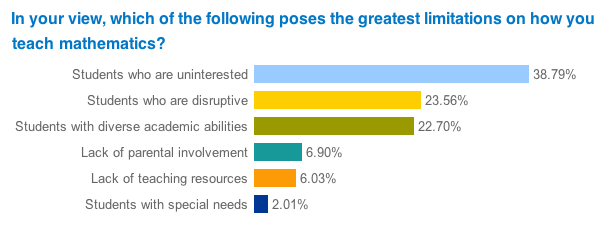
See those top two are part of doing your job, not an impediment to it. Even better, while the firefighters have no influence over the number of fires they fight, teachers have plenty of influence over a student’s interest in mathematics.
[via Chris Shore]
Previously:
2013 Jul 11. The Wire’s Lester Freamon:
Detective, this right here, this is the job. Now, when you came downtown, what kind of work were you expecting?
Uri Treisman gave a near-perfect talk on race, poverty, and equity at NCTM 2013 (which I trust you’ve now seen at least once) but he left one crucial thread dangling.
He spoke of fault-tolerant systems by way of a metaphor to commercial air travel. The early airplanes developed by Concorde would respond to the most trivial hairline fractures by plummeting from the sky. British air dominance ended, according to Treisman, when Boeing simply assumed there would be lots and lots of those fractures and then built a system to tolerate them. This process culminated in a wind tunnel where Boeing engineers dialed up the wind speed on a prototype, started its engines, dropped a guillotine on the nose of the plane, and then watched the airplane continue to hum along regardless.
Here’s Treisman:
Guess what? Poverty really sucks. It’s incredibly hard. All the lifespan studies going back to the 1920s show that poverty in youth is a very hard force. We need to build fault-tolerant schools and systems if we’re actually going to address equity.
Treisman left the design of those schools and systems as an exercise to the viewer. He doesn’t even specify the faults explicitly, though it isn’t hard to define some.
For one example, the poor are more itinerant than the wealthy. They change jobs, locations, and schools more often. Any system that doesn’t find some way to recover from that liability, to induct students into new routines and ameliorate lost class time as quickly as possible can’t be considered “fault-tolerant.”
Dan Goldner has picked up the conversation where Treisman left it and I hope he continues it. His school has targeted five areas for fault tolerance ranging from students taking the wrong course to intermittent attendance. Head to his post and read their tentative solutions. Then help us with the question:
What are the policies of the fault-tolerant school? The fault-tolerant classroom?
Featured Comments:
Having a National Curriculum means pupils and students who have to move around have at least some continuity to their education.
Just like we talk about math problems having multiple entry points, students should have multiple opportunities to re-craft their math plan. The idea that you must take courses A, B, C and D or else you will never get to course E is antiquated. The fault-tolerant school provides opportunities, and encourages students to pursue them, rather than maintaining artificial obstacles.
I am not absolving schools of the responsibility of finding ways to keep these students on track, but the task is almost Sisyphian in many cases. In areas where poverty is the rule, a school needs to be a community center, providing health-care related services, afterschool opportunities, and family programming; many students need this range of services in order to stay in school. Academic support beyond the school day could be made available in this type of setting as well, providing the tutoring that struggling students from more affluent families may receive privately. We can talk about engagement, perseverance, and productive struggle all day long, but truthfully, there is a huge block of students for which these issues are completely secondary to surviving their circumstances.
Earlier this evening, 39 math teachers attended a web conference to discuss the “State of the Math Twitter Blogosphere,” a community that comprises many millions of math teachers from god-knows-how-many countries. I’m sure the premise of that conference —Â that anything these 39 teachers might say or do or decide about any of these questions would have any kind of corporate effect on the community they’re one infinitesimally small part of —Â was well-meant, but it seemed awfully self-regarding at the same time. The premise frustrated me.
My microphone frustrated me also at the exact moment I was going to speak my piece. Here is that piece, polished a little and elaborated quite a lot. It expresses my frustration, yeah, but also a lot of gratitude for a community to which I really probably owe a kidney if it asked.
One thousand math teachers will start one thousand new blogs and one thousand new Twitter accounts tomorrow and they will be totally unaware that this conversation ever happened. They will be completely unaware of our corporate resolutions here.
This conversation might be ineffective but it might also do some harm. I’m uncomfortable with how concerned we are with the right ways to tweet, blog, collaborate, and socialize online.
Because I’ve had that conversation before. For several months on Twitter I didn’t follow anybody. I enjoyed composing silliness in 140 characters but I didn’t yet feel any need to read anybody else’s. And people gave me grief about it. As though there was some right way to do this Internet thing.
There isn’t.
The resolutions we make as a group here won’t matter at all. They won’t have any effect on the community of which we’re one small particle. But the resolutions we make personally matter enormously — whether you’re read by two people or two hundred or two million.
I encourage you to be the blogger and tweeter you want everybody else to be.
Imagine if everyone tweeted and blogged like you. (And I don’t mean your ideas and your opinions. That would be boring.) Imagine if everyone shared your ethic and the value you place on community. What kind of online math education community would result?
For example:
As I and my blog have changed over seven years, I’ve found different ways to express that ethic to my community. Here is a fly-by of those changes, in case they’re of any use to you.
When I started blogging:
I blogged like no one was reading. Bloggers come and go. The bloggers that have stayed all seem to recommend this.
I asked for commentary. You can email someone directly and ask for commentary. You can write a post and include a link to someone else’s blog, which they’ll then follow because we’re all vain creatures. You can write a post and then tweet a link that includes the author’s Twitter handle. (Example: “My recent post on Dan Meyer’s wrong ideas about the mathtwitterblogosphere. /cc @ddmeyer.” Irresistible!)
I tried to have an opinion. Most of them were wrong, but I respected bloggers who wrote about their own opinions as well other people’s. So that’s how I wrote.
I blogged under my own name. There are plenty of good reasons to blog anonymously, but if that isn’t your explicit goal, you should spackle your identity —Â including your name and photo —Â all over your blog. It’s amazing how many times I read some great idea from some new blog and I want to holler that blogger’s name from the Twitter rooftops only to have to apply some serious Google-fu to find it.
I asked explicitly for criticism. You may tell yourself you’d happily accept criticism, but no one will offer it unless you ask for it explicitly, repeatedly, and then respond gratefully to the criticism that’s helpful and then ask for more. Eventually you won’t have to. At the moment, no one does this better or more consistently than Michael Pershan. None of his readers can seriously doubt his gratitude and eagerness for criticism. It’s his ethic.
I started to “feature” comments. I wanted to build a community around here, to celebrate good ideas and good criticism apart from my own, so I started pulling useful comments up to the main post and then telling those commenters I appreciated their comments. I appreciated how seriously other blogs took comments and I wanted to be that kind of blogger.
Then the gears on this blog shifted. Now:
I try to turn interesting opportunities into blog posts. Your name and contact information are on your blog, right? As people contact you for increasingly interesting projects and opportunities, you can share that learning with people who didn’t have your same blind-stupid luck.
I answer every email. This isn’t true, but it’s close to true and I absolutely want it to be true. I have an email in my inbox right now from a first-year teacher I know nothing about asking me whether he should take a job offer at one school or another. I get emails from parents — really desperate parents — who want their children to be challenged less by math (and sometimes to be challenged more), from principals who want to know how to change their math faculty’s approach to teaching, from Chinese students who’d like to tell me what math is like in their country, from sympathizers, from antagonists. I answer (nearly) all of these because that’s how I’d like this community to be.
I try to highlight the best of new blogs. This “Great Classroom Action” feature suddenly overwhelmed me a few months ago because there was so much of that action and you guys were so good at capturing it. But I’ll pick that back up. It’s important. When I was in the classroom, I could contribute the action. Now that I’m not, all I can do is read the blogs so you don’t have to. I hoover up every RSS subscription I can, scan every post, and keep my eye out for images of students doing interesting, challenging mathematics.
I try to create more value here than I’ve captured. This has become increasingly difficult because I am enriched by you all every day in new and different and more extravagant ways, which challenges me to find ways to create the same kind of extravagant value. Your generosity makes reciprocity very difficult, but I volunteer for webinars, hop on phone calls, answer emails, contribute feedback on curriculum projects, and write appreciative notes to your students who catch my errors. I don’t know if I’ll ever find enough ways to pitch in.
This is how I do online community not because it’s the right way or the only way to do online community but because it’s how I want this online community to look. I’m not asking anyone here to be like me. I’m not asking anyone here to resolve to do anything corporately. I don’t think those resolutions will have any effect. I’m asking you to consider how you’d like this community to look and then to act accordingly.
I can’t speak with enough gratitude for this place and I’m excited to see what you all make of it and what it makes of all of you.
2013 Jun 25. I update posts, even ones that are millions of years old, because I love coming across other people’s old posts that show not just their current thinking or their oldest thinking but the progression from one to the other.
2013 Jun 25. Kate Nowak, the high priestess of the high council, simultaneously wrote up her own ethic, though she wouldn’t be so pompous as to call it an “ethic.”
Featured Pushback
I don’t think it’s a matter of being concerned with the ‘right’ way, so much as the ‘most effective’ way … or perhaps the ‘less ineffective’ way.
But Chris asked some great questions and people came up with lots of thoughts to share about them. No one was trying to delineate the “right ways” to interact online.
[..]
For crying out loud, it was a conversation that was centered around helping people feel more welcome and comfortable joining in whenever and however possible.
2013 Jun 29. Updating myself in the comments:
But I want say that I see how the title of this post, the tone of the first few paragraphs, along with whatever esteem this community has for me has had the cumulative effective of making some of you shocked and defensive, and in no position to give those ideas that close read. I am sorry for that, both because I’ve distracted the conversation from the 90% of this post that I actually care about but especially because I like you guys and your work and would never want you to feel small on my account.