Category: uncategorized

Total 483 Posts

Twin Pressures On Good Novice Teachers

Shawn Cornally:

Hence, the argument for higher teacher pay: we’ll stay in the classroom longer, rather than jumping ship when our salary schedule is incremented less than inflation (i.e. making less the older I get, like my second year of teaching). In other words, it’s not student achievement you’re directly paying for, it’s avoiding turnover.

“Maybe that’s not a bad thing?” you say. “Some of my best teachers were young and excitable.” you opine.

So here’s the rock: there are certain teachers who thrill a great deal more to the challenge of good teaching than to any missional obligation to care for children. (See: McMatherson, Mathy; Nowak, Kate; Pershan, Michael.) As teaching gets easier, these teachers are forced to impose tougher and tougher challenges on themselves (because teaching itself doesn’t offer that kind of differentiation) just so they can stay interested in the field.

And then there’s the hard place: the demands of good teaching, particularly in charter systems, are often unmanageable for anybody but the young, single, and childless – long hours, comparatively low pay, and only a thin veil of separation between you and your work.

Without even glancing at a census table, it’s possible for us to see that the rock and the hard place close in on good novice teachers at almost exactly the same time. The job becomes untenable at about the same time that it becomes unchallenging.

Kate got out. Vegas oddsmakers have Pershan out of the classroom in another six years. I don’t know McMatherson all that well but his writing has me scared. I don’t know the solution either. (Shawn’s post offers a few.) I barely understand the problem. I’m happy we’re all still here, at least, still buzzing somewhere around the periphery of math education in various service roles if not actually inside the math classroom itself. (Blogging is so a service role, okay?) I’m just worried more and more that classroom teaching is shaping up to be an entry-level job.

2013 Feb 12. Jason Buell reminds me that Kilian Betlach coined “The Ledge” years ago.

2013 Feb 12. Riley Lark and Ben Chun both say this post describes their situation fairly well. Kate Nowak dissents.

Featured Comments

Tom Hoffman:

This is the kind of issue that seems increasingly insolvable because the solution is so straightforward. Everyone needs lighter teaching loads, less time in front of students, and budgets that have a bit of slack so that it is possible to pursue interesting ideas, go to conferences, etc.

Lighter teaching loads, more free time, and a little extra money don’t improve things on their own, but they are a prerequisite for just about anything interesting happening.

Tom Woodward:

I’m not sure enough people care about keeping teachers of that quality. My bet is that the powers that be will opt for consistency and repeatability over powerful teachers they can’t easily replicate.

I fear many pieces are already lined up for the (further?) McDonaldization of education- increased focus on scripting, rigid pacing guides with standardized lessons plans, adaptive path LMSs etc. Not too far a stretch to record the “best” Disney approved edutainers and then pay low skill workers to manage the bodies. It’s not far from what I saw at the School of 1 in NY a few years ago. They’re franchising.

I’d like to be very wrong.

P.J. Karafiol:

I’m not sure I agree with this analysis. For me, a teaching certification program I did about five years in—one that required a lot of reflection—woke me up to the fact that I had a LOT of room to grow; I spent the next five years trying to do the stuff I realized I wasn’t doing yet. Maybe what we need to do is take these not-quite-novice teachers who have mastered the basic skills of getting stuff done and help them see how much more they have to learn.

Andrew Shauver:

What strikes me about my profession is that if I, with my newly-acquired master’s degree, want to advance my career, it REQUIRES me to leave the profession. There isn’t a structure in which I stay in the classroom, but advance my career in the traditional sense of that term.

There are lots of moral victories and self-actualized achievements, and I’m certainly welcome to take on more responsibilities, but it doesn’t do a whole lot more than add to an already-heavy workload.

That’s the main motivator for me going forward. If I decide that I want to engage in policy-making, observation and evaluation, work strongly on curriculum matters or assessment, I really have to strongly consider leaving the classroom because those advancement opportunities don’t exist in my current assignment.

There aren’t offers for half-time teacher/half-time teacher evaluator or half-time curriculum support person or half-time data-analyzer. If I have interests in those things, I have to pick one or the other.

2013 Mar 12. By “unchallenging” I should have said something to the effect that “the challenge of the job transmutes into something less satisfying than it was, while the costs of the job remain constant.” Maybe that’ll still spin up the Internet indignation machine, but it’s more accurate anyway.
Tweet-Sized Tasks

Here is one of my favorite quotes on task design from one of my favorite math educators:

A good problem seems natural. A good problem reveals its constraints quickly and clearly.

Is it possible to pose a task so quickly and clearly that it would fit in a tweet?

I asked and lots of you gave it a shot. Here’s mine as well as a few of my favorites:

Extra merits for roping in your personal life:

Extra demerits for trolling:

I’ll depart from Sallee briefly and say that it’s nice, sometimes, when the constraints aren’t fully revealed. I’d like the task to be clear, but in life the constraints often require clarification. When you ask yourself, “What extra information do I need here?” you’re doing the work of mathematical modeling.

Feel free to play along in the comments, but you’ll have to constrain yourself to 140 characters.

Featured Tasks

Jonah:

Two points A and B on a paper, 13”³ apart. You have a pencil and a 12”³ ruler. Construct the line segment AB.

Caitlin Browne:

How many squares are on a standard checkerboard?

Bowen Kerins:

Is it really possible for Steven Seagal to have “millions of hours” of weapons training?

2013 Sep 22. From Nat Banting on Twitter:

Give students the sums when rolling two irregular dice. Ask them to design the dice based on data.

2012 Was The Year Of Single-Serving Math Education Websites

In 2012, several math teachers turned passion and pedagogy into code, creating seven single-serving websites for their community:

I’m stretching the definition of “single serving” somewhat, but the difference between these sites and other education-related sites like Edmodo or Teachers Pay Teachers or BetterLesson is a) these have a narrow focus, b) they reflect a very particular vision for how students learn or how teachers become better teachers (eg. Math Mistakes believes it’s important that teachers examine student errors; Estimation 180 prioritizes number sense; Activeprompt makes it easy to ask one very particular question.), c) they pursue that vision relentlessly, d) they were created and maintained by teachers, not corporations.

One takeaway and two questions:

  1. It’s a treat getting to work in a place as creative and industrious as the math edublogosphere. For real.
  2. The majority of these sites were set up with cheap web hosting and free software like WordPress or Weebly. The barriers to taking an idea and turning it into a digital tool have never been lower. So what’s your idea and how will you turn it into a tool in 2013?
  3. What are other disciplines doing along these lines that I’ve missed?

The Necessity Principle

How could we improve this task?

Fuller, Rabin, and Harel (2011) [pdf] define “intellectual need,” “problem-free activity,” and offer several ways to improve that task in one of the best pieces I read last summer:

When students participate in mathematical activities that stimulate intellectual need, we say that they are engaged in problem-laden activity. Unfortunately, many students are engaged in problem-free activity, in which they are driven by factors other than intellectual need and, as a result, do not have a clear mental image of the problem that is being solved, or indeed an understanding that any intellectual problem is being solved.

The piece features:

  • Dialog between teachers and their students that results in “problem-free behavior” and “social need.” There’s something in here for everybody. Everybody – myself included – will feel a twinge of recognition reading one or more of those exchanges.
  • Great suggestions for how to mend those scenarios, for queueing up intellectual need and problem-laden behavior.
  • Five categories of intellectual need. The need for certainty, causality, computation, communication, and connection. You can lean on any of those categories and watch several great lesson ideas fall out.

Featured Comment

mr bombastic:

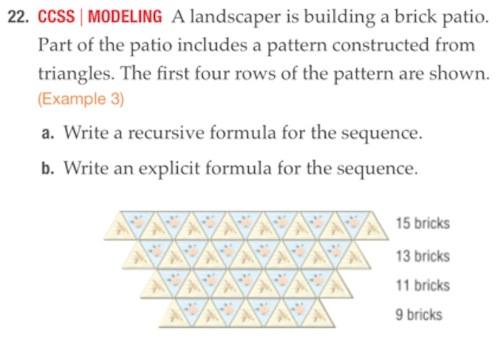
The recursive part in the original question is especially annoying in that it sends the message that math is used to take something that is totally obvious (two more brick in the next row) and somehow make it seem complicated.

Jo Boaler Reveals Attacks By James Milgram And Wayne Bishop

Jo Boaler:

Academic disagreement is an inevitable consequence of academic freedom, and I welcome it. However, responsible disagreement and academic bullying are not the same thing. Milgram and Bishop have engaged in a range of tactics to discredit me and damage my work which I have now decided to make public.

It’s gripping reading. If you had told me five years ago the kind of character assassination Boaler experienced was possible in higher education, I would have thought you were joking.

BTW: Jo Boaler is one of my advisers at Stanford. If Milgram and Bishop’s baseless attacks on her research had been successful, I would have missed out on her mentorship. So I’m linking to this essay out of both personal and professional interest.

BTW: She has a blog, a Twitter account, and this essay, all of which should be seen by as many people as possible.