Category: uncategorized

Total 483 Posts

Breaking Bad

Breaking Bad closed out its third season last night standing shoulder-to-shoulder with the all-time great TV dramas. Here’s showrunner Vince Gilligan describing (allegorically) what’s so exhilarating about classroom teaching:

Television is a great job for a writer in the way that movies used to be, way before my time. Back when writers in Hollywood were on staff or under contract at any given studio and you’d write movie scripts and then the movies would get made within a few weeks, such that you could be a working writer in the movie business back in the ’30s and ’40s and ’50s and have a hand in writing five or six movies a year that actually got produced. The only thing remotely like that in the 21st century here in Hollywood is working in the TV business. My writers and I sit around and dream this stuff up and then we see it executed a week or even days later, and it’s a wonderful feeling and it’s magical.

Though, with teaching, that timeframe shrinks to hours when you’re improving a lesson you taught first period for use in your third period class.

BTW: Here’s a bonus remark from Donna Bowman’s season finale review, celebrating television and rebuking the cultural Chicken Littles:

People living through a golden age often don’t know it. Extraordinary flowerings of art, technology, culture, or knowledge are obscured by intractable problems, crises, declines in other parts of the society. [..] It’s easy to look at television, with its 500 channels worth of endless crappy versions of the same empty ideas, and conclude that everything’s gone to shit. I have plenty of friends who are proud to proclaim the dreary, inevitable decline of entertainment, and answer my protests to the contrary with assertions that searching for the few worthwhile nuggets in that morass is a pointless waste of their time. Ironically, this pronouncement coincides with the greatest flowering of televised drama and comedy in the medium’s history. Freed by the proliferation of basic cable channels with a yen for signature programming, emboldened by the example of HBO, bolstered by fanatic followings and critical praise, the best television ever is on the air right now, in this decade. Throw in the DVR, the essential cure for the channel-surfing that hollows out the soul with its endless evidence of the wasteland, and suddenly your eyes are refocused above muck-level, where a profusion of flowers blooms.

Testify.
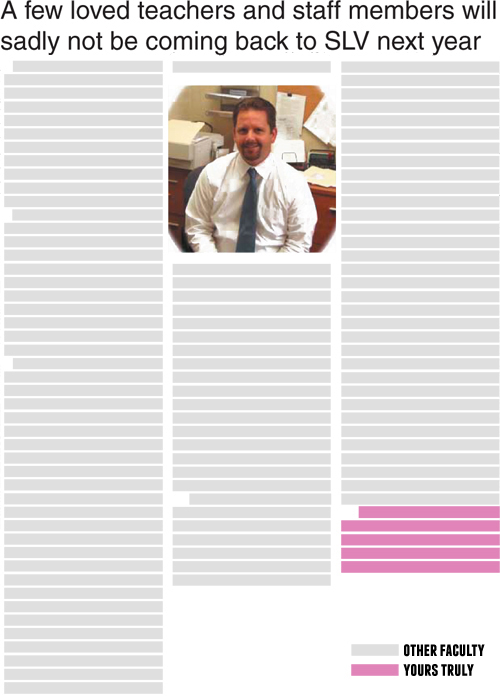
Probably Indicative Of The Splash I’ve Made On My Campus Over The Last Four Years

From the student newspaper (apologies to Andrew Kuo):

At the end of every year I’ve worked at this school, I’ve either been laid off or I’ve quit, which means that no one really believes I’m leaving now. I was offered a doctoral fellowship at Stanford starting next fall, lasting the better part of a decade, and emphasizing “curriculum design and teacher education.” If I’ve made my motivations for teaching and blogging clear at all these last few years, you’ll understand this wasn’t an offer I could turn down.

If I’ll admit to any buyer’s remorse, though, it’s right now, a few hours after saying goodbye to some of the coolest human beings of any age I’ve had the good luck to meet. I’m feeling too melancholy to write at length about any of this, which is probably a good turn for humanity, but these would have been the general themes:

  1. the opportunity cost of teaching, the time that planning for functional teaching has cost me every day for six years; how not teaching will allow me to start banking some time and concentration towards longer projects.
  2. some frivolous concern for the future of this blog; uncertainty that I’ll have any time or energy to write anything here during my doctoral studies, much less anything of any insight into the classrooms I’ve abandoned; concern that I’ve now become the sort of egghead I found it so easy to ignore when I was a teacher.
  3. some really frivolous remarks about blogging as career propellant.

For now, I’m going to see how fast I can hit the bottom of this bottle; I’m going to tell my wife as many stories about those kids as she can stand; and I’m going to hope my next job is half as rewarding as the last.

I got a lot better from teaching than I gave. Never let me tell you otherwise.

TMAO Rides Again

Maybe? The post reads like Kilian Betlach (neé TMAO) but I’m surprised to find his byline on a blog called “The Future of Teaching” given his skeptical stance towards your edu-technology of choice.

Regardless, “Kilian” puts words to an escalating fear of mine: that advocates of ed-technology have grown weary of extending (what they have presumed to be) carrots to classroom teachers and are starting now to see the appeal of Arne Duncan’s sticks:

My knee wants to say it’s a little afraid that the reform 2.0 folks are lining up with those who promote an excellence agenda, one that says our top kids must be prepared to be better than the top kids from other countries, and never mind what’s happening (or not) in Washington Heights, the RGV, or Deep East Oakland. This isn’t necessarily so, and it isn’t unavoidable, but my knee wants to constantly shout that as we try to (re)imagine what the public schools of 2030 will look, we must do so from the perspective of those schools have never well served.

It’s hard for me to distinguish (for one example) this Scott McLeod post from a press release from the desk of Michelle Rhee. Both drip with the same disdain for teachers who would have enacted their (McLeod and Rhee’s) preferred vision for public schooling years ago were it not for their (the teachers’) willful, clannish embrace of mediocrity.

Organizing Principles

As I lock picture on season six of this incoherent teevee drama called “Teaching,” I am very interested in articulating some general themes and principles around which I’ve tried to organize my instruction. Problem is: the more time I spend creating math problems, the more I detach myself from those interesting generalizations. I am grateful, then, to a couple of edubloggers who have done some of that heavy lifting for me.

1. The Skills Aren’t Arbitrary

Tim Childers:

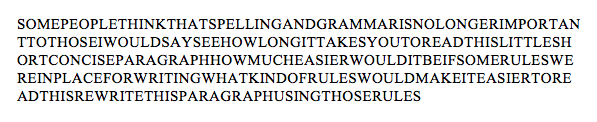
The original Greek texts [of the New Testament] were written in all capital letters with no spacing and no punctuation. I wondered what would happen if I gave kids the note below on the first day of class?

It is exceptionally easy for me to treat the skills and structures of mathematics as holy writ. My default state is to assume that every student shares my reverence for the stone tablets onto which the math gods originally etched the quadratic formula. It is a matter of daily discipline to ask myself, instead:

  1. what problem was the quadratic formula originally intended to solve?
  2. why is the quadratic formula the best way to solve that problem?
  3. how can I put my students in a position to discover the answers to (a) and (b) on their own?

That’s hard.

And the same mandate goes for any hapless ELA teacher reading this blog. Why spaces? Why apostrophes? Why different words for “happy” and “ecstatic?” Why hyphenated compound adjectives?

2. Great Problems Are The Coin Of The Realm.

Avery Pickford offers a five-bullet definition of great problems. It’s excellent and concise. Here is the first bullet:

The problem should be accessible. It should minimize vocabulary and notation, have multiple entry points, and include ways to collect data of some sort. It should have multiple methods that promote different learning styles and celebrate different ways of being smart.

Dr. Tom Sallee, math professor and president of College Preparatory Mathematics, gave two of the best conference sessions I have ever attended (recapped here and here) and said this in one of them about good problems:

A good problem seems natural. A good problem reveals its constraints quickly and clearly. Developing good problems is not at all an easy task. I have a lot of experience with it and I have failed many times.

The best part about this particular currency is that as I get richer, you do too. When you create and post a great problem about Applebee’s, that’s money in my pocket as well.

I find myself dazzled daily by the great problems y’all share. We’re just printing money lately.

Good Bloggers On Good Blogging

Kate Nowak leads; Sam Shah follows. Both offer some great advice if you’re looking to get into blogging. Alternately, if you’re reticent and timid about the whole thing, here’s a poignant quote from Kate, three months before she wrote her first post:

I don’t have a blog, because I have nothing original to contribute.

So there you go.