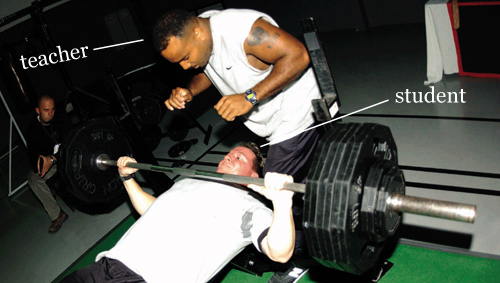
The good teacher knows if the learner learns through the ears, the eyes, or the hands just like the good spotter knows where the lifter wants support – at the wrists or under the elbows or on the bar. The good spotter is unhelpful; the good spotter doesn’t intervene at the first sign of struggle but realizes that the struggle is essential, that the struggle is the entire reason they are there, and waits as long as possible before intervening.
The good teacher puts weight on the student’s intellectual bar and lets her struggle under that weight as long as possible, asking questions to help her cut through the confusion, just like the spotter shouts encouragement at the lifter.
Mostly I envy the spotter. The job is so (comparatively) easy. The spotter steps in just as the lifter begins to collapse and not a moment before. That moment is nowhere near as obvious in teaching where what the learner says she needs and what the learner actually needs often are not the same thing, where it isn’t visually obvious that the learner is too perplexed or not perplexed enough.
And, my word: we’re spotting thirty people at once.