Category: uncategorized

Total 483 Posts

How I Welcome Newcomers to Online Teacher Professional Development (a/k/a the #MTBoS) and How You Can Too

Here is the promise:

There is a community of math educators that meets online at all hours of the day. They trade support and resources and many of the educators who meet there will tell you it is the most indispensable professional development they have ever experienced. If you lack support in your school or district, this community might actually get you through. I’m referring to the the Math Twitterblogosphere, or the #MTBoS, an abbreviation that is as unwieldy and charming as the community it names.

Here is the reality:

Where am I? Who are all these people? Is it rude to just say something to somebody? These conversations look interesting but do I just … jump in?

Here is an ugly bit of unexamined privilege:

Loads of people informed me immediately that, nope, Twitter only works that way if you already have lots of followers, if you’re already in the community, and that it also helps to belong to a demographic that is accustomed to being listened to all the time.

People informed me that their first leap into this teaching community was scary, that getting “shot down” was bad, but bad also was simply getting ignored.

I decided I didn’t want to ignore a tweet from a newcomer to the Math Twitterblogosphere. So about a month ago I wrote up the designs for a Chrome extension and hired a freelancer to build it. The extension highlights tweets from users that meet any criteria I choose.

Here is my “Welcome to the #MTBoS” rule. It highlights tweets from anyone with fewer than 100 tweets, people who are likely new in town, so I can make sure they hear from somebody.
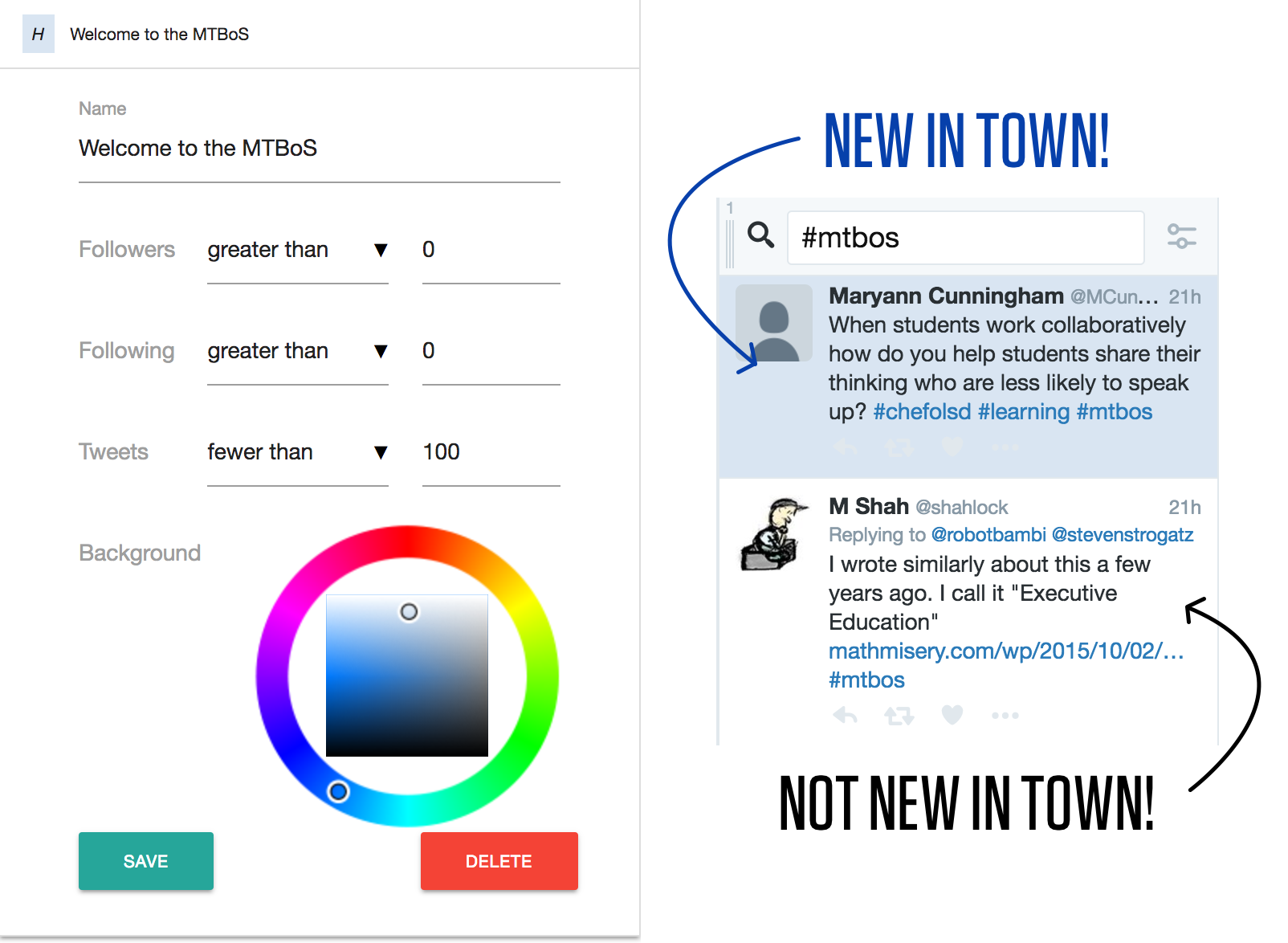
The results have been a blast. I don’t break much of a sweat on these welcome wagon tweets. “Never stop tweeting” is my standard greeting, after a more personal remark. Other times I try to connect newcomers to the resources they’re after. Regardless, people are generally really excited to receive these quick tweets.

That’s someone whose day got made because this little Twitter extension made it easy for me to make sure she didn’t get ignored.

You can make someone’s day too. Loads of these newcomers aren’t following me. Many of them are looking for classroom teachers to follow. Many of them are looking for people who are only a couple of years ahead of them in their careers, not ten or twenty.

You’re welcome to install the same extension, without any warranty, and with only the most meager set of instructions. (If I start hearing that a bunch of you want to install it, I’ll give it a proper download page with a proper set of instructions. 2017 May 25: Updated with that page.)

Hey. Good work, everybody. People are writing dissertations about us. People from outside mathematics education are looking in at us as a model for professional community. This place is special. Let’s keep expanding it — its numbers, its representation, and its heart. This is one idea I had recently. What’s yours?

Featured Comment

Michael Pershan offers his work towards community building: comment on more blogs.
RIP Malcolm Swan

In trying to explain to family and friends what Malcolm Swan meant to the field of math education, I’ve been putting him in the same category as Michael Jordan — talents that come along once in a generation in disciplines that are as much art as science. In Swan’s case, he designed experiences that endeared students to mathematics, and endeared teachers to students, more effectively than anyone I know. You can pick up his The Language of Functions and Graphs, now thirty years old, and wonder, “What have we been doing all this time?” Swan drew math out of the world and thought out of our students in ways that feel challenging and new even today.

Malcolm was uncommonly humble and generous for someone of his talent. He was willing to spend time and trade ideas with me long before I had anybody’s name to drop, or any name of my own. He was also uncommonly dedicated to the field of math education, writing articles, giving talks, and hosting workshops, and all throughout you knew he believed completely that you too can do what I do, that math education isn’t art or science so much as it’s design. And he believed that design could be taught and learned.

That’s why I’m sad for everyone who knew Malcolm personally, for his family and his colleagues at the Shell Centre, but I’m not as sad for our profession as I thought I would be. Malcolm’s talent was generational and unique, but he did more than any of us could have hoped to explain it. Over his career, he added to our profession in permanent ways far more than his death now subtracts. I know we will still be learning from Malcolm for decades. And throughout those decades, the best day of my week will be any day I get to introduce a new teacher to his work, and pass along his conviction that “you too can do what he did.”

The Difference Between Math and Modeling with Math in Five Seconds

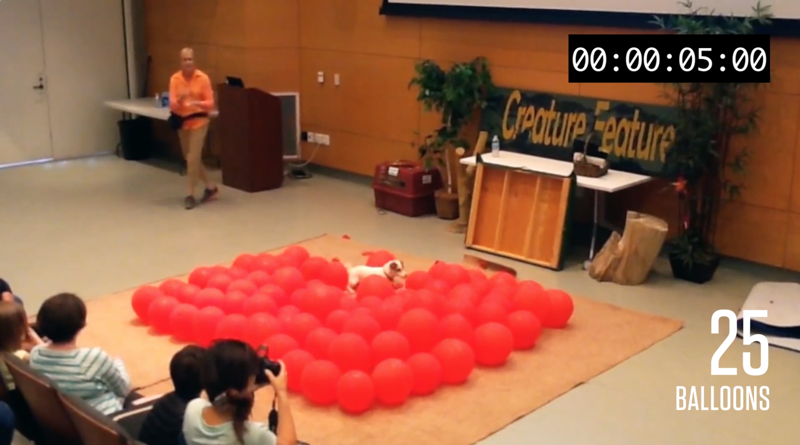
Jim Pardun sent me a video of a dog named Twinkie popping balloons in the pursuit of a world record. How you train a dog to do this, I don’t know. How there is a world record for this, I don’t know either.

What I know is that this video clearly illustrates the difference between math and modeling with math.

You can’t break math. Some people think they broke math but all they did was break ground on new disciplines in math where, for example, triangles can have more than 180° and parallel lines can meet.

Our mathematical models, by contrast, arrive broken. “All models are wrong,” said George Box, “but some are useful.” And we see that in this video.

Twinkie pops 25 balloons in 5 seconds. How long will it take her to pop all 100 balloons? A purely mathematical answer is 20 seconds. That’s straightforward proportional reasoning.

But mathematical modeling is less than straightforward. It requires the re-interpretation of that answer through the world’s imperfections. The student who can quickly and confidently calculate 20 seconds may even be worse off here than the student who patiently thinks about how the supply of balloons is dwindling, adds time, and arrives at the actual answer of 37 seconds.

Feel free to show your classes that question video, discuss, and then show them the answer video. Or if your class has access to devices, you can assign this Desmos activity, where we’ll invite them to sketch what they think happens over time as well.

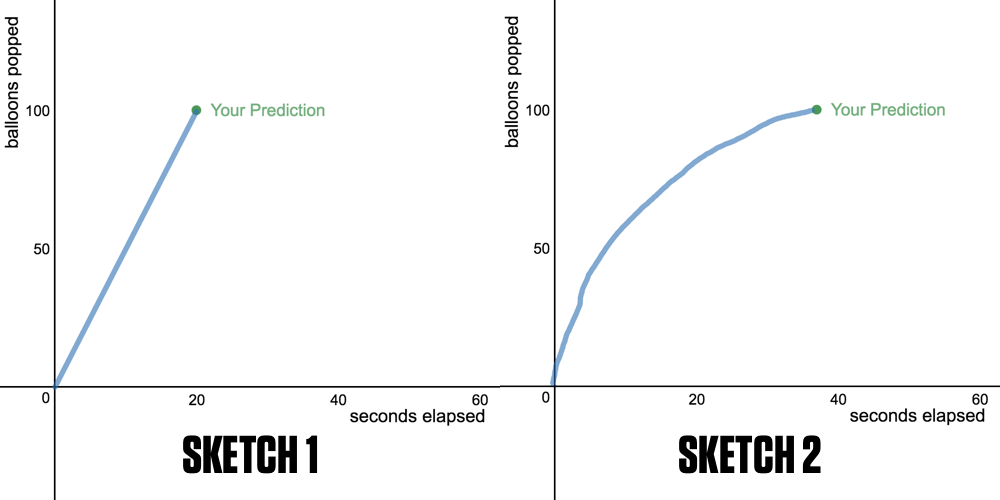
The difference between the students who answer “20 seconds” and “37 seconds” is the same difference between the students who draw Sketch 1 and Sketch 2.

You might think you know how your students will sort into those two groups, but I hope you’ll be surprised.

That difference is the patience that modeling with math requires.

BTW. I’m very interested in situations like these where the world subverts what seems like a straightforward application of a mathematical model.

One more example is the story of St. Matthew Island, which dumps the expectations of pure mathematics on its head at least twice.

Do you have any to trade?

2017 May 19. Steve Rein asked for the data set. Right here.

Shock and Disbelief in Math Class

Reader William Carey via email:

Last year I realized that Pre-Calculus is really a class about moving from the particular to the general. We take particular skills and ideas students are comfortable with – like solving a quadratic equation – and generalize them to as many mathematical objects as we can – solving all polynomial equations. As we worked our way through polynomials, we wanted to move from reasoning about particular quadratic equations like y = x2 + 2x + 1 to reasoning about all quadratic equations: y = ax2 + bx + c. For homework, the students had to graph about twenty quadratics with varying a, b, and c.

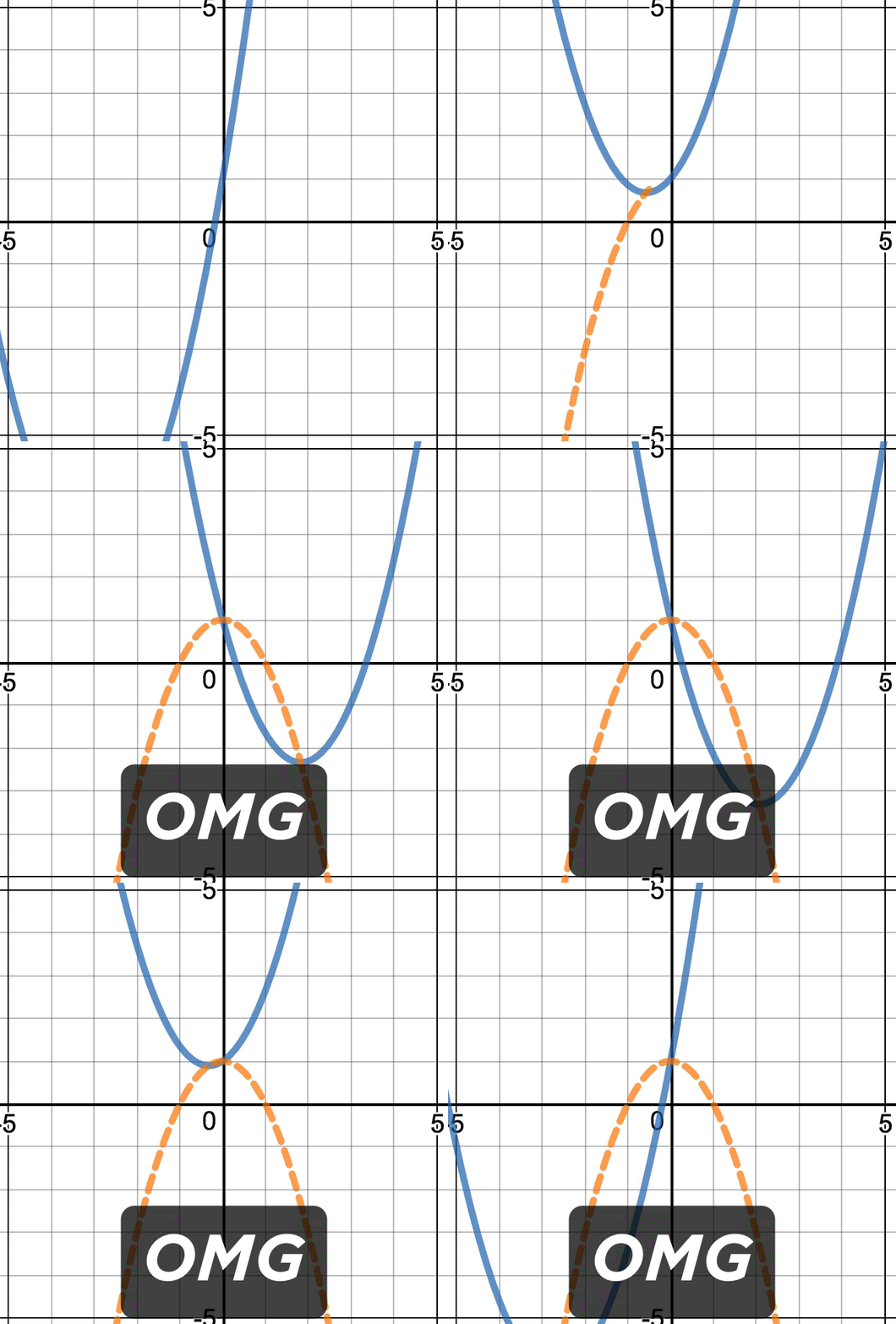
Then we got together to discuss the results in class. They remembered that a controls the “fatness” or “narrowness” of the parabola and sometimes flips it upside down. They remembered that c moves the parabola up and down. They weren’t totally sure what b did. A few students adamantly maintained that it moved the parabola left and right (with supporting examples). After about fifteen minutes of back and forth, we decided to go to Desmos and just animate b.

Shock and disbelief: the vertex traces out what looks like a parabola as b changes. Furious math and argument ensue. Ten minutes later, a student has what seems to be the parabola the vertex traces graphed in Desmos. Is it the right parabola? Why? Can we prove that? (We could and did!)

Previously: WTF Math Problems.

“All the time.”

David Cox:

Yesterday, a student gave me step-by-step directions to solve a Rubik’s Cube. I finished it, but had no idea what I was doing. At times, I just watched what he did and copied his moves without even looking at the cube in my hands.

When we were finished, I exclaimed, “I did it!”, received a high-five from the student and some even applauded. For a moment, I felt like I had accomplished something. That feeling didn’t last long. I asked the class how often they experience what I just did.

They said, “All the time.”

Featured Comment

Lauren Beitel:

Is there an argument to be made that sometimes the conceptual understanding comes from repeating a procedure, then reflecting on it? Discovering/noticing patterns through repetition?

Great question. I wrote a comment in response.