Asking Politicians To Take Summative Math Tests Devalues Math Education

Diane Ravitch (and Kate Nowak and Ben Blum-Smith):

Insist that all policymakers, think tank gurus, academic experts, and politicians who believe so passionately in standardized tests do this: Take the tests in reading and mathematics and publish your scores.

I understand the cathartic appeal of the challenge but I don’t understand what these educators think the inevitable failure of a politician, age 54, to recall advanced algebra will prove. What is the implication?

  1. We should only teach students the material a politician can recall at age 54?
  2. We should only assess students on the material a politician can recall at age 54?

Math educators struggle with this kind of shoddy post-hoc analysis all the time, which is why I’m surprised to see it grip Nowak and Blum-Smith. Parents tell their kids, “I can’t graph a polynomial to save my life and I’m doing fine,” as if the deficits and disinterests of a grownup should have more than a thimbleful of bearing on curriculum decisions we make on behalf of students.

There are valid arguments that advanced algebra is overvalued or that our summative assessments don’t accurately measure the value of advanced algebra. Let’s invest our energy there and not in this sideshow, the only result of which will be a little catharsis for reformers and lots of parents telling their kids, “The governor of New York can’t graph a polynomial to save his life and he’s doing fine.”

2012 Jun 3. Kate Nowak posts a follow-up:

So if any of you [politicians] are listening: take a test and see how you do, and reflect on what that number says about you. Reflect on what influences that number for a variety of kids with varieties of challenges in their lives. Reflect on whether it makes sense to judge and compare schools and teachers based on that number. Reflect on how kids and teachers are spending their time in school if they are motivated by fear to maximize that number, and whether you think that is a healthy use of their time. Ask yourself if punishment is an appropriate response. And then talk start listening and talking to people who know how to do this better.

No objections.

Visit a public school. Follow a student around for a day. Hang out in the faculty lounge. Take the tests. Reflect on all of the above. You’re a representative. Understand the outcomes of your policies on the people you represent.

None of that requires you to post your scores for the derision and catharsis of frustrated educators, simultaneously sending the message that the only point of education is to prepare students to become bureaucrats.

Five Favorites โ€” 101Questions [6/2/12]

  1. San Francisco House, Scott Farrar.
  2. Costco TV, Megan Hayes-Golding.
  3. Bill Roll, Joe Kremer.
  4. Good Tip / Bad Tip, Joe.
  5. Little Boy Counting, David Wees.

My Own Listing:

Data Dump:

I’m obliged to Phil Wagner for helping me parse 30,000+ questions:

Most Common First Word

49%: How
18%: What
5%: Is
4%: Why
3%: Which

Most Common First Two Words

20%: How many
10%: What is
10%: How much
6%: How long
2%: How big

Most Common First Three Words

8%: What is the
2%: How long will
1%: What are the
1%: How big is
1%: How many people

Most Common First Four Words

2%: How long will it
1%: How big is the
1%: How tall is the
1%: How long is the
1%: How long does it

Grab Bag Of Awesome

Phil Daro:

Wrong answers are part of the process too. Time and again in the Japanese classroom you’ll see, “Jen discovered an approach that doesn’t work. Jen, explain your discovery to the class.” Jen explains the discovery to the class. “Does everyone understand Jen’s discovery? Now let’s all figure out why it didn’t work. Jen, did you figure out why it didn’t work? Let’s figure it out.” It’s actually often easier to get to the math figuring out why an approach didn’t work than why an approach did work.

[N.B. Often times a student has correctly answered a different question, and asking “For what question would Jen’s approach work very well?” is generative.]

Apostolos Doxiadis argues for more “paramathematicians”:

If our rationale for teaching a subject is circular โ€” โ€œyou must learn it because it is useful, because it has uses, because it is useful, because you will need it later, because it is usefulโ€ โ€” we wonโ€™t go a long way. A developing human being is many things, and chief among them a poet, an adventurer and a problem-solver. Give the poetry, the adventure and the problems, through stories, both small stories of environment and large stories of culture. Grip the heart โ€” and the brain will follow.

As for the mathematicians themselves: donโ€™t expect too much help. Most of them are too far removed in their ivory towers to take up such a challenge. And anyway, they are not competent. After all, they are just mathematicians โ€” what we need is paramathematicians, like you…. It is you who can be the welding force, between mathematics and stories, in order to achieve the synthesis.

David Gessner built a shack for himself but left a gap between the door and the roof. He was rewarded when he didn’t patch that gap. Read about it and then imagine the contents of a blog post entitled, “Leave Some Gaps In Your Tasks.”

Featured Comment

Barry:

We may well ask of any item of information that is taught โ€ฆ whether it is worth knowing? I can only think of two good criteria and one middling one for deciding such an issue: whether the knowledge gives a sense of delight and whether it bestows the gift of intellectual travel beyond the information given, in the sense of containing within it the basis of generalization. The middling criterion is whether the knowledge is useful. It turns out, on the whole, โ€ฆ that useful knowledge looks after itself. So I would urge that we as school men let it do so and concentrate on the first two criteria. Delight and travel, then.

[Help Wanted] Ask Your Students To Ask Some Questions

Here are some questions that interest me:

  1. How useful is 101questions as a proxy for student interest?
  2. For example, when we find that 19% of 101questions users skip The Ticket Roll, does that mean that 19% of math students will skip it also?
  3. When we scribble information all over our images in our textbooks (instead of presenting concrete contexts) how does that affect their perplexity?
  4. For which contexts is video useful? Is the Pyramid of Pennies more perplexing as a photo or a video?
  5. Does a tripod matter? How is a student’s interest in a video affected if it features a slight wiggle rather than if the camera is locked down?

Niche questions, certainly, but they interest me so I set up two installations of the 101questions software at eagle.101qs.com and hawk.101qs.com to answer them.

What You Can Do For Me

If you are in a 1:1 classroom where Vimeo and YouTube aren’t blocked, and you have twenty free minutes between now and the end of the year, you can help me answer them.

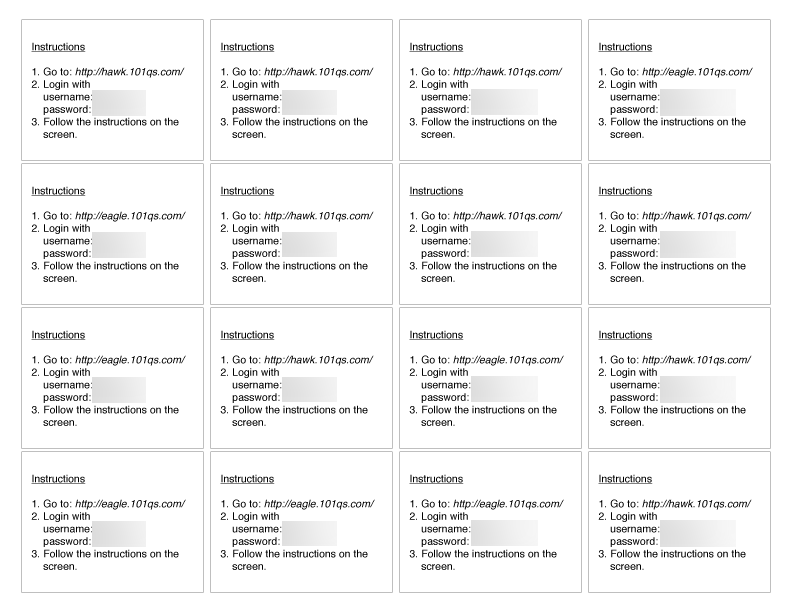
In the comments, let me know how many students you can commit and in what classes. I’ll e-mail you a handout (looks like this) you can cut up and pass out to your students.

The rest should be smooth. Once the number of conscripted students clears a certain bar, I’ll close the thread.

BTW: Nathan Kraft surveyed his students along similar lines. The results are fascinating.

2012 May 30: That’ll do it. Comments closed. Thanks for your help, everybody.