United Kingdom PD Opportunities

I’ll be taking a leave of absence from Stanford during the winter quarter of 2013 (all of February and March) to work with (and learn a lot from) the Shell Centre in Nottingham. While I’m in town, I’d love to do some work with UK maths teachers – workshops or lectures or whatever else. I have four openings. If I can help out, please drop me a note at dan@mrmeyer.com.

2012 May 18: Apologies for the double-post. I just finished up some renovations around here.

Five Favorites — 101Questions [5/12/12]

An embarrassment of riches this week. It was difficult keeping this to five:

  • Too good to be true, Scott Keltner. So is it … free … then? I give this image strong odds on provoking a class debate and highlighting some of your students’ misconceptions of percent growth.
  • Car Chase, Ryan Brown. The current darling of 101questions. (12 questions, no skips, as of this writing.) Notice how the first car smacks into the second, which was hidden off-screen. That’s stylish camera work!
  • Muggsy Bogues, Tony Gumbo. The question, “How much shorter is Muggsy Bogues?” is one thing. “How many different ways can you express that difference?” is another. (eg. Absolute v. relative.) Start with the first. End with the second.
  • First day of school, John Golden. “Is your height linear?” It’s a striking visual and the units along the “x-axis” are identical so you have a rare moment to examine the growth of height over time using people in photographs rather than points on a graph.
  • Plinko, Michael Pershan. Yeah, great cut at the end there. Where’s the wisdom in putting the biggest pay-out beneath the most likely bucket? Bowen? (Related: this image, taken from this video.)

Other notes:

  • Counting is so last winter. You’ll notice that your first ten responses will generally come from the same ten-or-so people who have seen everything uploaded to 101questions and keep current on all new uploads. It’s interesting to watch their tastes change. For instance, counting lots of little things used to be a lot of fun for this crowd, but now, as Tony Gumbo’s Bryant Denny Stadium can attest, counting is out. (Which isn’t to say that rating won’t pick up once more casual users check in, just that the obsessives have made their decision about counting.)
  • Speaking of obsessives, Andrew Stadel has written a great tutorial for getting the most out of 101questions.
  • Veggie Juice swings for the fences. You decide where it lands.
  • Closing. Timon Piccini’s Cab Ride is the first first act to “close,” which means 100 people responded to it. Now it goes to the very bottom of the pile on the homepage, where it’ll only be seen once people have seen everything else. Initially, I thought first acts would close in a matter of hours after being uploaded. That was naive. It took months.

Plus my own listing:

Featured Comment

Ryan Brown:

At this point, I’ve posted about 300 questions. I’ve noticed that I’ve kind of changed my approach for coming up with questions for other people’s items. Rather than try to guess the question that fits as math teacher, I’m trying to put myself in the shoes of a 9th grader and decide “will they find this perplexing”? Fuzzy pictures: skip. Small font items like receipts and print advertisements that are full of numbers and words but no overtly visual content: skip. I’m also noticing that I’m beginning to skip items that are repeats of previously seen items — even just same genre items like super large ________. Initially, the questions were leaping right out at me. But now I feel like the student who says “oh, we’re doing this again.” No longer perplexed if I know what the teacher wants me to say. (Full disclosure: 2 of my 7 uploads are “world’s largest ______” related). Am I too harsh here, or are other people taking a similar approach?

I’m also finding a difference between “perplexing” and “interesting”. There’s a ton of stuff out there that is very cool and very interesting (intricate artwork, geometric designs, etc), but there is no obvious solvable mathematical question that is just begging to be asked. I skip those every time.

“Definitely not where I imagined this blog would go”

Daniel Schneider:

I thought I’d still be the only one reading it these days. I’ve only recently started telling friends and colleagues about this site, which means most of those 10,000 are from people I’ve never met. I’m surprised by how many people have found me and I’m glad people find my ideas meaningful. I guess I’m just amazed at how easy it’s been to have a voice in the semi-anonymity of the internet.

If you’re just getting into teaching, there are plenty of worse ways to invest your time than in blogging, tweeting, and building your own faculty lounge.

2012 May 10. On account of her stellar blogging, Kate Nowak receives unsolicited e-mails from administrators looking to hire her.

So, you know. For the past long while it seemed like admins and hiring-decision types paid no mind to my blogging. But that’s changing. People are paying attention, and more importantly, it’s people who value the same things we do: continuous learning, reflective practice, learning out loud. I was asked about specific posts on f(t) in the interview for my new job, which not only helped them get to know me, but heightened my opinion of them and their school as a promising place to work.

That Kate Nowak:

I don’t have a blog, because I have nothing original to contribute.

FeedThresh

Shawn Cornally coins the term FeedThresh (short for “Feedback Threshold”) and gives it a definition that feels exactly right:

  1. The student knows that first attempts are rarely perfect, and often require serious revising.
  2. The student wants expert feedback on work that is established and based on research and the literature.
  3. The student knows that his learning is not tied to class time or any other arbitrary unit of time or space.

Assessment is too complicated for any of us to do any more than say, “We’re trying to optimize for a certain set of values,” and then make those values explicit. Standards-based grading involves some compromise, but I don’t know of another assessment strategy that optimizes the values that Shawn’s made so explicit here.

The Mullet Ratio

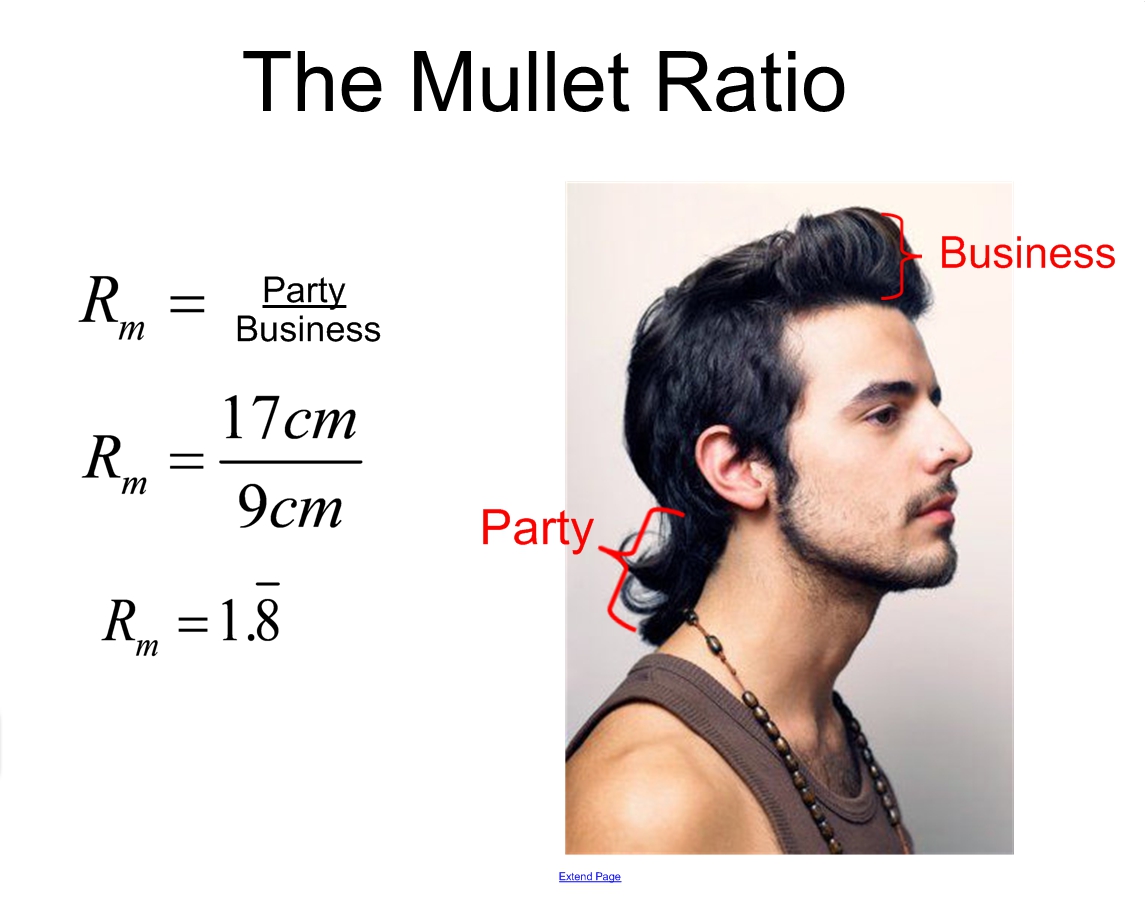
Matt Vaudrey takes an assist from Timon Piccini with a high-caliber lesson on the math of mullets. The money graf:

Students fit the pipe cleaner along the hair, then straightened it onto their rulers to find the measurement of the Party. The Business was usually pretty straight.

Great moves here:

  1. He begins the experience with intuition, the lowest rung on the ladder of abstraction, asking students to decide using nothing more than their gut “which one is more mullet-y?” By the end, they’ve named variables and defined operations, fully abstracting the context. Math has given a language to their intuition.
  2. He asks the students to generalize the ratio to their own haircuts, in addition to several other higher-level extension questions. You’re looking at an activity with a low bar for entry and a high bar for exit right here.
  3. He cut his own hair into a mullet for the occasion. That’s commitment, and gross.