[JOB POSTING] Math Adviser @ Caine’s Arcade

Caine’s Arcade tells the story of a nine year-old in East Los Angeles who made a functioning arcade – games, tickets, prizes, etc. – out of cardboard. He’s a scrappy underdog. He also needs your students’ help with math.

1. Fun Pass Economics

Nirvan Mullick:

I asked [Caine] how much it was to play. He was like, “For one dollar you get four turns. But for two dollars you get a fun pass.” Well how many turns do you get for a fun pass. “You get five hundred turns for a fun pass.” I got a fun pass.

Your students could probably lend a hand there.

2. Fun Pass Security

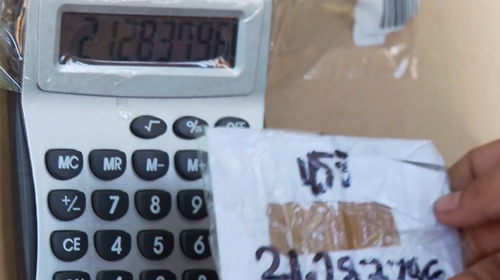
Caine installed calculators on all the games. Why? In order to validate the fun passes. He has a number on one side of the card. You type that number into the calculator, press “the check mark,” and another number comes out – a number that Caine thinks is totally unpredictable. So Caine writes the output number on the other side of the card and, thus, the fun pass is validated.

Resist the urge to editorialize about how our students think all of math is a fun pass validator. Instead, have your students show Caine how his system can be fooled and then suggest alternate methods for validating the cards.

Benefits? Not great. Pay? Not great either. Apply at the manager’s office, just past the cardboard skee ball machine.

2012 April 11. Aaaaand … cue the forged fun passes.

Hot Links

Amy Gruen’s blog is a pile of fun. She’s a magpie, looking about her world for odds and ends to bring back to her classroom, then posting pictures and explanation for our benefit. Recommmended.

Bryan Meyer:

You always hear people say, “kids don’t like math!” Correction…kids don’t like feeling dumb. People don’t like feeling dumb.

Dan Goldner:

I’m flabbergasted. I have a number of students–maybe 10? 20?–who determine by division how many bills there are, then figure out by multiplying 60x60x24 how many bills are given away in a day. Fine. But then they start subtracting … after day 1 there are 9,913,600 bills left. After 2 days there are 9,827,200. Almost immediately many students lose interest, but there are a few arithmetic ox that start chugging through it (with calculators, to be sure). 9,740,800. 9,654,400. I watch in disbelief as the markerboards are filled in, line by line. 8,617,600. 8,533,000. After a while I can’t help myself. I casually mention that people sometimes use division to do repeated subtraction, and I countdown from 10 by 2”²s and compare to 10/2. They are a little chagrined at not having thought of that, but they try it. Then they face confusion about handling the remainder.

[3ACTS] Bucky the Badger

W. Stephen Wilson:

The ability to communicate is not essential to understanding mathematics.

The Common Core State Standards for Mathematical Practice:

[Mathematically proficient students] are able to analyze situations by breaking them into cases, and can recognize and use counterexamples. They justify their conclusions, communicate them to others, and respond to the arguments of others.

Feel free to jump straight to the task page.

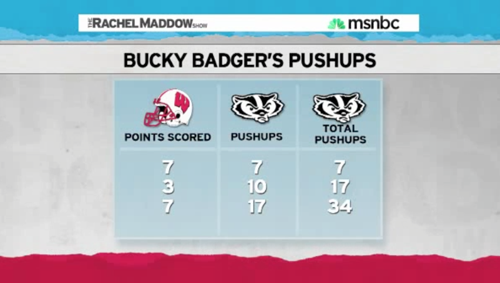
The jist, if you aren’t the movie-watching type, is that whenever Wisconsin’s football team scores, their mascot has to do push-ups equivalent to Wisconsin’s total score. This screen grab is a useful talking point.

Play the first act, which ends after Maddow announces the final score of the Wisconsin-Indiana game: 83-20. “83 POINTS!

Ask your students to write down a guess. “How many push-ups do you think Bucky did over the entire game?” Ask them to write down a number they think is too high and too low.

Here’s where it gets interesting. Ask them to write down all the information they’ll need to figure out the answer. That question is controversial even among math teachers at workshops I facilitate. Some argue that all you need to know is that Wisconsin scored eleven touchdowns and two field goals. Others argue that you also need to know the order of those touchdowns and field goals. In W. Stephen Wilson’s ideal math classroom, we’re stuck. Communication is inessential to Wilson’s ideal math classroom but communication is essential to any resolution of this dispute.

The mathematical practice standards require an argument. Both sides aren’t right. How will one side persuade the other? At this point, we learn a useful technique for arguing mathematically. One side has said, “Order never matters.” All we need to sink that rule is a single counterexample. One person suggests trying [7, 7, 3] and then [7, 3, 7] – the same scores in different sequence. Another suggests an even less costly test of [7, 3] and [3, 7]. And the matter is settled.

Having established that order matters, another question then arises: “If you’re Bucky, when do you want your team to score its field goals – at the end of the game or the beginning?”

Sidenote #1: Paper Wrecks This Problem

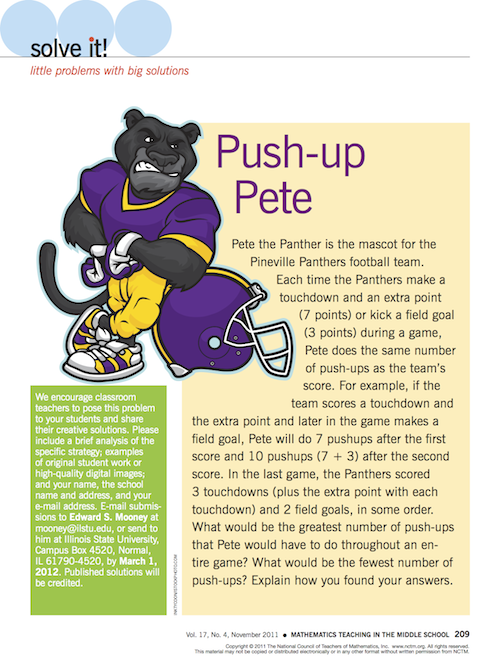
Paper is non-neutral. It changes the student’s task. NCTM posted a similar problem featuring “Push-Up Pete.” [h/t Cathy Campbell, John Scammell]

The question that’s rarely asked in print is, “What information will you need?” That information is generally nailed to the floor, written directly on the page. NCTM has revealed in the text of the problem that the order of the scores matters when all the action is in deciding whether or not the order of the scores matters.

Sidenote #2: Opposition To The CCSS Makes For Very Strange Bedfellows

The CCSS aren’t remotely above criticism. It’s bizarre to me, though, how many edtech pundits leapt on that Fordham piece, grateful for any institutional validation of their position against the CCSS. But Wilson and Wurman, the authors, like the punditry’s technological utopianism even less than they do the CCSS. The enemy of your enemy is not your friend.

Featured Comment

Tom:

My best two students disagreed on whether order mattered and I was able to convince (falsely) one of them that order didn’t matter. And sure enough one of my “average” students — who always works her butt off but is rarely rewarded publicly in class for that work — was the only one to figure out and show that order matters.

Technology Is The Oxygen

Kate Nowak recommends you rethink your upcoming session, “20 Ways To Use Pinterest In The Classroom!”:

But when people talk to me about the technology I have to constantly Reframe the Issue and explain how I’m not all pro any technology for its own sake. You don’t go, “Oh here’s this cool technology let me shoehorn it into my classroom.” Instead you go, “I think I have thought of the best way to teach this, and it would be impossible in an analog world, but I know enough about the technologies to realize this idea.” You don’t go to a twenty-minute inservice about xyz.com and go “I’m going to make an xyz.com lesson.” You use xyz.com for your own purposes, or you suspect its utility and put it in your back pocket, until your awesome instruction idea needs xyz.com in order to exist. Your lesson is the fuel and xyz.com is the oxygen.

BTW: I’m co-facilitating a workshop called “Technology Applications in Math and Science Classrooms” at Stanford this summer, July 30 through August 2. It’s open to the public. Registration information is at the bottom of this page.