Session Title
Thoughts On Rationalizing Algebra In Ways That Serve Kids, Not Universities
Presenter
Steven Leinwand, Principal Research Analyst, American Institutes for Research
Narrative
The day before CMC-North I was trading notes with our lead counselor, just swapping stories about kids, when she mentioned a student who was at the end of her turn at the local community college. She’d be transferring to a state college to complete a liberal arts degree if it weren’t for a failing grade in Algebra II. Because she can’t yet perform long division on polynomials, she’ll have to postpone her degree in (just guessing here) linguistics a full year.
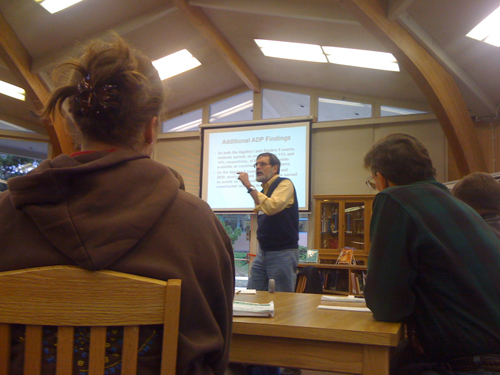
Leinwand opened his talk: “The great divider of our time is the Algebra II final exam. Algebra II squeezes off options for so many kids. Algebra II is anathema to all but the top 20% of the population. My premise: as currently implemented, high school algebra I and II are not working and not meeting either societal or student needs.”
He described the courses as “focused on increasingly obsolete and useless symbol manipulation at the expense of functions, models, applications, big ideas and statistics.”
He works with schools across North America and when he’s trying to get a feel for the tenor and rigor of their math programs, he asks for:
- the courses they teach,
- their course descriptions,
- the books they use,
- the balance of course enrollment,
- last year’s final exams for every class.
He said they give him unrestricted access to the first four but balk at the fifth. He said, “if you want to engage people in discussion, go and get those finals.”
Leinwand asked, why are most Algebra II final exams balanced towards the verbs:
- Simplify,
- Solve,
- Factor,
- Graph.
… when math is ever so much more about being able to:
- Find,
- Display,
- Represent,
- Predict,
- Express,
- Model,
- Solve,
- Demonstrate.
Lynn Steen: As mathematics colonizes diverse fields, it develops dialects that diverge from the “King’s English” of functions, equations, definitions and theorems. These newly important dialects employ the language of search strategies, data structures, confidence intervals and decision trees.
Leinwand: “No one is saying throw out the old dialect, but what about the new dialect.”
This all came across depressingly but he ended on a hopeful note, citing several promising projects. Among them, The Opportunity Equation, which aims to:
… explore the feasibility of offering a mathematics pathway to college for secondary students that is equally rigorous to the calculus pathway and that features deeper study of statistics, data analysis, and related discrete mathematics applications, beginning with a redesigned Algebra II course.
He called the forthcoming Common Core math standards “the last, best hope” for meaningful math reform. He ended with a proposal for Algebra I and Algebra II curricula, paced at one chapter per month.
Algebra I
- Patterns.
- Equations.
- Linear Functional Situations.
- Representing Functional Situations.
- Direct and Indirect Variation.
- Data.
- Systems of Equations.
- Exponential Functions.
- Linear Programming.
Algebra II
- Review and Reinforce Big Ideas and Key Skills of Algebra I.
- Quadratic Functions.
- Polynomials and Polynomial Functions.
- Patterns, Series, and Recursion.
- Exponential and Logarithmic Functions.
- Rational and Radical Functions.
- Probability and Statistics.
- Optimization, Graph Theory, and Topics in Discrete Mathematics.
Visuals
PowerPoint. Black text on a white field. He introduced his slides with this, “These are terrible slides coming up. You want to read PowerPoint slides that break every rule of PowerPoint these are them.”
I felt sick. Leinwand had attended my PowerPoint: Do No Harm talk last year and I could only hope he hadn’t added that disclaimer on my account. He was wrong anyway. He used his slides as conversation pieces. Doesn’t matter to me that they were monochrome.
Handouts
None.
Homeless
- There is a gentleman at the table across from me murmuring and nodding agreement at Leinwand’s every line. It would not be inappropriate to describe the atmosphere in this session as something like religious conversion.
- New rule: “Legislators can’t require a test that they themselves don’t take and publish the results of on their websites.”
- If you’re looking for an example from Leinwand of the “old dialect,” here’s one: rationalizing roots in the denominator of fractions. Here’s another: the conjugate in the same context. Can anyone make a case for that?
- One of “the most honest and important documents in our business in the last five years”: the $3.1 billion budget State Superintendent Jack O’Connell submitted in response to Governor Schwarzenegger’s pressure to make Algebra I an eighth-grade standard.
BTW: Fantastic follow-up from Josh G.
All of this just highlights the real problem: universities and colleges want a gatekeeper. They want that extra way to filter admissions, because they have to do it somehow. Worse, they don’t want to be seen as the “easy” school to get into, because this lowers their respectability. (This also drives me crazy.) So they demand gatekeepers, whether or not those gateways are actually a more useful math education for their students.
BTW: I have attached Leinwand’s slidedeck here.