Oh Yeah, And This Other Thing:

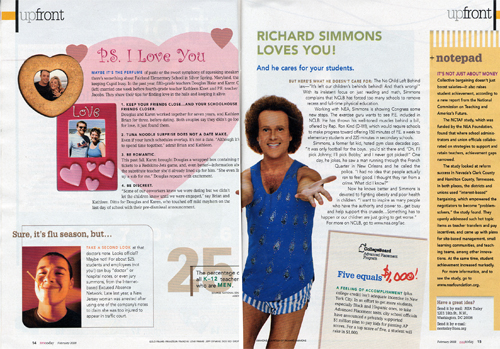
NEA Today : teachers :: Highlights : kids

I mean, look at this spread. Seriously. I get this thing in the mail every month and every month I stand in front of my box for, like, twenty minutes, shocked that this thing is pitched at adults, shocked that I pay for it.

Still can’t figure out if Reg Weaver’s going for Goofus or Gallant, tho’.

This Thing I Just Realized:

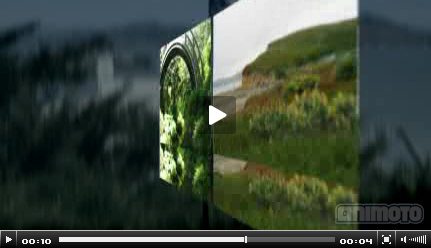
Teachers : Animoto :: Teenage Boys : Michael Bay

Animoto belongs in the classroom as much as Transformers does in an arthouse.

The masterminds behind both are clearly field-tested and combat-readyCheck out the Animoto intro video, which is a motion-graphic marvel, for proof., but as a storytelling device, as a medium for instruction, as a delivery device for anything but rockin’, noisy thrills, light on content, heavy on flash, their products flatly suck.

Again: if you want to strike an emotional chord with your audience or jazz up your Poughkeepsie vacation slideshow then Animoto’s got you covered.

But all y’all Classroom 2.0 Animoto-philesI only subscribe to their feed ’cause I’m running a heated bet with myself that Sir Ken Robinson’s state of the educational union will get 900 individual mentions (” … hey, has anyone seen this video … “) before school’s out. So far I’m winning.: when has any worthy learning moment come as cheaply and easily as an Animoto slideshow?

  • Upload your photos. [Great interface.]
  • Browse their archives for music. [It automatically embeds the citation.]
  • Uh.
  • Wait?
  • That’s it?

Yeah, I realize it slickly analyzes your music for tempo and adjusts visual rhythm to match but nowhere does it analyze your photos for content. Nowhere does it automate a narrative. Nowhere does AnimotoOr Michael Bay, while we’re here. do anything more than jab your frontal lobe with a sharp, happy stick.

*poke poke poke*

yeah! yeah! yeah!

Not saying there isn’t a place for this, but I am saying it isn’t the classroom. This is decidedly the one-size-fits-all visual essay and if I’ve gotta brainwash your kids when I get ’em from you and reteach ’em the form, it won’t be without posting this cranky missive first.

Gone In A Few Thousand Seconds

In December, a student gave me a gift card to a nearby sandwich shop. It was used. He didn’t care about the balance and neither did I. It was an irreverent Christmas gift, a tiny act of care from a student too cool for caring. I appreciated the gesture, naturally, but had no idea what to do with it until a few days ago.

It was lunchtime and I put it on a shelf somewhere just off the beaten classroom path. I circled my lunchtime crowd and asked them, “how do long do you think it’ll last before someone takes it?” We took bets, bragging rights for stakesFor the record, I take bets on everything. During our dimensional analysis unit, I’ll tell ’em Randy Moss ran the 40 yard dash in 4.25 seconds and take five bets on how fast that is in miles per hour. Easy, superficial, easy method for pumping them up for the work. Did I mention easy?.

If you guessed 24 hours, you’d have every reason to crow.

It kind of kills me how slippery my stuff is around here. Students take everything. Compasses, calculators, and rulers, in particular, have a shorter shelf life than whole milk.

That fact wedges me awkwardly between two competing interests. On the one hand, I want my stuff to remain my stuff for maybe a semester or two.

On the other hand, the obvious solution here (some kind of check-out system) is completely antithetical to my classroom game. My classroom is the place that it is, in large part, because I keep time-hogging administrative details to a few minutes daily and, as much as possible, I keep them out of my students’ line of sight.

eg:

I don’t dedicate a regular time slot to attendance. I don’t dedicate a regular time slot to homework review. I rarely pass back work โ€“ just assessments and only while they’re occupied by something interesting.

I feel strange wasting even small units of time. I draw up the next day’s highlighted problems the night before in Keynote and have them ready to go at a click of my remote.

Total time saved: maybe thirty seconds per problem, but all these measures taken as a sum make me, like, the richest teacher I know.

ie:

If I want to host a classroom spitball session on strategies for surviving a 47-story fall, or show Vampire Weekend’s awesome little music video, or mention in passing last year’s most popular baby names, or all three in the same period, I don’t worry about falling behind my colleagues or missing year-end benchmarks. I have hours in the bank.

I can’t speak with much precision for how my students feel about all this but I try to imagine this classroom from their perspective, a classroom which actively excludes boring self-sustaining details and instead pushes engaging moments into all available space, even the margins.

I’m working hard at it. I want this class to be the best paced and most engaging math class they’ve ever taken, even if it’s really, really poorly stocked.
So Happy Together #3

Make the marriage of your digital projector and laptop a happy one.

One Idea:

Become the teacher/learner hybrid.

Like this:

I buy some tea from the deli next to the school. $1.80. I’m at the grocery store the next day and notice a box of the same tea for $6.49. 18 bags. I start wondering, “how much is the deli profiting off our transaction?”

Then:

I take a picture of the box and put it in front of my beginning algebra classes the next day โ€“ today.

This is how we introduce rates: how it doesn’t just matter that the box costs more or that you get more tea in it rather you must consider the two things against each other.

After we divide price by bags and come up with 36 cents per bag, the students notice that same figure on the price tag. The grocery store helpfully makes these calculations for you.

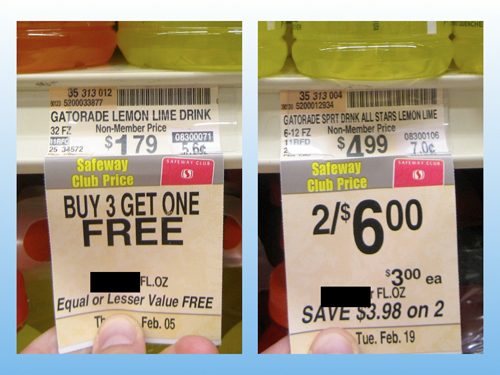
So when I put up two more photos, two sports drinks, one in bulk, the other in miniature six-pack, I censor those figuresIn this particularly mind-blowing example, the cost per ounce was the same..

And we spend 45 minutes running computations, discussing the results, arguing over the significance of the results โ€“ all from three photos.

No wipes, checkerboards, animations, or other PowerPoint detritus. This is the 21st-century digital projector bashed back into the 20th century.

This is one of those carousel slide projectors I’ll only pretend to have seen in person. I’m only projecting still images but here, in the 21st century, I can draw those images from infinite sources from around the globe or my local supermarket.

This practice habituates like a hard drug. With a digital projector waiting back in my classroom, I can’t help looking for interesting, relevant images to put in front of my class.

A digital projector shrinks the time-gap between my learning moment and theirs.

A digital projector has effectively buried the difference between What Fascinates Me and What I Teach.

Previous Editions: