Why Secondary Teachers Don’t Want a GitHub for Lesson Plans

Chris Lusto calls for a GitHub for lesson plans:

To say that the community repository model has done wonders for open source software is a massive understatement. To what extent that success translates to curriculum I’m obviously unsure, but I have randomly-ordered reasons to suspect it’s appreciable.

I attended EdFoo earlier this year, an education conference at Google’s campus attended by lots of technologists. Speakers posed problems about education in their sessions and the solutions were often techno-utopian, or techno-optimistic at the very least.

One speaker wondered why teachers spend massive amounts of time creating lessons plans that don’t differ all that much from plans developed by another teacher several states away or several doors down the hall. Why don’t they just build it once, share it, and let the community modify it? Why isn’t there a GitHub for lesson plans?

I’m not here to say that’s a bad idea in theory, just to say that the idea very clearly hasn’t caught on in practice.

Exhibit A: BetterLesson, which pivoted from its original community lesson repository model to a lesson repository stocked by master teachers and now to professional development. (Its lesson repository is currently a blink-and-you’ll-miss-it link in the footer of their homepage.) The idea has failed to catch on with secondary educators to such a degree that it’s worth asking them why they don’t seem to want it.

Our room at EdFoo was notably absent of practicing secondary teachers so I went on Twitter to ask a few thousand of them, “Why don’t you use lesson download sites?” (I asked the same question two years ago as well.) Here are helpful responses from actual, really real current and former secondary teachers:

Nancy Mangum:

Using someone else’s lesson plan is like wearing a friend’s underwear. It may do the job but ultimately doesn’t fit quite right.

Jonathan Claydon:

Their wheels aren’t the right size for my car.

Justin Reich:

Linux works because code compiles. Syllabi don’t compile. If I add a block/lesson, I never know who it helps.

Bob Lochel:

I don’t require a script, just decent ideas now and then.

Grace Chen:

I’m not sure they solve for the problems they think they’re trying to solve. It takes time to read / internalize / modify others’ plans.

David Wees:

It’s challenging to sequence, connect, plan, and enact someone else’s lesson.

Mark Pettyjohn:

The plan itself is the least important element. The planning is what’s critical.

2016 Jun 11. Dwight Eisenhower:

In preparing for battle I have always found that plans are useless, but planning is indispensable.

In sum: “Small differences between lessons plans are enormously important, enormously time-consuming to account for and fix, and whatever I already have is probably good enough.” It turns out that even if two lesson plans don’t differ all that much they already differ too much.

Any lesson sharing site will have to account for that belief before it can offer teachers even a fraction of GitHub’s value to programmers.

2016 Jun 8. Check out Bob Lochel’s tweet above and Julie Reulbach’s tweet below. Both express a particular sentiment that the nuts and bolts of a lesson plan are less important than the chassis. (I don’t know a thing about cars.)

I was chatting with EdSurge’s Betsy Corcoran about that idea at EdFoo and she likened it to “the head” in jazz music. (I don’t know a thing about jazz music.) The head contains crucial information about a piece of music — the key, the tempo, the chord changes. Jazz musicians memorize the head but they’ll build and develop the performance off of it. The same head may result in several different performances. What I want — along with Bob and Julie and many others — is a jazz musician’s fake book — a repository of creative premises I can easily riff off of.

(Of course, it’s worth noting here that many people believe that teachers should be less like jazz musicians and more like player pianos.)

Featured Tweets

Featured Comments

Chris Lusto:

There seems to be a general distrust of ā€œother people’s lessons.ā€ Which I get. But nothing about this model would change the extent to which you do or do not teach other people’s lessons, or the fidelity with which you do it. Again, the whole thing that got me thinking in this vein was the problem of managing, in some kind of coherent way, all the changes that teachers already make as a matter of course. If you’re starting with an existing curriculum, then you’re using other people’s stuff to some extent. And once you alter that extent, it might be nice to track it, for all sorts of reasons. Maybe classroom teachers don’t find that interesting, but somebody in the chain between publisher and implementer certainly does. Not totally sure who the best target audience might be.

Jo:

As an elementary math coach I don’t want a repository of lesson plans either but my teachers long for one. However, when given pre-written lesson plans they’re not happy with them—for all the reasons listed above.
The hardest thing about elementary math is that most elementary teachers go into teaching because they love reading and they want to share that. They rarely feel that way about math. So, they want a guided lesson that will teach the requisite skills. Unfortunately, it doesn’t work for them any better than it works for secondary teachers.

Even in elementary it’s the process of planning that’s important. My brain needs to go through the work of planning—what leads to what, what is going to confuse the kids, what mistakes are they likely to make, what false paths are they likely to follow. The only way to deeply understand the material and how to present it is to plan it. The only way to truly understand the standard is to wrestle with what it really means.

Planning is the work; teaching is just the performance.

Ethan Weker:

I get a lot out of reading other lesson plans/approaches to teaching/ideas, and steal activities fairly regularly, but my actual lesson plans aren’t copies of others’. It’s more like they’re inspired by what other people do. This is where the artistry of teaching comes in.

Brandon Dorman:

I get it — we don’t want a repository of lessons, but what happens once those lessons get downloaded and re-worked? Right now there isn’t a way to see derivatives of those lessons, which could be very important.

Stephanie:

Brandon, I love that idea. Recipe websites do this – what can be substituted for what.. how can different teachers with different ingredients, different tools and in different places.. these are good parallels for the teaching world.

2016 Jun 13. Mike Caulfield offers an illustration of the value of planning relative to plans.
Math: Improve the Product Not the Poster

160602_4hi

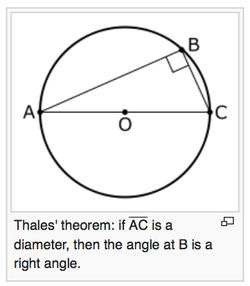
Danny Brown has expressed an interest in teaching mathematics that is relevant to students, relevant in important, sociological ways especially. This puts him in a particular bind with mathematics like Thales’ Theorem, which seems neither important nor relevant.

160602_1

Danny Brown:

Here is Thales’ theorem. Every student in the UK must learn this theorem as part of the Maths GCSE. You are explaining Thales’ theorem, when one of the students in your class asks, “When will we ever need this in real life?” How might you respond?

He proceeds to offer several possible responses and then, with admirable empathy for teenagers, rebut them. Brown finds none of our best posters for math particularly compelling. You know the ones.

  • Math is everywhere.
  • Math develops problem solving skills.
  • Math is beautiful.
  • Etc.

So instead of fixing our posters, let’s fix the product itself.

Brown’s premise is that students are listening to him “explaining Thales’ theorem.” Let’s question that premise for a moment. Is that the only or best way to introduce students to that proof? [2016 Jun 3. Brown has informed me that explanation is not his preferred pedagogy around proof and I have no reason not to take him at his word. So feel free to swap out “Brown” in the rest of this post with your recollection of nearly every university math professor you’ve ever had.]

Among other purposes, every proof is the answer to a question. Every proof is the rejection of doubt. It isn’t clear to me that Brown has developed the question or planted the doubt such that the answer and the explanation seem necessary to students.

So instead of starting with the explanation of an answer, let’s develop the question instead.

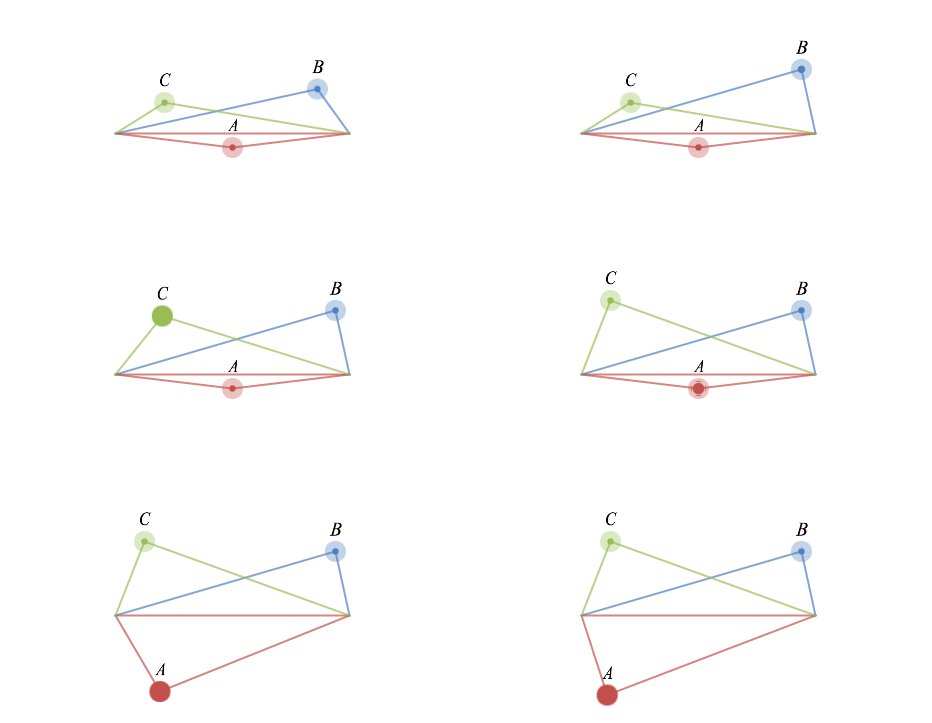
Let’s ask students to create three right triangles, each with the same hypotenuse. Thales knows what our students might not: that a circle will pass through all of those vertices.

160602_2

Let’s ask them to predict what they think it will look like when we lay all of our triangles on top of each other.

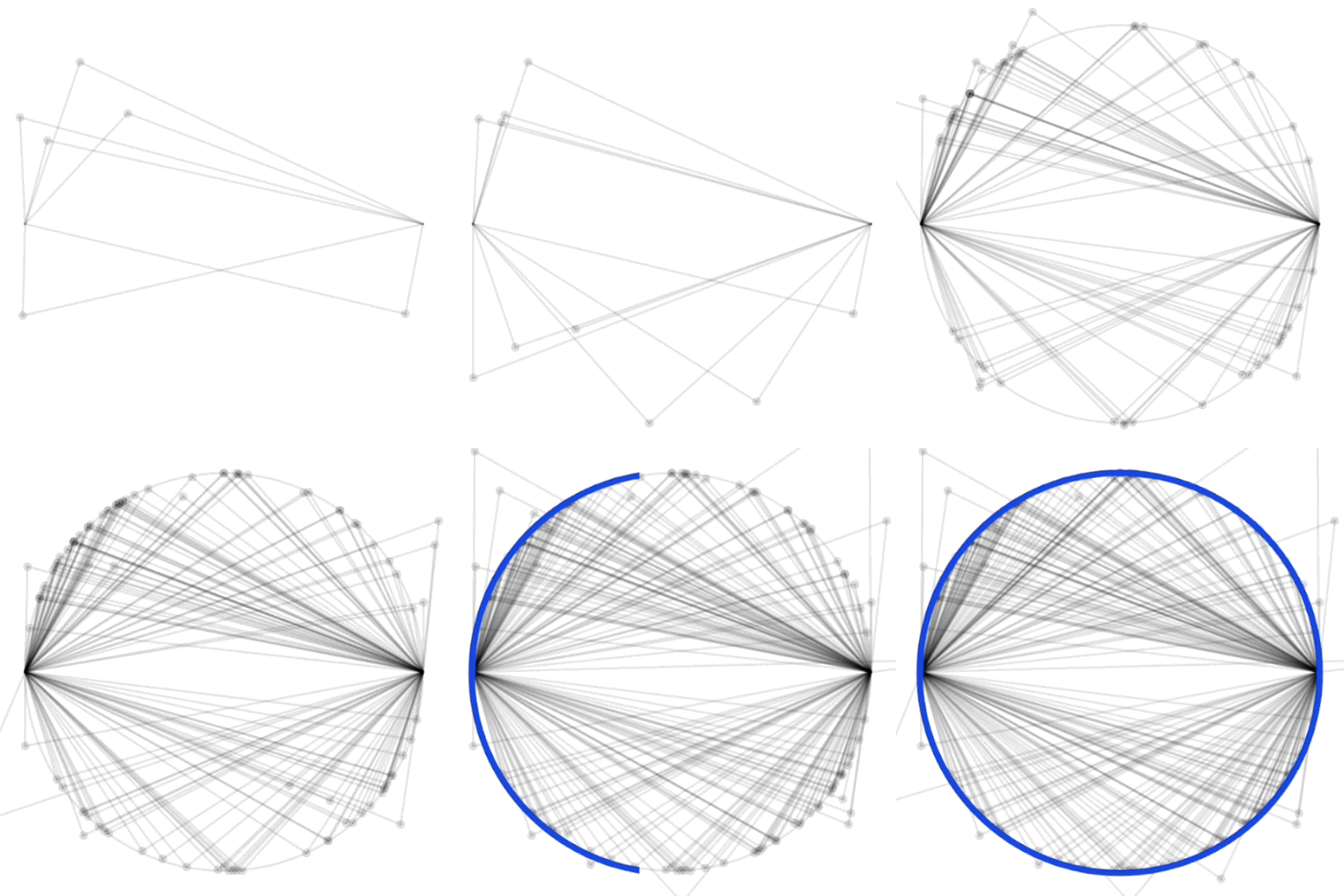
Let’s reveal what several hundred people’s triangles look like and ask students to wonder about them.

160602_3

My hypothesis is that we’ll have provoked students to wonder more here than if we simply ask students to listen to our explanation of why it works.

“Methods”

To test that hypothesis, I ran an experiment that uses Twitter and the Desmos Activity Builder and is pretty shot through with methodological flaws, but which is suggestive nonetheless, and which is also way more than you oughtta expect from a quickie blog post.

I asked teachers to send their students to a link. That link randomly sends students to one of two activities. In the control activity, students click slide by slide through an explanation of Thales’ theorem. In the experimental activity, students create and predict like I’ve described above.

At the end of both treatments, I asked students “What questions do you have?” and I coded the resulting questions for any relevance to mathematics.

77 students responded to that final prompt in the experimental condition next to 47 students in the control condition. 47% of students in the experimental group asked a question next to 30% of students in the control group. (See the data.)

This suggests that interest in Thales’ theorem doesn’t depend strictly on its social relevance. (Both treatments lack social relevance.) Here we find that interest depends on what students do with that theorem, and in the experimental condition they had more interesting options than simply listening to us explain it.

So let’s invite students to stand in Thales’ shoes, however briefly, and experience similar questions that led Thales to sit down and wonder “why.” In doing so, we honor our students as sensemakers and we honor math as a discipline with a history and a purpose.

BTW. For another example of this pedagogical approach to proof, check out Sam Shah’s “blermions” lesson.

BTW. Okay, study limitations. (1) I have no idea who my participants are. Some are probably teachers. Luckily they were randomized between treatments. (2) I realize I’m testing the converse of Thales’ theorem and not Thales’ theorem itself. I figured that seeing a circle emerge from right triangles would be a bit more fascinating than seeing right triangles emerge from a circle. You can imagine a parallel study, though. (3) I tried to write the explanation of Thales’ theorem in conversational prose. If I wrote it as it appears in many textbooks, I’m not sure anybody would have completed the control condition. Some will still say that interest would improve enormously with the addition of call and response questions throughout, asking students to repeat steps in the proof, etc. Okay. Maybe.

Featured Comments

Danny Brown responds in the comments.

Michael Ruppel responds to the charge that Thales theorem isn’t important mathematics:

As to the previous commenter, Thales’ theorem is not a particularly important piece of content in and of itself, but it’s one of my favorite proofs for students to build. It requires careful attention to definitions and previously-learned theorems as well as a bit of creativity. (Drawing that auxiliary line.) Personally, my favorite part of the proof is that students don’t solve for a or b, and in fact have no knowledge of what a and b are. but they prove that a+b=90. The proof is a different flavor than they are used to.

“The Cup Is the Y-Intercept”

Are your students overgeneralizing their models? After working exclusively with proportional relationships for the last month, are they describing every new relationship as proportional?

This isn’t a task, or a lesson, or anything of that scope. It’s a resource, a provocation, one that gives students the chance to check their assumptions about what’s going on.

Play this video and pause it periodically, asking students to decide for themselves, and then tell a neighbor, what’s coming next.

160529_1lo

10 marbles weigh 350 grams. So 20 marbles should weigh how much? I’m curious which students will say the answer is less than, exactly, or more than 700 grams. I’m curious which students will say it’s impossible to know.

Reveal the answer.

160529_2lo

That will be surprising for some. Now invite them to speculate about 30 marbles. 40 marbles. And 0 marbles.

Let me end with three notes.

First, my thanks to Kevin Hall who had the fine idea for the video and encouraged me to make it. I’ve never met Kevin. That’s the kind of internet collaboration that makes my week.

Second, the stacking cups lesson offers a similar moment of dissonance. Can you find it?

Third, here’s Hans Freudenthal on technology in 1981:

What I seek is neither calculators and computers as educational technology nor as technological education but as a powerful to arouse and increase mathematical understanding.

Featured Tweet

Michael Jacobs:

I always like creating a proportional reasoning speed bump by giving these types of questions.

160531_2

160531_1

Featured Comment

Kate Nowak:

Hey! Nice idea for helping kids make the turn from proportional to linear relationships. There were two things I wanted to change:

– the discrete nature of the domain
– the way it’s not clear in the still images whether we are being shown the mass of just the marbles or the mass of the marbles + the glass together (the brief shot of the balance scale with the glass on it at the beginning of the video wasn’t doing it for me).

So I made a video! Here! It was shot on my phone using a jar of cumin to stabilize, so it could certainly be professionalized.

The Difference Between Sketching and Graphing

Here is what I mean. Ask a student to:

Give an algebraic function whose graph has one positive root, a negative y-intercept, and an asymptote at x = -5, if that’s possible. If it’s impossible, explain why you can’t.

Maybe the student can determine the function. At some point, an advanced algebra student should determine the function. But what do I learn from a student who can’t determine the function? What does a blank graph tell me?

160523_1lo

The student might understand what roots, intercepts, and asymptotes are. She might understand every part of the task except how to form the function algebraically. I won’t know because I’m asking a very formal task.

This is why a lot of secondary math teachers ask a less formal question first. They ask for a sketch.

Sketch a function whose graph has one positive root, a negative y-intercept, and an asymptote at x = -5, if that’s possible. If it’s impossible, explain why you can’t.

160523_3hi

Think of what I know about the student that I didn’t know before. Think of the feedback that’s available to me now that wasn’t before.

Desmos just added sketching into its Activity Builder. That was the result of months of collaboration between our design, engineering, and teaching teams. That was also the result of our conviction that informal mathematical understanding is underrepresented in math classes and massively underrepresented in computer-based mathematics classes. We want to help students express their mathematical ideas and get feedback on those ideas, especially the ones that are informal and under development. That’s why we built sketch before multiple choice, for example. I’m stating this commitment publicly, hoping that one or more of you will help us live up to it.

Moving the Goalposts on Personalized Learning

Mike Caulfield:

But the biggest advantage of a tutor is not that they personalize the task, it’s that they personalize the explanation. They look into the eyes of the other person and try to understand what material the student has locked in their head that could be leveraged into new understandings. When they see a spark of insight, they head further down that path. When they don’t, they try new routes.

EdSurge misreads Mike pretty drastically, I think:

What if technology can offer explanations based on a student’s experience or interest, such as indie rock music?

Mike is summarizing what great face-to-face tutors do. They figure out what the student already knows, then throw hooks into that knowledge using metaphors and analogies and questions. That’s a personalized tutor.

But in 2016 computers are completely inept at that kind of personalization. Worse than your average high school junior tutoring on the side for gas money. Way worse than your average high school teacher. I don’t think this is a controversial observation. In a follow-up post, Michael Feldstein writes, “For now and the foreseeable future, no robot tutor in the sky is going to be able to take Mike’s place in those conversations.”

So it’s interesting to see how quickly EdSurge pivots to a different definition of personalization, one that’s much more accommodating of the limits of computers. EdSurge’s version of personalization asks the student to choose her favorite noun (eg. “indie rock music”) and watch as the computer incorporates that noun into the same explanation every other student receives. Find and replace. In 2016 computers are great at find and replace.

This is just a PSA to say: technofriendlies, I see you moving the goalposts! At the very least, let’s keep them at “high school junior-level tutor.”

BTW. I don’t think find-and-replacing “indie rock music” will improve what a student knows, but maybe it will affect her interest in knowing it. I’ve hassled edtech over that premise before. In my head, I always call that find-and-replacing approach the “poochification” of education, but I never know if that reference will land for anybody who isn’t inside my head.