Another aspect of personalization is the relationship between student and teacher, and I found that as blended learning decreased the amount of face to face whole class instruction in my class last year, I didn’t get to know my students as well and as quickly as I had in the past. When I know my students and find out what “works”, what engages, each particular group of students, as well what works for individual students, then my classroom can better meet individual needs, not just in the way I teach math, but in the way I encourage students to manage their time, to grow in their work ethic and study habits, to overcome math anxiety, and many other things. Whole class interaction is a lot of fun for me and, I believe, for students. Resources, such as videos, are great for motivated students to review or move ahead, and I will continue to provide them, but I am returning to primarily whole class instruction this year.
Two anecdotes about curiosity, followed by a challenge:
1. Nana’s Lemon Water
I facilitated a workshop in Atlanta a few weeks ago and a participant had one of these enormous Thirstbuster mugs. I asked, somewhat nervously, “Whatcha got in there?” She replied “water with lemon.”
I wondered, as I’m sure others might, “Well how much lemon would you need in that enormous thing to even taste it.”
It’s natural for humans to have questions and seek to answer them. Once I heard her answer, though, an unnatural, teacherly act followed. I tried to recapture the question, something like mounting a butterfly in a shadow box or preserving a specimen in a jar, so that a student could experience it also.
That’s this video and the attached lesson.
2. Rotonda West
Another example. It takes very little curiosity to appreciate the gorgeous, curated satellite images from overv.eu, such as this image of a Florida housing development:

What’s trickier for me is to format that appreciation, that awe, into a question, to capture that question so I can share it with students.
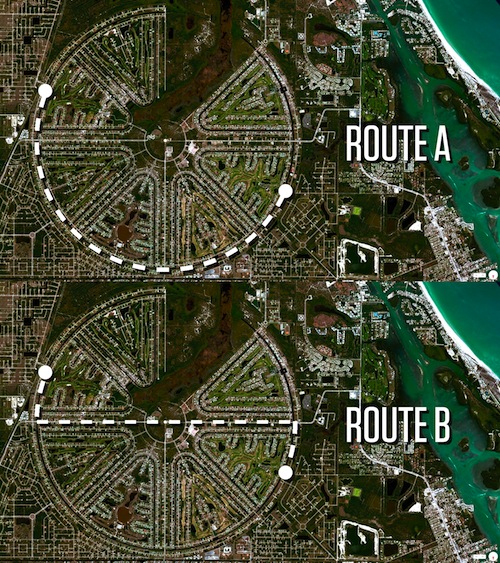
Making that image (and the answer) required a certain technological know-how, sure, but the really challenging part is training myself to probe interesting items for the curious questions they contain. It’s one of teaching’s unnatural acts and it requires practice and feedback.
3. Challenge
Curiosity is cultivated. Curious people grow more curious. These are examples of how I cultivate my own curiosity.
With that said, what curious questions can you find in this interesting story and video about the tallest water slide in the world? How can we capture that curiosity and make it accessible and productive for our students?
Previously: How Do You Turn Something Interesting Into Something Challenging
Bill Gates, via Tom Hoffman:
… the one thing we have a lot of in the United States is unmotivated students.
It’s astonishing to me how many people develop their pet education theories assuming there is little or no interaction between motivation and learning, or that motivation is somehow outside the teacher’s job description. The assumption that motivation is entirely the student’s job leaves us no way to check ourselves for de-motivating pedagogy. If students don’t like sitting in warehouses, watching lecture videos, and clicking away at multiple choice questions, it’s either their own fault, or the fault of Miley Cyrus, social media, or Kids These Days, but not ours. Our theories can’t be impeached. We just need a better class of students.
Related: Rocketship charter schools (which were last seen on this blog here) are abandoning their enormous warehouses where elementary students click away at multiple choice questions:
Teachers — who are at-will employees who can be fired at any time — also criticized Rocketship’s intolerance for dissent, saying it contributed to the disastrous redesign that placed 100 students in a classroom.
“Teachers raised concerns,” said one ex-teacher, “and no discussion was allowed on the subject.”
Those who privately expressed doubt feel vindicated [by the removal of the warehouses] although sad, by the resulting test decline.
Great.
Featured Comment
Tom Hoffman:
I was thinking that you can tell a lot about a person’s view of education by exactly when they realize the importance of motivation. From the beginning, in the middle or at the end.
I think one thing that probably strikes teachers about Gates’ quote there is how much it sounds like a cranky old teacher in the break room.
Jay Fogleman:
I find the idea that “today’s youth” are “unmotivated” is bizarre. When teenagers are “hooked” one topic or activity, they are darn near unstoppable.

After last week’s post knocking around “personalized learning”, Michael Feldstein argued that the term is too ambiguous to be useful:
All learning is personalized in virtue of the fact that it is accomplished by a person for him or herself. This may seem like a pedantic point, but if the whole point of creating the term is to focus on fitting the education to the student rather than the other way around, then it’s important to be clear about agency. What we really want to talk about, I think, is “personalized education” or, more specifically, “personalized instruction.”
Mike Caulfield described the value of structured discussion and how current personalized learning technologies undermine it:
… if there is one thing that almost all disciplines benefit from, it’s structured discussion. It gets us out of our own head, pushes us to understand ideas better. It teaches us to talk like geologists, or mathematicians, or philosophers; over time that leads to us thinking like geologists, mathematicians, and philosophers. Structured discussion is how we externalize thought so that we can tinker with it, refactor it, and re-absorb it better than it was before.
Is personalization orthogonal to structured discussion? That’s debatable, I suppose.
In practice, do the current forms of personalization in vogue (see, for instance, Rocketship) undermine the ability of a skilled teacher to run productive structured discussions?
Absolutely. Not a doubt in my mind.
Alex Hernandez claimed I set up a false choice between personalized learning paths and structured discussion:
Students can engage in personalized learning for a portion of the day and spend the rest of their time in rich learning activities that only teachers can provide. The bet here is that if students can drive their development of background knowledge, teachers can “trade up” and focus their energies on challenging tasks and compelling experiences.
Kevin Hall, one of the most useful foils I have at this blog, described a particular form of personalization:
Different groups could do the task with the same or isomorphic data sets in different contexts: sports, movies, etc. [..] My guess is ed tech will have us to this point relatively soon, don’t you think?
I just finished reading Daniel Willingham’s Why Students Don’t Like School, a challenging and affirming read at different times, and he takes a very dim view of this kind of personalization:
Trying to make the material relevant to students’ interests doesn’t work. As I noted in Chapter One, content is seldom the decisive factor in whether or not our interest is maintained.
I left comments in response to Michael Feldstein, Alex Hernandez, and Kevin Hall, in which I elaborate on the title of this post.
And Benjamin Riley, after starting this whole fire, tossed on another can of kerosene.