Great Classroom Action

130927_1

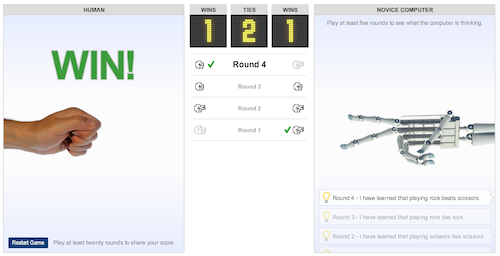
Bob Lochel has his statistics students take a “Rock, Paper, Scissors” prediction robot down:

Anyway, the NY Times online Science section has shared an online game of “Rock, Paper, Scissors”, where you can play against a choice of computer opponents. The “Novice” opponent has no understanding of your previous moves or stratgey. But, the “Veteran” option has gathered data on over 200,00 moves, and will try to use its database to crush your spirit Here’s what we did.

Sarah Hagan links up the definition of a function to dating advice:

After this short conversation, I think I saw some light-bulbs come on. There was laughter, and I heard several girls discussing how they were going to ask the next guy they were interested in if he was a function or non-function. They decided this was problematic, though, because he wouldn’t know what they were talking about if he hadn’t taken Algebra 2.

Campaigns for “Literacy / Numeracy Across The Curriculum” always seem to wind up a joyless exercise in box-checking for teachers outside those disciplines, but Bruce Ferrington’s school approached schoolwide numeracy with some whimsy:

The boss has decided that teachers are going to wear a number around their necks. No, we are not all convicts doing time. It’s a cunning plan to get the kids to look at numbers in new ways. The whole idea is that the students are not allowed to use the names of the teachers. They need to call them by a number combination or calculation that equals their number.

Bryan Meyer takes a rote numerical calculation (multiplying numbers in scientific notation) and adds several mathematical practices with an extremely canny, extremely simple makeover:

We decided that if we wanted kids to talk, they needed to have something rich and complex to talk about and make sense of. After brainstorming some different options, we turned the computational question into a conceptual one.
Blogger To Watch: Ben Orlin

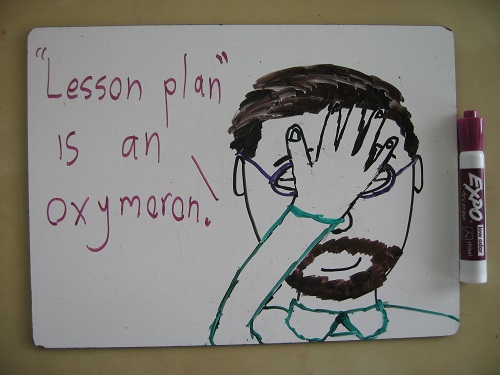
Oakland math teacher Ben Orlin started tweeting in April and blogging around the same time at his site, “Math with Bad Drawings,” which he illustrates with bad drawings (his description!) like this.

130923_1

He’s got great instincts for teaching, great insights into student thinking, and a punchy, nimble style. I highly recommend you subscribe to his blog, follow him on Twitter, stalk him at work, etc.

Three great posts:

[Makeover] Summary

Many thanks to Mr. Weiss for reminding me to compile all of this summer’s makeovers. Here’s every revision principle we applied this summer, ranked from most frequently occurring to least.

  • (9) Add intellectual need.
  • (6) Raise the ceiling on the task.
  • (5) Add intuition.
  • (5) Lower the floor on the task.
  • (4) Reduce the literacy demand.
  • (4) Show the answer.
  • (2) Put students in the shoes of the person who might actually experience this problem.
  • (2) Start the problem with a concise, concrete question.
  • (2) Ask a better question.
  • (2) Delay the abstraction.
  • (1) Offer an incentive for more practice.
  • (1) Enable pattern-matching.
  • (1) Get a better image.
  • (1) Add modeling.
  • (1) Change the context.
  • (1) Open the problem up to more than one possible generalization.
  • (1) Justify the constraints.

If you’re looking for a dy/dan house style, for better or worse, that’s it right there.

Great Classroom Action

130921_1

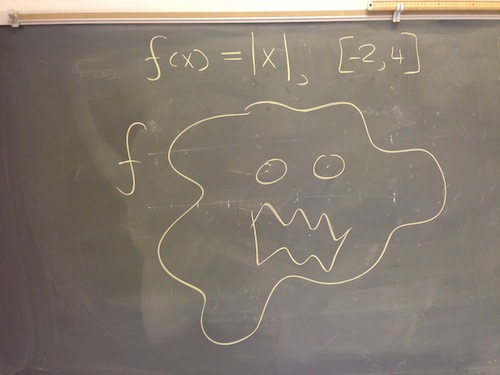
James Key uses a function monster to illustrate transformations:

f(x) is a function monster, and it can only *eat* numbers between -2 and 4. Now we define g(x) = f(x-3). We know that f eats numbers from -2 to 4. What numbers can g eat?

Cathy Yenca uses a number talk to draw out the distributive property:

I love how this scenario never fails me. Inevitably when I ask — not for the final answer — but the process and thinking that students used to find the answer, someone shares that they thought of “outfits” … 3(20 + 25) … and someone else shares that they thought of shirts and jeans separately … 3 – 20 + 3 – 25.

In the middle of a lengthy and fun post describing his first day of school, Andrew Knauft asks his students which number in the set {9, 16, 25, 43} doesn’t belong and why:

Here was a student, on the first real day of class, evaluating an argument independently of her own person bias, without forgetting that bias! (She believed her reason, for a different number, was more convincing, so the argument she read, although good, wasn’t good enough to sway her off her choice.)

Also in the vein of constructing and critiquing arguments, Andrew Shauver asks which image-preimage reflection is “best” out of a set of imperfect reflections rather than which one is “right”:

That question opens up a lot of potential thought-trails to wander down. As I did this activity with students today, the class settled on three criteria for rating these reflection attempts. The first is that the image and pre-image should be congruent. The next thought was that the image and pre-image should be the same distance away from the line of reflection. Finally, the students thought that the segment connecting the image/pre-image pairs would should be just about perpendicular to the line of reflection.

Explore The Math/Twitter Blogosphere

File this as Reason #437 I’m proud to be a part of this enormous professional community.

Tina Cardone, Julie Reulbach, Justin Lanier, and Sam Shah have decades of blogging and tweeting experience between the four of them and they’d like to put those decades to work on your behalf. If you’ve enjoyed sitting on the sidelines of the math ed blog scene until now but would like to get in the game, they’re offering their coaching.

Sign up at Exploring the Math Twitter/Blogosphere for “eight weeks of fun missions and prompts.” I’ll be subscribing to every blog that participates. Can’t wait to see some new faces and new insights in my RSS feed.