[3ACTS] Ditch Diggers & Bubble Wrap

Here are two new tasks – Ditch Diggers and Bubble Wrap. They’re united by one common feature:

I saw something interesting and tried to turn it into something challenging.

This process is always harder than I think it wil be.

With Ditch Diggers, I was bobbing up and down on an inner tube in Kauai as a tour guide told us that two groups dug these irrigation tunnels by blasting and digging their way towards each other from opposite ends.

With Bubble Wrap, I was reading about an Italian performance artist who passed out sheets of bubble wrap of different sizes so people waiting for a train could calm themselves down.

Both of these things interested me, but the line from there to a classroom modeling task forces me to ask myself:

  1. What question would lead to that interesting knowledge?”
  2. Is there some way I can provoke that question visually?
  3. Could a student guess at that question?
  4. What information would a student need to answer that question?
  5. What mathematical tools would a student need to answer that question?
  6. Is there some way to confirm the answer visually?

So the next time you see something that’s simultaneously a) interesting to you and b) mathematical, try running through those questions above and see how they’d play out. In the meantime, you can check out my specific answers above.

BTW. Many thanks to Chris Hunter for helping me brainstorm Bubble Wrap.

Getting The Most Out Of Edublogging

Michael Pershan:

I’m going to commit to finding things that are intellectually taxing that are central to my teaching. It’s going to require experimentation to find the right combination, but I think this search itself constitutes a sort of hard practice.

Evan Weinberg:

I need to be a lot more aware of the level of my own excitement around activity in comparison to that of the students. I showed one of the shortened videos at the end of the previous class and asked what questions they really wanted to know. They all said they wanted to know where the bird would land, but in all honesty, I think they were being charitable. They didn’t really care that much.

There you have two bloggers who are open and honest about their classroom misadventures. They don’t just say to themselves, “Well, if critical feedback comes through my blog, I’m sure I’ll be better off for it.” They’re bloggers who actively seek out that criticism. That isn’t easy to do, but a career is way too short to let the Internet’s vast store of criticism and insight go to waste.

Let’s Do Some Math: Scrambler

Here’s the scrambler, a carnival ride out of my childhood:

I’m curious where my red cart will be when the ride finishes. To begin with, you might tell me a location where my red cart definitely won’t end up. Ordinarily I’d ask you what information would be helpful for you to help me answer my question, but in the interest of time, I think this may help you here:

My sense is there are a number of different ways to answer my question but I’m not sure how many. Please post your thoughts in the comments and as precise a location of the red cart as possible. I’ll update this in two days with the answer.

BTW. A follow-up question (or “sequel” in the three-act parlance): if you trace a path behind the red cart as it moves, what will the path eventually look like? (This is called a “locus” but I suppose it’s best if we postpone formal vocabulary development until our debrief.)

2013 Feb 01. Here’s the video as it runs down to the end of the ride:

And here’s a killer Desmos calculator that lets you adjust all kinds of parameters on the scrambler.

Great work in the comments. Several people analyzed the periodic nature of the scrambler. Others

Alan November’s Three Strategies For Web Literate Learners

Alan November, in a workshop with teachers in Hong Kong where I found myself kind of randomly today:

  • Give your students two sites that offer two competing versions of the truth. Have them determine which one is true.
  • Assign one student each day the role of official researcher. Henceforth, whenever a question arises, the researcher answers it, not the teacher. Students eventually start asking more researchable questions more often.
  • Come into class with your own research question. Tell the class you need someone on the planet who knows more than you do about it. Have them find that person.

I like the list. How adaptable are these items to a mathematics classroom?

Pattern Matching In Khan Academy

Stephanie H. Chang, one of Khan Academy’s software engineers:

I observed how some students made progress in exercises without necessarily demonstrating understanding of the underlying concepts. The practice of “pattern matching” is something that Ben Eater and Sal had mentioned on several occasions, but seeing some of it happening firsthand made a deeper impression on me.

The question of false positives looms large in any computer adaptive system. Can we trust that a student knows something when Khan Academy says the student knows that thing? (Pattern matching, after all, was one of Benny’s techniques for gaming Individually Prescribed Instruction, Khan Academy’s forerunner.)

It is encouraging that Khan Academy is aware of the issue, but machine-scorers remain susceptible to false positives in ways that skilled teachers are not. If we ask richer questions that require more than a selected response, teachers get better data, leading to better diagnoses. That’s not to say we shouldn’t put machines to work for us. We should. One premise of my work with Dave Major is that the machines should ask rich questions but not assess them, instead sending the responses quickly and neatly over to the teacher who can sequence, select, and assess them.

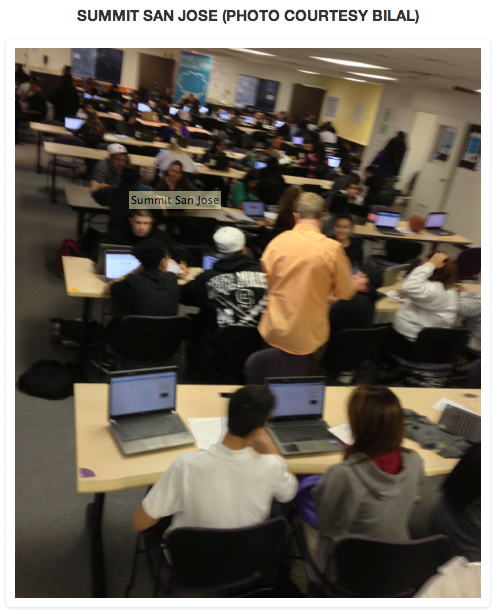
BTW. Also from Chang’s blog: a photo of Summit San Jose’s laptop lab, a lab which seems at least superficially similar to Rocketship’s Learning Lab. My understanding is that Summit’s laptop lab is staffed with credentialed teachers, not hourly-wage tutors as with Rocketship. Which is good, but I’m still uncomfortable with this kind of interaction between students and mathematics.

[via reader Kevin Hall]

Featured Comment

Stephanie H. Chang responds:

We think the work you’re doing with Dave Majors is really exciting and inspiring. Open-ended questions and peer- or coach-graded assignments are incredibly powerful learning tools and my colleagues at KA don’t disagree. We definitely have plans to incorporate them in the future.

Mg:

My old school last year relied on a teaching model where the students had to try and teach themselves a lot of math by utilizing classroom resources. A lot of the practice was through Khan Academy or by students completing practice problems with accessible answer keys. Ultimately what happened was that the students only looked for patterns and had no conceptual understanding of the math at all. Even worse was that students who had “mastered” the concept were encouraged to teach the other students how to solve problems but they could only do so in the most superficial manner posssible.

Bowen Kerins:

One way sites like Khan (and classroom teachers) can deal with this is by retesting – say, three months later, can a student solve the same problem they solved today? If not, they clearly only had a surface-level understanding or worse.

I’d like to see Khan or other sites force students to retest on topics that were marked as “completed”. But then again, I feel pretty much the same way about miniquiz-style Standards Based Grading.

jsb16:

Reminds me of the story about the tank-recognizing computer. I doubt we’ll have worthwhile computer scoring that isn’t susceptible to pattern-matching until we have genuine artificial intelligence.

And then the computers will want days off, just as teachers do.

Noam:

KA does force review of concepts after mastery is achieved, generally a few weeks after completion. Problem is, doesn’t take students long to do the pattern matching again.

We instituted a policy where students must make their own KA style videos explaining how to solve a set of problems that they struggled with. Best way we found to deal with the issue.

Zack Miller, comments on the laptop lab at Summit where he teachers math:

Our math model as described as concisely as possible: students spend two hours per day on math; one hour in breakout rooms and one hour in the big room (seen in your picture) where students are working independently. In the breakout rooms, students work on challenging tasks and projects (many of which we can thank you for) that develop the standards of math practice, often in groups and with varying amounts of teacher structure. Development of cognitive skills via frequent exposure to these types of tasks is paramount to our program. It is also in the breakout rooms where students’ independent work — which is mostly procedural practice — is framed and put in context. Students’ know that their work in the big room supports what they do in the seminar rooms and vice versa.