[Help Wanted] Can I Get Your Feedback On MathRecap.com

MathRecap is a project in modernizing and increasing access to math education conferences. I and my fellow recappers concluded our coverage of CMC-North last week. How did we do?

On the one hand, our most trafficked recap, Lisa Nussdorfer’s iPad session, received 538 unique pageviews, which means many more people had access to her talk than just the thirty of us in the classroom where she was scheduled. That’s great.

On the other hand, traffic wasn’t so explosive that I’m convinced this kind of site is as useful as it can be. So I’m inviting your commentary: What would make a conference recapping site most useful for you? If it isn’t something you find useful, why not?

NCTM is in four months. That’s a pricey ticket and many of you aren’t attending. So what can a site like MathRecap do for you?

Featured Comments

David Wees is the first to say that MathRecap wasn’t well publicized:

This is the first I’ve heard of the site, so I missed the announcement somehow, so maybe people just don’t know about it? I’ve added it to my feed though, and included it in my list of mathematics education blogs.

Jason Dyer:

I had no idea how what was being discussed translated into classroom practice, what “culturally relevant pedagogy” looks like past one ambiguously phrased word problem, and how the standards of mathematical practice are linked.

Michael Pershan:

Blog posts are good. Presentations are good. But what is each format particularly suited to do? In particular, what gets lost when you try to translate a presentation to a blog post?

Great Classroom Action

121216_1

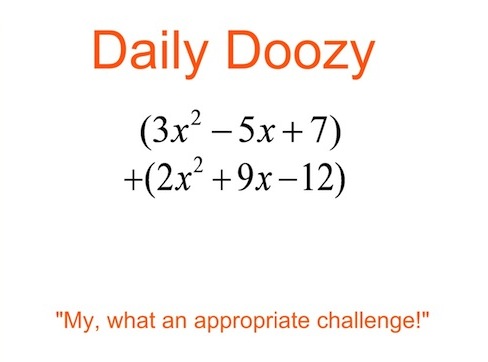
Matt Vaudrey’s Daily Doozy.

I’ve been faithfully naming the “Learning Goal” with each class for several years now. And frankly, it doesn’t inspire. Yawn. Instead of (actually, in addition to) this, I’ve added the Daily Doozy to my pre-lesson routine.

This a really profound shift and it deserves a discussion that’s longer than this capsule allows. He illustrates the Daily Doozy on polynomial addition, also, which underlines a point I don’t make often or well enough: after you have enough experience with variables and numbers, pure math becomes real-world math.

Cathy Yenca’s How Much Per Gallon illustrates Matt Vaudrey’s Daily Doozy in an applied context:

I “set the stage” by grabbing the water bottle from my desk, and asked, “Have any of you ever bought that colored, flavored liquid stuff to put in your water? Is it good?” A wave of opinions came crashing toward me, as students expressed their love for or disgust of the product. “How much do you think a gallon would cost?”

Carol Rogers uses two photos and a perfect question to illustrate the power of arrays.

Jonathan Claydon illustrates one way to put student teachers to use in his implementation of Log Wars:

Anyway, rumor is that kids love this game so I was optimistic. I took the cards that Kate Nowak links to and modified them a little bit to make a better distribution of numbers (most of the cards in their sets evaluate to 2). I finished with a set of 40 logs, printed them on mailing lables and had my student teacher affix them to index cards that had been cut in half. I gave each color group their appropriate color deck of cards. We had a brief demo and then I let them loose.

PSA: Unless you explicitly aim for anonymity in your blogging, do you, your students, and your career a favor by putting your real, full name somewhere on your blog’s home page. The weirdest, coolest opportunities come from having your real, full name attached to your great blogging. I find a lot great bloggers voluntarily (and probably unwittingly) giving up those opportunities.

What We Can Learn About Learning From Khan Academy’s Source Code

121212_5

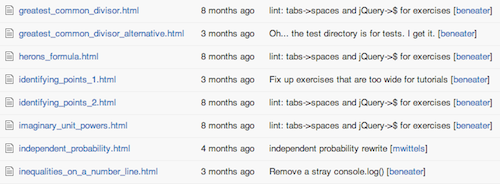
It’s great, first of all, that Khan Academy has all their student exercise code on GitHub for everybody to see. I don’t know any other adaptive system that does that. I figured there had to be a better way to reward them for that transparency than the criticism and judgment I’m about to post here, so I made them a badge also.

121212_4

Their code illustrates the different ways good math teachers and good programmers try to figure out what students know.

Take proportions, for instance. Here is the code that runs beneath Khan Academy’s proportions assessment.

In each of the dozen files I’ve reviewed, Khan Academy first generates some random numbers that meet certain criteria. In the proportions assessment, they call for three random unique integers between 5 and 12. No decimals. No negatives. No zeroes.

var numbers = randRangeUnique( 5, 12, 3 );

Then they use those numbers to generate exercises. With proportions, they insert an “x” randomly into that list of numbers. The final order of that list determines the proportional relationship that students will have to solve.

numbers.splice( randRange( 0, 3 ), 0, "x" );

But good teachers are more than random number generators. They create exercise sets that increase in difficulty, that ask students to demonstrate mastery in different contexts, all because proportions are conceptually difficult but procedurally simple. It’s extremely easy for students to get by on an instrumental understanding of proportions alone. (eg. “All you hafta do is multiply the two numbers that are across from each other and divide by the number across from the x.” Boom. It’s badge time.) It’s especially easy when the only thing that changes about the problem is the random numbers.

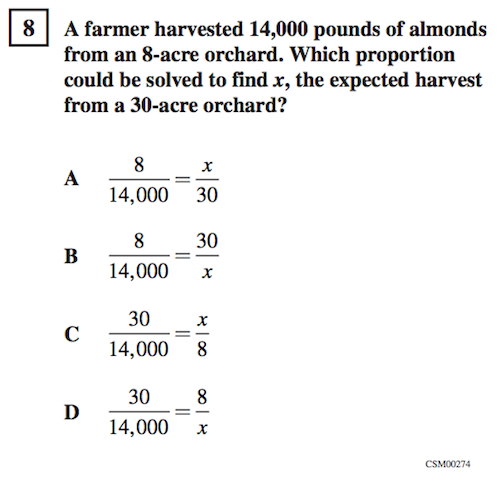
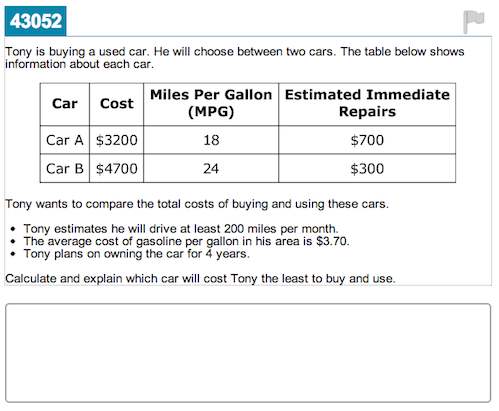
But forget good teachers for a minute. Let’s look at the bar set by various standard-setting organizations. Here is what you have to do to demonstrate mastery of proportions on a) Khan Academy, b) the California Standards Test, c) the Smarter Balanced Assessment.

Khan Academy

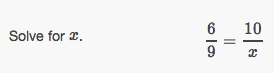
You’ll do a handful of problems just like this, with different random numbers in different places.
121212_2

California Standards Test

121212_1

Smarter Balanced Assessment

121212_3

The difficulty and value of the assessments clearly increases from Khan Academy to the CST and then Smarter Balanced. (I’m hesitant to guess how well a student’s score on the Smarter Balanced Assessment will correlate to all her practice on Khan Academy.)

Here we find a difference between good math teachers and good programmers. The good math teacher can create good math assessments. The good programmer can make things scale globally across the Internet. The two of them seem like a match made in math heaven. Just get them in a room together, right? But the very technology that lets Khan Academy assess hundreds of concepts at global scale – random number generators, string splices, and algorithmically generated hints – has downgraded, perhaps unavoidably, what it means to know math.

2012 Dec 13. Peter Collingridge points out in the comments that Khan Academy has a proportions assessment comparable to the California Standards Test. If they have anything similar to the Smarter Balanced Assessment, please let me know.
Watch Students Watch The Answer To Their Math Problem

Sadie Estrella’s class worked on Pixel Pattern and then watched the answer.

I’ll try not to be ideological here about photos and videos in modeling tasks. If you have another way to achieve the same cathartic reaction we find 38 seconds into the video, drop me a note in the comments. I’ll take it.

Previously

[3ACTS] Best Squares

I’ve been working on this series for the last two months. I asked four of the most active contributors on 101questions (Andrew Stadel, Chris Robinson, Timon Piccini, and Nathan Kraft – all dudes, sorry about that) to:

I love these problems, but they scare the hell out of me.

You have the #3act hallmarks: a short visual setup, minimal language demand, and a question that can be approached intuitively at first. Have your students write down a gut-level ranking of each contestant. Who drew the best square?

Now we ask the students what information matters and doesn’t matter and how they’ll use that information to make a rule.

We’ll eventually give them all the information they could want – area, perimeter, angles, side lengths, and coordinates (so they can get whatever we missed). The point is, we could very easily hint our way towards an answer by providing the area and the perimeter in advance, but now the student’s task is much harder and much more interesting.

Also, your task is much harder and much more interesting. You have to take whatever rule your groups of students come up with and parry back with cases – large, small, degenerate, etc. – that heat that rule to the melting point.

If the student says, “Let’s subtract each side from the mean side length. All the sides should be congruent,” you offer her a tilted rhombus, which scores perfectly against that rule but shouldn’t.

If the student says, “Let’s subtract each angle from the mean angle measure. All of them should be 90°,” you offer her a short, wide rectangle, which scores perfectly against that rule but shouldn’t.

These problems terrify me because even as I put an answer in the teacher’s guide [pdf], I’m not convinced it’s the best answer. (Should we give the bigger squares more credit because they’re tougher, for instance?) I only know the process is worth the terror.

BTW. This activity owes a debt to The Eyeballing Game and to Patrick Honner’s question, “Which triangle is more equilateral?” where you can find him parrying superbly in the comments.

Featured Comment

Bowen Kerins:

Why should it be “our task” (teachers?) to take the students’ rule and parry back bad cases? This is one of the most interesting roles a student can take in this process. I’d much rather have the students coming up with edge cases against their own, or ideally others’, rules. I’d keep a few in my back pocket just in case, but students can drive that conversation in great ways.

James Key:

“Draw two points and then the point exactly between them.”

Sorry to be nit-picky, but while the above task certainly meets the requirement for “minimal language demand,” I think ONE MORE WORD is required for the sake of precision: “halfway.” There is not a unique point that is “exactly between” two given points; there are many. But there is one point that is “exactly halfway between them.”

I know that “conciseness” and “precision” sometimes compete with one another, and I confess that I often strike the balance poorly.

2012 Dec 15. Fawn Nguyen gave this a go in her classroom.