[LOA] Lies We Tell Ourselves

  • The number of party guests increases according to the function g(t) = 2t + 4, where t is the number of hours after the party started and g is the number of guests.
  • The number of iPads sold increases according to the function s(t) = 2t + 4, where t is the number of weeks after the iPad went on sale and s is the number of iPads sold in millions.
  • The number of points the team scores increases according to the function p(t) = 2t + 4, where t is the number of minutes after halftime and p is the number of points scored.

Party guests. iPads. Points.

They’re all the same to the student who doesn’t understand abstraction, the process by which we turn those contexts into words and symbols. The idea that any one of those contexts will engage that student any more than another is a fiction.

BTW. Clarifying: the issue at hand isn’t that these three problems are simplistic or false abstractions of a context. It’s that they start at a high-level of abstraction. (This isn’t a revisitation of pseudocontext, in other words.)

2012 Sep 27. Nathan Kraft points us to some research that says, “This kind of superficial personalization, indeed, increases engagement and achievement.” So I may have overstated my case considerably. The point of this ladder of abstraction series, though, is that investments in making abstraction more explicit are way more worth our while, not that other investments aren’t important also.

101questions Updates

[cross-posted to the 101questions blog]

The big changes:

  • You can upload files now. No more pasting links to external content. You no longer have to upload your image to Dropbox or ImageShack or anywhere else (an incredibly cumbersome step for a lot of people) just to get material onto 101questions. We’re no longer restricted to YouTube’s hardline interpretation of Fair Use either.
  • You can download files now. Click “Actions” on any uploaded first act and then click “Download.” It’s awesome. It downloads whatever file the user uploaded (it won’t pull down content uploaded to YouTube or Vimeo) along with a text file with all the submitted questions.
  • You can get more responses more quickly by sending your link around. It bummed people out that they’d link to a first act and other people couldn’t add a question unless they saw it randomly come up on the homepage. “You should be able to add a question to the page itself,” they said. I resisted but I was wrong and now you can.

The small changes:

  • A pile of corrections to aspects of the UI that annoyed me, Amazon S3 integration, automatic comment subscription, a lot ground laid for the winter update.

[LOA] Hypothesis #5: Bet On The Ladder, Not On Context

#5: Kids care less about context โ€“ “real world” problems โ€“ than they do about problems that start at the bottom of the ladder. “Real world” is a risky bet.

Real World

Here is a “real world” problem:

The caterers Ms. Smith wants for her wedding will cost $12 an adult for dinner and $8 a child. Ms. Smith’s dad would like to keep the dinner budget under $2,000. Ms. Smith would like to invite at least 150 guests to her wedding. How many children and adults can Ms. Smith invite to her wedding while staying within budget?

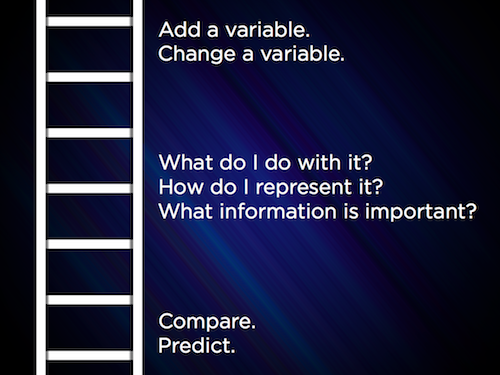
There is nothing to predict. Nothing to compare. The important information has already been abstracted. The question has been fully defined. The problem, as a whole, has been stretched tight and nailed to a board. The student’s only task is to represent the important information symbolically and then apply some operations to that representation.

And so hands go up around the room. The students attached to those hands say, “I don’t know where to start.” The task has hoisted them up to a middle rung on the ladder of abstraction and left their feet dangling in the air. Students are frustrated and disengaged in spite of the “realness” of the task.

Fake World

Meanwhile here is a “fake world” problem:

Here are questions you can ask at the bottom of that task’s ladder:

  1. What are the new percents? Write down a guess.
  2. Which quantities change?
  3. Which quantities stay the same?
  4. What names could we give to the quantities that are changing?

These questions include students in the process of abstraction. Each student guesses the new percents and is consequently a little more interested in an answer. Students aren’t just asked to accept someone else’s arbitrary abstraction [pdf] of the context. They get to make their own arbitrary abstraction of the context. (Why ABCD? Why not WXYZ?) All of these tasks prepare them to work at higher levels of abstraction later.

Solution

My preference is a combination of the two โ€“ร‚ย a context that is real to students and a task that lets them participate in the abstraction of that context.

But I can’t tell you how many conversations I’ve had with teachers (veteran and new) and publishers (big and small) who tell me the fix for material that students don’t like is to drape some kind of context around the same tasks. Rather than expanding and enriching their tasks to include the entire ladder of abstraction, they insert iPads or basketballs or Justin Bieber or whatever they perceive interests students.

Real-world math is a risky bet. Bet on the bottom of the ladder. Here are some of those bets:

  1. With the wedding task above, the teacher can ask students to pick any combination of children and adults they think will work. Any combination. 100 kids and 50 adults? Fine. Now tell me how much it costs. We’re all invested for a moment in a problem of our own choosing. Then we assemble student work side-by-side and notice that we’re all doing the same kind of calculations. Then we say, “All your work looks the same. What’s happening every time?” The students are participating in the symbolic abstraction.
  2. Louise Wilson is using the images and videos on 101questions to give students practice just asking questions about a context. Asking questions is the assignment. Getting answers isn’t.
  3. Andrew Stadel is giving his students daily practice with estimation, another task at the bottom of the ladder.

We ask our students to work most often at the top of the ladder and the result is a pervasive impression that a successful math student is a student who can memorize formulas and implement them quickly and correctly. Those are, of course, great and useful skills, but mathematicians also prize the ability to ask good questions, make good estimations, and create strong abstractions. These are skills where other students may excel. There is unrewarded excellence in our math classrooms because we have defined excellence narrowly as being good at abstract skills. You can only find (and then reward) that excellence by betting on the bottom of the ladder of abstraction.
[LOA] Hypothesis #4: Right Question / Right Rung

#4. Choose the right question for the right rung.

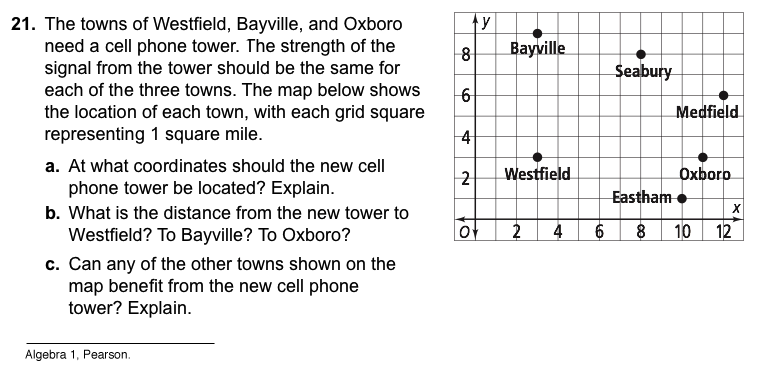
This is a high-level abstraction of cities on a map:

I don’t think it’s easy to start so high up on the ladder and answer questions like:

  1. “Can you guess where they should put the new cell tower?” or
  2. “What information will be important to know here?” or
  3. “How should we represent that information?”

Guessing, it seems to me, is a task that is easier to perform at lower level of abstractions. (Like this one.) Meanwhile, it’s impossible for the student to consider the lower-level question, “What information will be important to know here?” when the important information has already been selected. (The relative locations of the cities.) It’s impossible to consider the question, “How should we represent it?” when the representation has already been selected. (A coordinate plane.)

Likewise, it’s impossible to ask a student to “Calculate the location of the new cell tower” when they’re looking at a low-level abstraction of the context. Calculation is a task that’s made possible by higher levels of abstraction.

Again, we find a limitation of print-based curricula. The authors choose to show a single level of abstraction of a context and then ask all their questions about it, whether or not they’re the right questions for that rung.

[LOA] Hypothesis #3: Test Your Abstractions

#3: Let your students test their abstractions.

The Google team has one hell of an abstraction on their hands. They’ve distilled the complicated process of driving a car and its infinite judgment calls, muscle twitches, and cursing into a finite set of variables. That set of variables is so finite, in fact, they say that a computer can compute it in real-time and drive a car by itself.

That just isn’t plausible. At various points, I’ll wager the Google team didn’t think their abstraction was plausible either.

I’ll put any sum of money on this: the team wanted to know if their abstraction was any good. They’d thrown away so much data for the sake of a manageable abstraction. Did they throw away too much? Could they have thrown away more? Is the abstraction just right? They could have turned to existing theory and models in artificial intelligence and said, “Well, the literature says the model should work.” But no one would have walked away from that conversation satisfied.

People like to test their abstractions. They want to see the driverless car drive.

Again:

The thing is, you and I are in on the joke. A lot of our abstractions are flimsy. If the basketball falls off the plane defined by the player and the hoop, the model falls apart. We abstract runners into particles moving at constant speed โ€“ร‚ย no acceleration or deceleration. Try that abstraction with Playing Catch-Up. It falls apart. But it falls apart interestingly, and we win twice over. First, our students work on the abstractions we need them to work on. But we get a discussion about the limitations of those abstractions as a bonus. How much error should we tolerate? Are there ways we could improve the abstraction?

So for all these reasons and because there’s very little downside, give students the opportunity to test out and refine their abstractions.