Session Title
“Red Knowledge / Green Knowledge: A Different Way to Think about Teaching”
Presenter
Tom Sallee. Professor of Mathematics/Researcher, UC Davis.
Narrative
Man’s a titan. He was when I took him for Non-Euclidean Geometry at UC Davis and he was in the Sanderling Room today where he kept an audience rapt with only his measured cadence and an old-school overhead projector. Ninety minutes passed in what felt like ten.
He spoke of red knowledge and green knowledge, the red stuff being procedural/factual and the green stuff being conceptual. He distinguished them by saying that, with red knowledge, “you know whether or not you know it.”
“What’s 8 – 7?” vs. “How do you multiply two-digit numbers?”
“You’ll never hear me say conceptual knowledge and procedural knowledge aren’t both important,” he said. “That’s insane.” But he said he preferred conceptual knowledge because it gave him “a fighting chance” with a problem he’d never seen before.
“We tend to hide our best stuff from our students,” he said, “and I don’t know why.” He was referring to problem solving, honed intuition, creativity, etc.
I reckon this distinction is on the mind of anyone with a blog and of most people reading this. Implementation remains kinda fuzzy for all of us, though.
So the basics are these: during lecture he focuses almost exclusively on green knowledge and he puts it almost exclusively on them to pick up red knowledge independently, through the text.
He focuses each lecture on what he perceives are the largest ideas in calculus (for non-majors). For example:
To three decimal places find a number b such that:
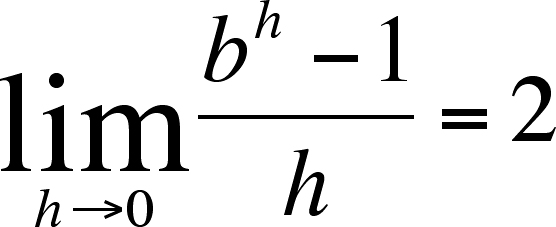
He’ll give that to kids who don’t know L’Hôpital’s Rule, kids who barely know the definition of a limit and draw them around to the idea that you can drop that equation into Excel and get a decimal answer accurate to three, four, five, or fifty decimal places.
He did this for a semester and compared survey results with a willing red-knowledge colleague. The results were descriptive and I wish I could recall the exact wording. My strongest take-away was that, while both classes evinced intellectual laziness that kinda comes with the college freshman territory (laziness that’s kinda our fault in high school) Sallee’s kids were much less intimidated by a problem they didn’t know how to solve and more often felt like class time had been well spent.
Presentation Notes
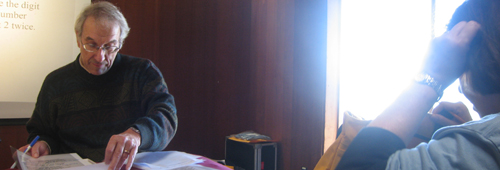
Acetane transparencies never looked so fine. He’d scribble on a couple, leave ’em up for a few minutes, and then put a new one up. Maybe because it was the second half of the day, maybe because I’ve got a nerd crush on the guy, I don’t know, but I welcomed the lo-fi approach.
Homeless
- Prefaced his talk with a two-minute summary so that anyone who wanted to bail could bail early rather than late. Classy.
- Recommended reading: The Structure of Scientific Revolutions, Thomas Kuhn.
- Rick West: “If you copy an answer, you’ve rented knowledge, you haven’t bought it.”
- He’s retiring this next year, which lent all kinds of urgency to his talk.
- The best assignment he ever received at CalTech: a sheet with 100 problems about which the instructor said, “Find all the problems you can do and don’t do them. Find a problem you can’t do and do it.”
Sufficient Megapixels
For Your Consideration
Building a bridge to the 21st century. Vote dy/dan best new edublog and best individual edublog.