Tom couldn’t quit if he tried. Here is the fourth in a great set of rap-themed classroom posters and his first nod to the international scene. ¶ Upload these to Snapfish, okay? They’ll print you out a full-color wall poster for under $10.
Year: 2007
Total 339 Posts
the photo sets:
- 25 photos taken at exactly the right moment, a set which is exactly what you think it is.
- Running From Camera, a German dude who sets his camera to a two-second timer and then sprints. If you’re gonna do any sort of long-term photo project, his set demonstrates the efficacy of a reference point. The dude’s blurry backside pins each photo down and lets your eyes wander off from there.
- Washington, D.C., on $85 a day, a set which probably isn’t what you think it is. [Related reading: souvenirs.]
the video clips:
- The Morning After, an awesome historical document, not of the actual (blasé) aftermath of Y2K, but of the worst-case scenarios we were all running through our heads on 31 December 1999.
- 721 claps per minute, offering the quick, back-of-the-gum-wrapper calculation, how many claps is that per second?
for your consideration:
Keep cool with Coolidge. Vote dy/dan best new edublog and best individual edublog.
I’m compiling notes for a presentation entitled Getting The Most Out Of Your Digital Projector (I know. Really catchy.) the main thrust of which is that my instruction has never been happier than when I made friends with:
- A digital projector, and
- A laptop.
One reason why:
The story goes that during World War II, Allied pilots were taking a beating. There was a very limited supply of retrofitting armor at the time so the Allies hired a statistician to determine where and how they might best allocate it.
The statistician took a top- and right-view diagram of the planes out to a runaway and watched the planes land. He marked a dot wherever he saw bullet holes and came back with something like the slide below. [cf. Abraham Wald’s original study.]

So after you tell your class that story and after you show that slide, you ask the question, “Where would you put the armor?”
You insert the question real quick and you turn your inflection up at the end like it’s just a quick set-up for the real question when in fact, nah, this is the only question.
They walk right into it and tell you they’d attach the armor where all those dots are clustered.
Then you tell ’em, “Nah, see, mister statistician put the armor where you don’t see dots.”
And I tell you: there isn’t any correlation between the age of the student and how long it takes her to figure out why.
See, I first told that story last year. I happened upon it ’cause some friend linked to some other blogger who linked to it out of someone’s del.icio.us feed.
Basically there was no way I’d ever find it again this year. I mean, maybe I’d remember the story but odds are slim I’d relocate that image again if not for the fact that my lightweight presentation files (a few megabytes per week) let me save every fun thing I’ve ever shared with my class. Forever.
And now this year, the same friend links to kottke who links to waxy via boing boing who gives up some other cool thing to share with my class. And suddenly I’ve got two awesome thought-provocations to spread over two days.
How long until I have 180 provocations for every day of the school year? No way to tell but given how happily my laptop and digital projector play together, I can only surmise: not very.
[Updated: to add a citation link to the source (courtesy Tim) and to clarify for anyone who thought I was claiming authorship for this anecdote or the illustration, I wasn’t. This post was explicitly about effective storage of found online resources.]
[Updated again: to add a link to Abraham Wald’s original study.]
For Your Consideration:
Are you better off than you were four years ago? Vote dy/dan best new edublog and best individual edublog.
If you asked me to name something that’d trigger a teenager’s passion, I wouldn’t leap at “Correctly Guessing a Has-Been Celebrity’s Age” straight away. But there they were, hollering, competing, and rallying over near misses like frat boys over fantasy football.
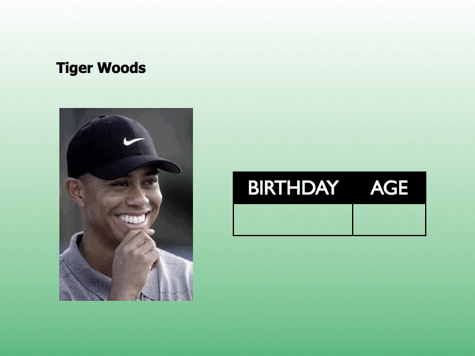
- You have your students make three columns: Name, Guess, and Actual.
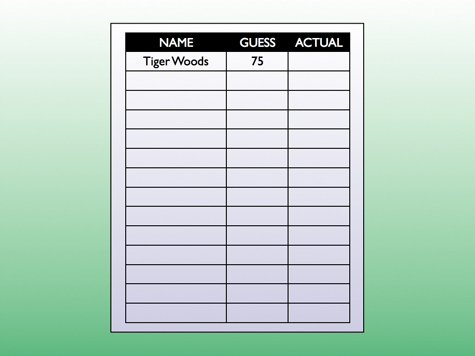
- You project twenty-or-so celebrities (a broad range of ages) onto the wall. You have ’em guess the age out loud.
- As they toss out guesses you say, “It’s probably a bad idea to toss out your guess. We’re all competing for the title of Best Age Guesser. Keep ’em close.”
- You keep projecting, they keep guessing. Maybe you ask ’em, “twenties or thirties or forties?” to keep ’em participating together.
- Then you go back through and give the ages. They write those under the “Actual” column. Watch ’em get crazy here, freaking out ’cause they were only three years off Natalie Portman’s age. Watch some of ’em blow Nelson Mandela by decades.
Enter the mathematics here:
- You ask, “how do we decide who guessed the best?” Expect intial suggestions like, “Whoever guessed the most right.” and “Whoever got closest to each age.”
- Take care of that first suggestion by asking who got the most right (Vicki, let’s say) and then ask the class, “Can we stop searching for the best guesser now? Is Vicki guaranteed? Why not?”
- Ask for clarification on the second suggestion. Get to a place where they’re subtracting the actual answer from the guess, getting negative numbers for underguesses and positive number for overguesses.
Make the math as hard or as easy as you want here.
Algebra and Below:
- Someone will suggest you add the new column of numbers up. You ask, “What number do we want there?”
- Someone’ll suggest “Zero.” You talk about the girl who overguesses Tiger Woods by 30 years and underguesses Oprah by 30 years.
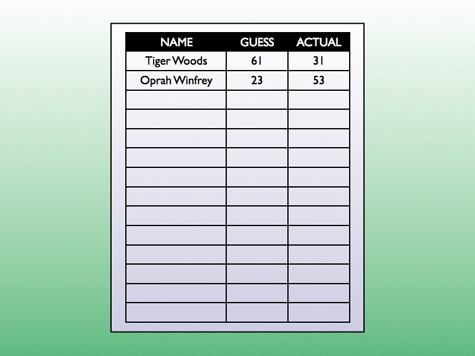
Girl has a zero but couldn’t guess your age if you handed her your driver’s license.
- “So what do we do?”
- Drop the negatives. It doesn’t matter if you guess over or under, only that you’re off.
- Have them find the mean of their new column, full of positives. What does it mean? (The average number of years they were off per guess.)
- Ask if it means they guessed over or under on average. (Can’t tell, we dropped the negatives.)
- Have them find the average including the negatives. (“Who guessed under on average? Who guessed over?”)
Algebra II:
- Connect this to absolute value.
Calculus:
- Talk about why the square of the differences is preferable to their absolute values. (x2 is differentiable where absolute value isn’t.)
Give the winner a fun-sized candy bar. Let her select a celebrity for inclusion in next year’s lineup.
Attachments:
- Keynote
- PowerPoint
- PDF (Obviously you’ll need to update the ages here.)
Credit Where It’s Due:
Got this idea from my ed-school mentor several years back. Yo, AB, I still use your stuff, man.
[Update: Matt has some pretty priceless extensions to this lab.]
How does the Mean and Median of all student guess do in this competition?
Creating a histogram of the guesses.
Looking at the standard deviation of the student guess. Do standard deviations vary with the age of the person.
And I reply:
Oh yeah, that’s great. It’s so clear now. I need to feature as many or more celebrities as there are students in the class. After the main event then I assign a celebrity to each student, they collect the guesses from around the class and perform a statistical analysis. Maybe I have Keynote slides set up so they punch in their data and present it real quick.
For Your Consideration:
Peace and prosperity. Vote dy/dan best new edublog and best individual edublog.
- vote dy/dan for:
- get a hundred of your friends to do the same
- then vote Teaching in the 408 for best teacher blog. (a few reasons why the dude deserves the eyeballs.)
Thanks, team. And if you’re looking for some extracurricular reading, check out the top vote-getters. Hadn’t heard of a few and a few are pretty good.