- In what two ways will your male teenage students spend their free time and disposable cash this weekend?
- How much does it matter if you don’t know?
Month: April 2008
Total 25 Posts
The public’s much-criticized lack of interest in advanced math may, in fact, betray their good sense, not their bad. Calculus-driven math may be foolish-driven math, that mis-prepares us, leaving us disarmed before the realities of our world. Perhaps a “statistics-driven” math would be equally tough and “advanced” but more suitable for a democratic citizenry?
I’m convinced the Algebra I > Geometry > Algebra II > Precalculus > Calculus train is useful only to the students who ride it all the way through Calculus, where all of Algebra II’s abstract gamesmanship finally pays off
Other math teachers feel free to drop some disagreement on me but Algebra II needs to earn its way as an elective and accede its place on state college prereq lists to Statistics, which, for anyone majoring outside the hard sciences, is more relevant, more useful, and often more fun.
[via the Teaching Excellence Network’s strong new blog]
Related:
- Roger Schank takes fewer prisoners than I do over at The Pulse.
It was only halfway through Jackie’s post, only after I had scribbled down a dozen techniques and ideas, that I realized she was writing a lesson plan and not just blogging anecdotally about her day.
Awesome. You have to notice.
Three People
Three people attended my presentation. Three.
Off my last OTF experience I brought 40 handouts with me. 37 came home.
When three people show up for the presentation to which you drove three hours and for which you spent 12 hours structuring content, creating slides, and designing handouts, it’s impossible not to run the numbers – that’s five hours investment into Austin, Dale, and Niko each.
Scrambling
I admit I’m most comfortable addressing large crowds (by which I mean, larger than three) and structuring interaction between the members. Obviously that wasn’t going to play with three people so I tossed myself out of the 747 and hoped the parachute would deploy.
I didn’t stand in front of them. I sat with them and we talked. I kept a loose grip on my wireless remote. I asked for their frustrations with PowerPoint, for their solutions. I issued challenges. I asked whether a slide would work well for kids and, if not, how it should be improved. As conversation lagged, I advanced slides and put up different visuals. The prompts and discussion began anew.
Feedback On My Improvised Constructivism
100% positive exit slips. ONE HUNDRED!!!! That’s a lot of percent right there.
On Handouts
My handout design followed the steps outlined here. To recap, if you’re simply selecting “Print” from PowerPoint’s “File” menu, you’ll find your handouts lining the recycling bin outside the venue.
Instead, create a document which will look different from participant to participant, something which reflects their sensibilities as much as it does yours, something which doesn’t mimic your slides so much as it complements them. Prompts for introspection and list-making are essential. White space is essential.
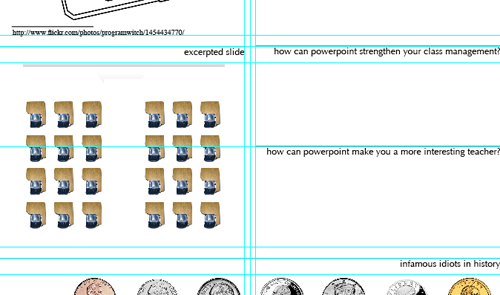
I used InDesign and invested heavily in grids. The finished product met my expectations.
On Slides
No observations I haven’t already whomped on the head a few dozen times already. Just that a) you’d better be able to bounce a quarter off any PowerPoint presentation which takes aim at best PowerPoint practices and b) on successive edits I consistently deleted slides. Whatever that means.
The Heartbreaking Moment
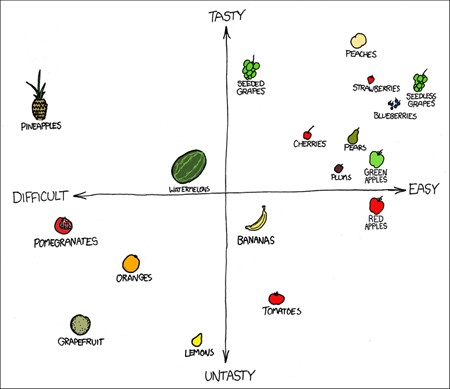
After we finished the third in a set of math-rich images I found online
“You see, um, I check a couple hundred websites each day but, see, it only takes like forty-five minutes because of this thing called, um, RSS, and you can get a reader from, for example, Google, and it’s totally free and … and –”
– and essentially I’m really unhappy with you guys for not prepping me for this one. If my personal learning internets hadn’t fumbled the ball here I might’ve had Common Craft’s explanation all queued up. Next time I’ll be ready.
- “Mercury News Craps the Bed on the Achievement Gap“, TMAO. Room D2.
- “An Idiot’s Assessment of the Gap“, Mr. AB. From the T.F.A. Trenches.
Both bloggers respond to a piece in the San Jose Mercury News, which engages a provocative but thoroughly false dichotomy best repped by the headline, “Smart v. Cool,” the thesis of which is that smart Latinos are stigmatized while smart Asians are vaunted, an article in which the Mercury and Nature take Nurture back behind the shed and shoot it.
Racial misdirection from the Mercury:
The put-downs are clear: Smart is not cool.
And too many Latino students are choosing cool over school.
But a few miles away at Hyde Middle School, in the heavily Asian Cupertino Union School District, Tiffany Nguyen detects the opposite attitude. If you’re not smart, “you’re really looked down on,” said the Vietnamese-American eighth-grader.
These attitudes, to the extent they exist when reporters aren’t around, are the effects of a massively under-performing school system. This is what happens when you take children who already have less, and then you give them less of everything that matters in education. This is what happens when adults have failed, for generations, to harness the human capital, technical knowledge, and simple will to make good on the promise of work-hard-get-ahead. This is the type of ideological blowback that occurs when poor kids receive fewer resources, crappier facilities, teachers unable to teach, principals unable to lead, and school districts unable to identify problems and formulate even the most basic plan to remediate them.
Get this straight and send it to your friends: Children of color don’t devalue a good education and therefore fail to get it, they’re never given it and eventually, sensibly, stop caring.
Comments are closed here. Let ’em know over there.