Month: April 2008

Total 25 Posts

PowerPoint: Do No Harm

Session Description

The difference between the best and worst classroom PowerPoint is vast, greater than any other classroom tool I’ve used. The teacher who uses it well will enjoy easier classroom management, more satisfied visual learners, richer classroom conversation, and will be, herself, a more satisfied teacher. The teacher who uses it poorly (which is to say, typically) will leave her students no better than when she found them and, in many cases, they’ll be a lot duller.

In other words, PowerPoint is rarely value-neutral. Let’s make it great.

Media Smorgasbord!

  • Quicktime [slidedeck narrated by yrs trly; iPod ready; 23 min; 40.2 MB]
  • Flickr Slidedeck [with notes]
  • PDF Slidedeck [with notes]
  • Session Handouts [pdf]
  • Keynote Slidedeck [remix, reuse, recycle]
  • Slideshare [ufa mess; Slideshare & Keynote continue their blood feud; whack colors substituted for transparency; plus slide transitions are somewhat essential support for the thesis that no one should ever use slide transitions; tried to sync up audio but the process is painful; minimum slide length is, like, nine seconds, so Lessigophiles beware.]

The Hardest Thing Lately

The hardest part of my day is ignoring Miles. I say hello to everyone before class, but not Miles. I kinda stare off past him, interesting myself in some shrubbery or a cloud, or I pretend to see a friend from my childhood far across the courtyard. He slumps past me, head low, hatred for all of humanity hanging over his head like a cloud.

It sucks, but every day I say hello to him, he’s sullen for two hours. Every day I act as diffident as he is to pleasantries like “hello” he’s fired up all period and eager to please.

I mean, what would you do?

[related]

Really Stupid Fun

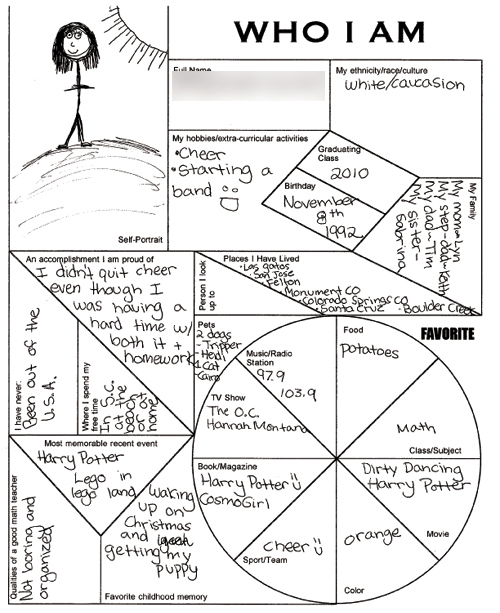
At the start of the year you’ll recall we completed this geometric personal survey, tossing likes and dislikes into trapezoids, circle sectors, etc, and drawing self-portraits. At the start of the year I turned ’em all into PDFs. ‘Cause you never know.

Today, eight months later, I tossed their self-portraits back at them and asked them to guess student from caricature.

Some of them, we decided, were fantastic facsimiles of the real deal. Some of them reflected a student’s character better than her appearance. And others not even the original artist recognized.

Really fun, actually, though a really great teacher probably woulda had his students write some new-school-year resolutions and then review ’em here in the second half of the year. I’m not him.

A Future Of Edublogging

Seems like the edublogosphere’s favorite topic of conversation nowadays is the edublogosphere and, specifically, what’s the point of it anyway. Most of the explanation and hand-wringing so far has put the cart several hundred yards in front of the horseHm. Felt strange not adding a hyperlink there. though Bud Hunt gets it right in a post that’s too moderate to get the round-the-world linkage it deserves.

Meanwhile I have a good idea that needs to get a lot better. There is ample research I haven’t even begun to dig through but here are the basics.

The Past

The attrition rate for new teachers hits 50% within five years. The same studies report the largest mitigating factor in that mass exodus is mentorship. Therefore, in California, some 14,000 new teachers participate in a (mostly compulsory) two-year induction program, which, depending on its execution, can be as bad as no mentorship at all.

At worst, it becomes a thing of rubrics: rank yourself along sixteen metrics from one to five where one is [inscrutable pejorative eduspeak] and five is [inscrutable superlative eduspeak], submitting either a rote lesson plan or a rote handout for evidence. Then re-rank yourself along the same metrics several months later, presumably finding progress.

A group of three or four of us met at Starbucks once a week. A veteran teacher from my district presided over these introspections. Our spitballing sessions over classroom challenges were by far the most productive aspect of induction but that too could be spotty. In my two years, I was paired with a) a history teacher and b) a science teacher, one of whom had more heart for the $5,000 stipend than for us new teachers, neither of whom could offer this math teacher much advice past general class management.

The Future

I’m not about to suggest that online mentorship is a superior alternative to face-to-face mentorship simply because it’s online and shiny, just that:

  1. we need stronger pairings between mentors and mentees, matching them along criteria like geography, age, and especially content area, etc.It’s still bizarre to me that they couldn’t find a math teacher mentor in the seventh largest district in California.
  2. the rubrics need to expand to include multimedia evidence of growth. One of the worst things anyone ever did for me as a new teacher was convince me that my lesson plans would ultimately take the form of paper (handout) or lecture (voice). If an inductee submitted, eg., this single photo and explained how it turned into twenty minutes of math, that should satisfy a standard.

There is need here. I’m getting more e-mail, more contact from new teachers. This weekend it was Renjie in Alabama and Glenn in Nevada, both first-year teachersGlenn reportedly burned through the dy/dan archives in a week, which may be a little too much bitter narcissism at a stretch..

Can a group of interested and qualified edubloggers form an online consortium, crossing Match.com with course management software? You log in and see the five inductees on your caseload, their most recent journal entries, their progress towards each teaching standard the consortium has established.

I’m not suggesting any pro bono nonsense. We would need to get in on some of that stipend cash. Or non-profit status. This would be a charter induction program. Something like KIPP for new teacher training. There is need.
Uncategorized

Moo.

In all this, the one variable I wish could control is the difference between my pedagogy and that of 90% of the edublogosphere. What I’m saying is that, on any given day, I read five endorsements of school computing swiss-cheesed by faulty assumptions and, since the revolution demands solidarity (ie. “at least the message is on the streets”) they go unchallengedeg. Nesbitt’s video. Why don’t you regulate your own propaganda?.

A lot of the time they’re innocuous cases of irrational exuberance but other times the conclusions drawn are on the order of, “If you still use handouts, you’re a deficient educator,” conclusions which long ago heaved out the bathwater and now have the baby halfway through the drain.

Or elsewhere, I find absolute prescriptions, solutions which work great in magnet schools unregulated by standards with tablet PCs for every student and a fat pipe sucking down the Internet, but which don’t come close to acknowledging the realities faced by, say, an educator working with 37 students assisted by one campus computer lab running 17 blueberry iMacs, a single home DSL connection split across the entire school. Those prescriptions strike me, at best, as hopelessly out of touch.

What I’m saying is that it’s much easier in this tech-enamored ‘sphere of ours to write those posts than it is to criticize them. I’m not saying my rejoinders don’t demand a more objective tone (I’m saying the opposite) just that, having exhumed a lot of dusty blog posts the last few days, a lot of people seem less offended by my tone and more offended that someone bothered to contradict their majority opinion.

What I’m saying is that you can expect my tone to change around here but we will still challenge each other. It’s still open season on your sacred cows.