Year: 2008

Total 265 Posts

My Next School

a/k/a So Beggars Can Be Choosers?

My work life has never seen so much upheaval. I have resigned my current district, effective the end of the school year, but until my fiancée finds her first post-grad job, I won’t know my next postal code, much less if the schools there have openings for lanky math teachers.

These circumstances, which include budget cuts and statewide layoffsPerhaps you heard about our little real estate whoopsie., would find 21-yo Dan beneath a desk clutching his knees but 25-yo Dan is somewhat enamored of the chaos. Moreover, due to an admixture of experience and arrogance, for the first time in my employment history, I will be interviewing my employers.

As much to reckon my own thoughts as to assist other job-seekers, in descending order of importance, my employment criteria are:

  1. a faculty which sees student failure as clear indication of school failure. I want to work with people whose first reaction to below-average common assessment results is, “how can I learn from my colleagues?” not, “the assessment was invalid because I’m pretty sure I know a little something about teaching.”
  2. a district-level professional development department. My small district has been so great in so many ways, but I have missed delirious fun like this for far too long.
  3. block scheduling. I’m not sure I can go back to the rapid rhythm of hour-long classes.
  4. a math department stocked with teachers young, old, and everywhere in between. The next youngest teacher in my current department is fifteen years my senior with two kids. I dig all my coworkers but, in many ways, we don’t relate.
  5. a central math office to better connect with my coworkers.
  6. autonomy in how I assess my students. Because of this, I mean.
  7. a homeroom/advisory period, which my school is instating just as I resign.
  8. veterans who step up and take the tough preps for new teachers. This isn’t self-serving. Lump me into the veterans and give me three preps, fine, but I want to work with people who treat new teachers better than an expendable, renewable commodity, who understand the most remedial classes need the best teachers.
  9. a deep paper budget. Not because I’m huge on handouts, but because I assess constantly and write much of my own curriculum.
  10. differentiated algebra, with placement determined by more than a middle school teacher’s impression of a student’s ability, a subjective measurement which shamefully shoehorned some brilliant students (however averse to homework) into my remedial math this year.
  11. regular articulation with feeder middle schools, so we can tell them to teach fractions better so they can tell their feeder elementary schools to teach fractions better.
  12. software for analyzing student achievement data.
  13. a digital projector.
  14. regular, district-sponsored time for department collaboration.
  15. my own room.
  16. a salsa bar in the cafeteria.
  17. 1:1 laptops.

There are distractions, of course. I need a job where I live and die by the strength of my work. Teaching is not that job but it has too much yet to teach me to leave it. As long as I am a teacher, then, and until further notice, this is the list by which I judge all applicants.

What have I forgotten? What have I misprioritized?

Jason Dyer Isn’t Human

Pity the poor bloggers who don’t have Jason Dyer running wild in their comments. He’s holding court right now in my last post, running something like a mathematical Total Request Live.

People drop by and say, “Hey, does anyone have an engaging, concise problem to motivate (eg.) matrix row reduction?” and Jason pops back with an awesome seven-word problem involving $5,000,000 in a stolen leather satchel which covers the entire standard.

You’re like, “Cool, but can I see that in a tenth grade,” and the dude obliges.

Credit, also, to Steve Peters, my UCD roommate, now at MIT for a doctorate in robot clouds or something, for putting his big brain to use around here.

What I’m saying is that perhaps I have underestimated these internets of yours, thank you.

Between Simple And Easy

My favorite problems are simple but not easy. The difference hasn’t always been apparent. I’m talking about clear, minimal constraints which require complicated, comprehensive thought. These problems are rare, but some lucky days they arise from a single image, like the one up there, like the one today.

The Question

If that table tennis ball is the Earth:

  1. how big is the Sun?
  2. how far away is the Sun?

Follow Through

You take bets. Is the sun a tennis ball? A beach ball? (A: something closer to a weather balloon.) If you miniaturized the solar system, what solar body would focus the Earth’s orbit? (A: the taqueria down the road.) You pick their pockets with these bets, getting them to buy into the problem unwittingly.

Maybe you put them into groups and wait until they requisition data. (eg. the radius of the Earth, the tennis ball, and the Sun; the mean distance from the Earth to the Sun.) Maybe you give them all laptops and let them scour the ‘tubes for the same data.

And I Wonder Constantly:

  1. do these simple-but-not-easy questions exist for every math standard on the books?
  2. who has them?
  3. are these people easily extorted?

The Most Dangerous Game

a/k/a Well How Do You Spend May?

A freshman collapsed motionless outside my door. Then he got up, laughed, and flashed a signal at a friend who groaned and fell down likewise. They both ran to class.

Gawah?

My freshmen came into first period flashing the same signals and I asked them, “Gawah?” They told me this:

Instructions

  1. You flash the birdman at anyone sworn into the game. If the flashee makes unblocked eye contact with the flasher, he has to [insert penalty here, which penalty, for my boys, was falling down].
  2. You can make eye contact with the flasher so long as you throw up a block first.

I couldn’t help it. I asked them to swear me in.

Tactics, Takeaways, and Assorted Combat Notes

  • As a general rule, if someone calls out “Hey, Meyer!” from across the classroom/lawn/courtyard/whatever, it’s best to throw up a block before you look.
  • If you want someone to look at you from across the classroom/lawn/courtyard/whatever, don’t holler out the person’s name. Holler out, “POPSICLES!” or something equally nonsensical insteadLike “FIRE!” Wait. Not that..
  • These kids are smart. They cameraphoned themselves flashing the birdman and then sent media messages to their targets. Digital natives!
  • I flashed the birdman into PhotoBooth and loaded the picture into our math slides. Later I pressed a button on my remote and flashed ’em all at once!Okay, yeah, I know this is pedagogically terrible. This won’t become a habit, I promise.
  • Word got out to the freshman class that I was sworn in. This created a tricky imbalance since a lot more of them know of me than I know of them. This imbalance became most evident as I planned lessons that afternoon in a coffee shop seven miles away where a kid I’d never seen before walked by my window seat, stared at me oddly, and then flashed the birdman!I blocked.

The Tally

Yeah, I guess I did okay.

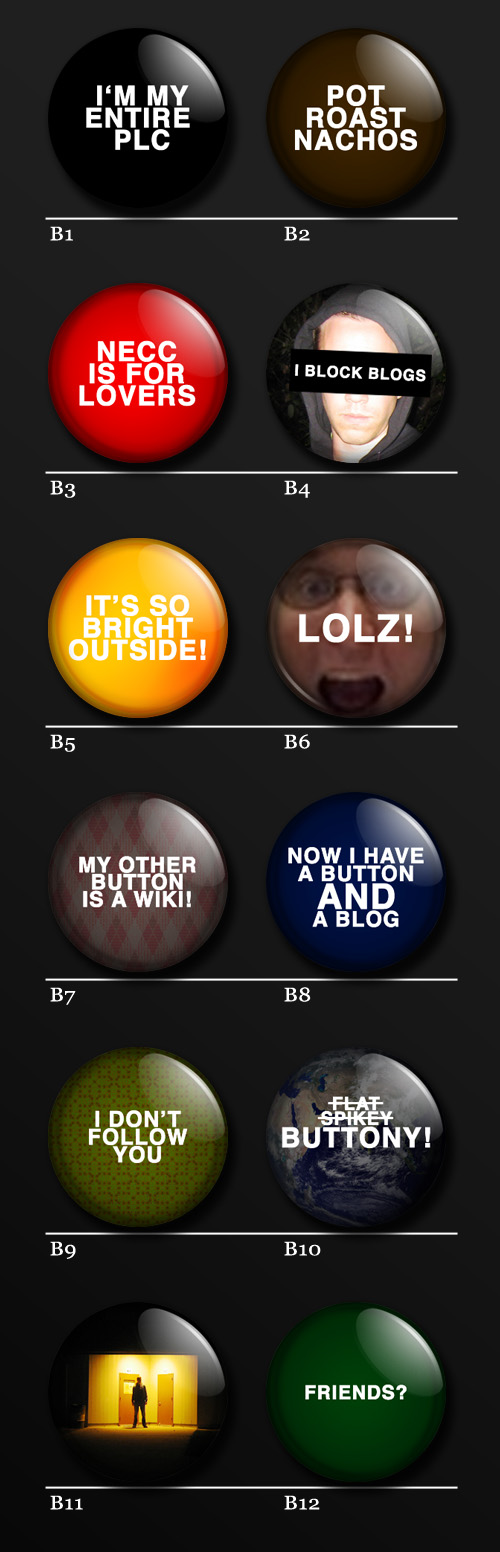
The NECC 2008 Merch Table

Scott McLeod issued a call for button designs mid-April, for use at NECC, working with the slogan, “I’m Here For The Learning Revolution.”

My submissions wandered a mile or two from his chosen theme (distractable, can’t help it) so I won’t hold my breath for the win. I will, however, take this moment to announce the grand opening of the dy/dan mercantile.

Buttons

Tees

Pricing

Buttons: $75.
Tees: $90. Two for $180.

Leave your order, size, and credit card number in the comments. I’ll take care of the rest.