Year: 2008

Total 265 Posts

Diane Ravitch On National Standards

Ravitch:

And I envision a curriculum that in toto amounts to not more than 50 percent of the school day, so that there would be many variations and additions depending on the state, region, and locale. I also envision a curriculum that encourages projects, intensive study, and creative teaching.

If we’re to turn this job into a profession, is consensus too much to assume here?

Saturday PD

a/k/a Homecoming!
a/k/a Mostly Gratuitous Entry!
a/k/a Best To Move Along, Seriously!

6AM

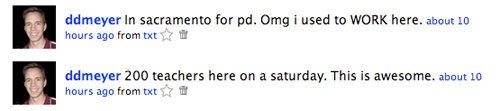
I woke up early on Saturday and drove to Sacramento, CA, to make up some professional development hours which I, uh, accidentally missed last week. This was also my first visit to the area since I unceremoniously evicted myself two years ago so I thought I’d lump in as much nostalgia as eleven hours would allow.

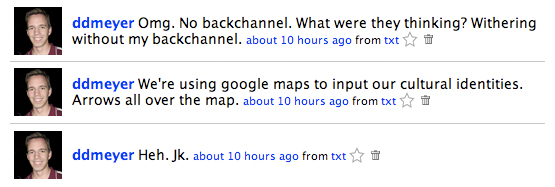
Twitter Interlude

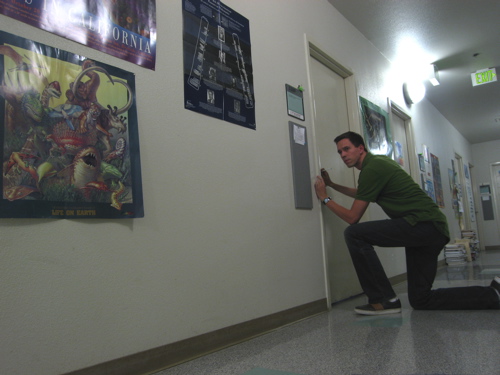
Photo Interlude

Keynote: From Survival To Success

Francisco Reveles came up in the streets of Segundo Barrio, Texas. At the end of his keynote he announced his candidacy for California State Superintendent. His talk, therefore, wandered purposefully along the path from that first sentence to the second.

For my money, he is the only sort who oughtta run a gang-beleaguered school, the sort who pushes past reactionary responses (eg. more enforcement more enforcement more enforcement), who recognizes that gangs fulfill specific psychological needs for their membership (eg. actualization, power, structure, camaraderie), who then deploys school resources to satisfy themDamian’s kinda guy, basically., Make that any kind of school, beleaguered by gangs or otherwise..

His whole keynote served largely to tease his later breakout session but one remark stood alone: “teachers with low expectations for their students are the most frequent victims of assault.”

Twitter Interlude #2

Breakout Session: Pop Art Stencils

Awesome and useless! I can’t believe I scored PD hours for this one.

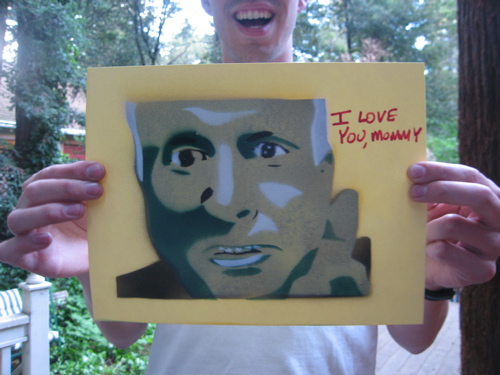
You take a photo and trace out its shadows, midtones, and highlights onto separate sheets of cover stock. You cut them into separate stencils, lay them down one by one, and spray on black, gray, and white. Awesome.

No way this ever figures anywhere into my classroom but

  1. it made for great reflection. This is, after all, exactly how I see teaching: on first blush an overwhelmingly complicated job which anyone can then disintegrate into smaller, more manageable tasks (tasks, which, once upon a regrettable time, I dubbed “slices”), and
  2. whatta mother’s day gift!

Photo Interlude

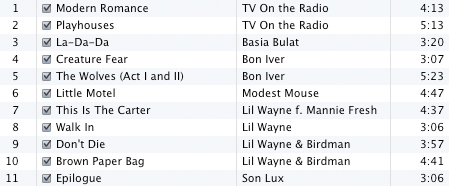
The Road Mix

Nostalgic Interlude

I rolled through Davis, CA, past Fountain Circle Apartments, Alvarado Ave., 7st St., Anderson Rd., and anywhere else I ever spent more than twenty minutes in college. I realized I was old enough to have taught some of the undergrads running around and cursed.

I saw my old friend, Josh Yoon, drive by in a Honda and flipped a u-turn as he parked only to realize as he got out of his car that he wasn’t Josh, rather, another Asian guy who looked only somewhat similar. I acknowledged that the nostalgia (and careless racism, let’s be plain) was hitting my head a little hard, cursed again, and moved along.

Twitter Interlude #3

5PM

On my way out, I stopped by my old mentor’s office, looking to share news of the largest return on his investment, the most recent, most curious development in his protégé’s short career. But he wasn’t around, so I beat a path out of my past and returned home.

Sobriety

A Year Ago

I wrote:

I can count on one hand the number of educators I’ve met (in real life or around here) who believe that hard work trumps passion in this job, that the latter follows the former, that caring’s the easy part, that “passion” has become loosely defined through overuse. And even then I’d have three fingers I wouldn’t know what to do with.

Our shot at professional credibility still seems like a long one but in the week preceding my last post I read some extremely encouraging assessments of teaching’s present and future state. I bring you excerpts.

Marc Dean Millot

Marc Dean Millot puts the professionalism angle to rest with an outstanding twofer:

His model of peer review is a stunning display of good sense.

Assume a teacher is charged with the educational equivalent of malpractice after a half dozen students failed to achieve proficiency as measured by state tests. The educator’s case would be reviewed by his peers, against a standard of care established by teachers, applied to the circumstances surrounding these six students.

Like a lawyer or doctor, he would not be accountable for student failure per se. The professional question would be whether this teacher did what any teacher should have done in this situation with these students.

What a teacher “should” do will obviously be the subject of intense debate, but the question is far from unanswerable.

He ends with a glance at my bedside diary:

It seems to me that teachers should not only welcome this approach to a review of their individual performance; they should be clamoring for it.

Grant Wiggins

Over at The Faculty Room, Grant Wiggins places blame for teacher attrition on the equal compensation (financial and otherwise) enjoyed by good and bad teachers alike, as imposed by their union, which, of course, puts this all back on NCLB.

We will never attract the best and brightest in large numbers under typical school working conditions. And as long as union contracts keep up the fiction that we are equals, that we are “all” professionals, then teachers will be treated more as laborers than experts with appropriate executive control over important decisions. (Don’t you see that as long as we are all equals, there can never be 6-figure pay for the really excellent among us?) We are going to need 2 million teachers soon. Anyone who truly values creative control, collegial collaboration, and professional decision-making opportunities would properly think twice about teaching as a career — even if those of us who still think of teaching as a calling are offended.

George Parker

The president of the Washington Teachers’ Union offers a self-recriminating op-ed which goes just to the line of saying, “Our priorities have sucked.”

As president of the Washington Teachers’ Union, I have a duty to represent more than 4,000 teachers. I also have a responsibility to work with our schools chancellor to improve the learning environment for students and teachers. At times it may appear that my duties of teacher advocacy and management collaboration conflict, which is not the case. The old-school paradigm of union rigidity must give way to a new-school approach of working productively with school leaders to improve student achievement.

Sarah Weisz

Sarah Weisz worries we scare off a lot of talent by obliterating “training” at the expense of “calling” in this job.

When we think about attracting new people to the profession, people who may want very much to teach without feeling “born to teach,” I think it’s important that we make a place in the rhetoric for them, too.

Deborah Meier

Similarly:

To dramatically improve schools, we need to transform the profession–making it attractive to thinkers and do-ers.

Maybe We’re Better Off Without Them

I won’t ask you to alter your vision for this job to reflect mine. I won’t even put a value – positive or negative – on either vision. I will make two closing claims, though:

  1. You likely overestimate the intersection of those visions. It makes sense to me – intellectually and anecdotally – that the teachers who are most motivated by the intangible rewards of this job will most resent tangible assessments of their performance. Moreover, whatever improbable combination of the two you harbor in your heart, the predominate rhetoric surrounding teaching emphasizes intangible calling over tangible training.
  2. Both groups inflict profit and loss on teaching but, put plainly, any corps that emphasizes emotional feelgoodery over the scientific method (to the overwhelming extent that teaching has) will suffer the endless resignation of effective, coldhearted curmudgeons.

The Difference Between Us And Them

Eric Hoefler:

I left teaching a year ago and took a corporate job. The people with whom I work are talented, smart, and exceedingly professional (and still manage to be fun, interesting people in the process). The job serves the Children’s Bureau’s efforts to review and continually improve the Child Welfare Program … a noble goal.

None of my co-workers write poems about the nobility of their calling.

I’m not saying you’re a bad teacher if you write poems, but my personal experience tells me that the best teachers are far less concerned with the noble calling than with getting the job done, and done well.

Who Do We Think We Are?

During The Faculty Room’s last cycle, contributors responded to claims that teaching is an overrated career. Greg Farr titled his rejoinder “The Greatest Calling of All.” Gerry Kosater opened with the line, “A career in teaching is more meaningful than any other profession.”

This refrain isn’t new. Neither is my opposition to its Hollywood incarnations, but my reaction has reached a boil and I really have to ask three questions:

Is It True?

Is this the noblest, greatest, most meaningful profession? The impossibility of measuring nobility aside (much less ranking nobility) hypothetically, is teaching noble?

Maybe. But the reasoning in both posts – that every successful person was, at one point, taught – is thoroughly unconvincing. Can’t we say the same of every thief, rapist, and murderer? And how many people have succeeded in spite of their teachers? Are we claiming we’re the noblest on average? That the Escalantes balance out the Letourneaus? How can we perpetuate the absolute nobility of a job in which so many people freely perform ignoble deeds?

What Good Is It?

Perhaps this incantation serves as some compensation for those teachers who elected this job out of self-sacrifice, social obligation, a “calling,” or another emotional impetus which – I point out in full disclosure – I almost certainly do not share.

In short, for a lot of teachers, the refrain feels good to say. It feels good to hear.

What Harm Is It?

Lots, where I work, where I aim at professional work in a job which doesn’t demand professionalism. Daily, I leap at and sometimes clear a bar which exists only in my head, in the work ethic I have self-imposed, a bar which in reality hovers shin high. Can I tell you: the friction between what my job asks of me and what I ask of myself is spectacular.

I want teaching to be a viable option for professionals – for people motivated more by the challenge this job offers an intelligent, persistent worker than by noble aspirationsNot that one can’t claim both. Please let’s skip that criticism. – and, towards that goal, these refrains are an impediment.

Because professionals do not issue bulletins proclaiming their nobility. Professionals proclaim heightened standards of care and increasingly rigorous self-critique. Professionals fight for and maintain their public’s trust.

Tell me how we earn that trust when we protect the worst among us from oversight, when we shun professional standards even in the abstract, when we then sing this nobler-than-thou hymn on the doorstep of the same white- and blue-collar workers who pay our salaries?

These poems and platitudes give the impression that we are fine over here – further recompense unnecessary – content in our cloud of self-importance. But I am not fine. I need more from my 60-hour work week, more from my career, and more from my job than poems and platitudes.