We’re deep into linears
We’ve established “rate” as “something per one something” and the y-intercept as our initial condition, all without using the terms “slope” or “y-intercept” or the variables “y” or “x.”
Maybe you frown at that kind of corner cutting but a) you have no idea how gradually you’ve gotta introduce those abstractions at the level I teach, and b) that’s why I don’t read your blog.
So watch as I take my kids through this tech-drenched project-based assignment. Squint through crossed eyes and I might look like someone you’d see at NECC.

-
Set It Up
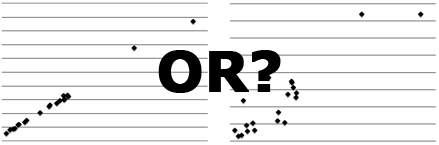
If I fly 300 miles out of San Francisco, is the duration of my flight predictable? Is the cost? Would the graphs look predictable or random?
-
Give Them Laptops
We have a mobile lab of 15 MacBooks. That’ll do.
-
Fly Out Of United Airlines
Send them out of the same airport. (SFO is our local hub.) Have them pick fifteen one-way, non-stop destinations. Ask them if they have any international YouSpace or FaceTube friends they’d like to visit, thereby cementing your digital street cred.

Baghdad, as many curious students found out, is somewhat inaccessible.
-
Record Flight Data In Hard Copy
Have them record:
- airport codes,
- departure times,
- arrival times,
- flight durations
Have fun explaining why a flight takes off from San Francisco at 9:00 AM, lands in Honolulu at 11:30 AM, and lists a 5.5 hour flight time. ,
and most crucially:
- distance in miles,
- time in minutes, and
- cost in dollars.
-
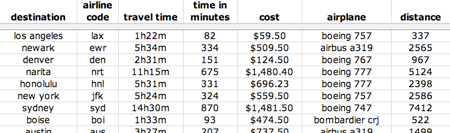
Enter Flight Data Into Excel
If you want to skip past the hard copy step straight to this one, just know you’ll need a continuous two hours.
-
Graph!
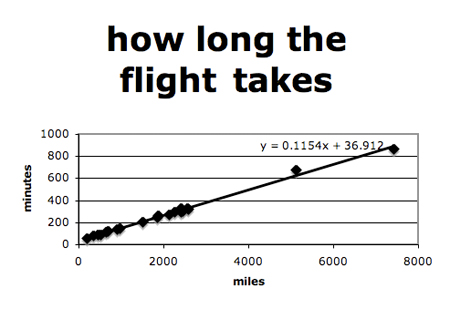
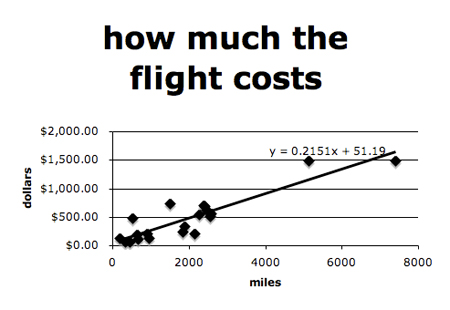
Marvel a bit at how well Time v. Distance fits a regression line and how terribly Cost v. Distance does.
-
Discuss
- What does the rate mean for each? The plane flies at .11 minutes per mile, roughing out to 545 miles per hour. Each flight costs 22 cents per mile.
- What does the initial condition mean for each? This one’s truly fantastic, as you’d expect the initial condition for time to be zero. (A flight of zero miles oughtta last zero minutes.) Instead, that 36.9 minutes is the time the airline builds in for sitting on the deck, waiting to take off. Elsewhere, that $51.19 initial condition is the charge just for stepping onto the plane.
- What does it mean if a dot is above / below the line? The flight is longer / shorter than you’d expect for that distance. The flight is costlier / cheaper than you’d expect for that distance.
- Why is cost v. distance such a terrible fit? What does cost depend on if not distance? Why, for instance, does a short flight to podunk li’l Eureka, CA, cost more than a flight to LA at double the distance? TFJ pulled the answer to that one outta thin air, eyes darting back and forth, putting it all together in what has gotta be one of the most satisfying moments of my career, a moment in which I was pretty much wholly uninvolved: “There’re only one or two flights to Eureka.”
PDFs here! Getcher PDFs right he-ah!