Year: 2008

Total 265 Posts

Well I Never

Let’s say your New York City charter school has resolved to pay every teacher a base salary of $125,000. You’re about to drown in applicants. How do you sort through them?

If you’re founder/principal Zeke Vanderhoek:

The school’s teachers will be selected through a rigorous application process outlined on its Web site, www.tepcharter.org, and run by Mr. Vanderhoek. There will be telephone and in-person interviews, and applicants will have to submit multiple forms of evidence attesting to their students’ achievement and their own prowess; only those scoring at the 90th percentile in the verbal section of the GRE, GMAT or similar tests need apply. The process will culminate in three live teaching auditions.

Waitaminit … expertise verified by student achievement?!

Who in the hell does this stuffed suit Vanderhoek think he is, telling me my worth as a teacher is in any way related to what my kids know? If they don’t learn, that’s on them, their parents maybe too, but not me.

I mean, look, man, I’m an artist and you can’t assess art with numbers. Unless they’re the six numbers you’re fixin’ to write on my check.

I mean, it’s almost like he’s trying to turn teaching into a profession.

Ban Bad Homework

My latest post is up at Authentic Education, responding to the prompt, “Should homework be banned?” I respond (unsurprisingly) along the lines of, “No, but …. ”

So ban the homework assigned because a teacher couldn’t manage her class (“Okay … okay, everyone … listen up … take the rest of this home for homework.”) or because a teacher couldn’t make something meaningful out of the full class period (” … tell you what, I’ll let you start early on tonight’s homework.”).

Holler back over there.

[Update: Dana Huff throws down the gauntlet and Alfie Kohn (!) picks it up.]

Anyway.

Been getting a little heavy around here with classroom management, so let’s toss out something inconsequential:

  1. How People Count Cash? Turns out they don’t just talk differently in other countries. Also turns out Afghanistan has us beat on style.
  2. Old Spanish Castle Optical Illusion. Which blew our collective mind. To keep this inside the PowerPoint family (if you don’t want to mess with Java in the middle of class) put the inverted image on one slide and the black-and-white image on the next in exactly the same place. Look at the first for thirty seconds and then advance the slide.
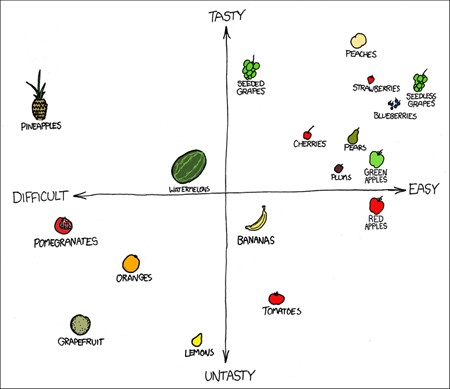
  3. F–k Grapefruit. Pointlessly profane but completely cool. I blocked off the cartoonist’s suggestions and had them toss out their own, which turned into a total melee, students throwing stones at each other over the right y-coordinate for cranberries.

    I realize this is totally soft math but I’ll absolutely defend the value of having these kids reframe their daily lives in mathematical terms. No one had considered fruit like this until today.

  4. Karate Slow Motion. A man shatters a brick at 4,000 frames per second, his entire forearm reshuffling itself grotesquely in less than a second. The kids insisted it was fake. I told them it wasn’t but I wished it was. Horrifying stuff.
  5. 41 Hilarious Science Experiments. Hardest I’ve laughed in several months.

And now back to your regularly scheduled handwringing.

2011 Aug 26: This is Dan from the future. It’s bizarre coming back to these posts where I didn’t realize I was teaching math with things like the tasty / easy graph. At this point, I’m still filing the things that will eventually define my career under a “Miscellaneous” category. I mean, look at that. The title of this post is “Anyway.” Like the tasty / easy graph isn’t one of the best introductions to the Cartesian plane ever. This is such a weird time capsule. Anyway. Here’s JL with some great comments on classroom implementation:

We started by graphing fruit on a coordinate plane where the y-axis ranges from “Tasty” to “Un-tasty” and the x-axis ranges from “easy to eat” to “difficult to eat.” Students were given 3 sticky notes and told to write a different fruit on each one. Then they went up and graphed them. They were asked to defend their ordered pair. If a student put Pineapple on the “easy to eat” side, there was an uproar of argument. Kids got really, REALLY into it.

My Editor Needs An Editor

Okay, so what I’m trying to say is that the textual study of classroom management failed me in ed school. Even grails like The First Days Of School, Every Minute Counts, etc., didn’t do me anywhere near as good as butchering a period and slumping back for an autopsy with my mentor.

I can’t offer every new teacher that experience but I think I can offer them something close, something, I’m almost certain, better than the usual detached ed-school take on classroom management.

I want to insert teachers into a sequence of carefully engineered classroom management disasters – which we’ll call … um … “episodes” for right now – each one focusing on a distinct, typical conflict, each one increasing in complexity, and each one so virtual you can just walk away from the disaster with a pocketful of answers at the end.

In other words, I want you to own your management solutions rather than buy mine. My book of maxims is easily dismissed and finitely applicable to your classroom. But if I put you and your new teacher buddies into a virtual classroom management thicket (ideally alongside a mentor) and say, “hack your way out of it,” each of you will construct your own solutions, each of which will look slightly different from the others.

Moreover, as with any line of inquiry that begins, “What went wrong here?” you’ll find solutions to problems I included unwittingly, which is awesome. Moreover, you can insert yourself into the same situation a year later and watch your entire solution set change. Are these outcomes even possible with a book of prescriptive advice?

Obviously I’m talking about televisionWhoops – lost half of you right there but past that I’m still working things out.

So How Do You Teach Classroom Management?

The New Distraction

Okay, fifty comments on a weekend post kinda settles the question, “Is there a market for classroom management tutorial?” I’m distracted now by a new question, raised several times throughout the comments, “Is classroom management too individualized, too tightly bound up in context, to teach?”

The Trouble Teaching Classroom Management

Yesterday I wrote an over-long since-edited post which positioned classroom management as an inverted pyramid, describing how, at the base level, you’re dealing with people who deserve specific, highly prescribed treatment, simple attitudes like, “treat others like you want to be treated,” which you could spend several lifetimes realizing.

But as you climb up into your role as a) teacher of a class, b) teacher of students, and c) teacher of very difficult students, the number of prescriptions splinter exponentially across vectors of personality and context.

For Instance

For instance, when I talk to a hurt or angry student outside, I’ll approach from the side. I’ll make some non sequitur about the weather or something to take the initial edge off. We’ll talk side-by-side, both of us facing the same direction because, subconsciously, I know this posture suggests we’re on the same team, both of us working towards a goal we’ll negotiate shortly. At their best, these resolutions ennoble teachers, students, and classes all at once.

But maybe you find the same results face-to-face, with direct eye contact and a commanding, caring presence. These tiny, crucial decisions are too tied up in context, background, and temperament to address comprehensively in a management course populated by sixty different preservice educators.

What Isn’t The Solution

Which is why I’m tempted less than ever towards authorship, towards a book of bromides and recommendations like those written above, so easily dismissed by the reader as “not me, not my class, not my kids.” Even if I could stock it with great stuff like TMAO’s, “We agreed to see in our kids their best, and demand it from them, daily,” a phrase which has been banging on my head like a kettle drum lately, your hit/miss ratio is gonna hover near one.

The Solution Then

I convinced myself recently that a) the solutions to classroom management conflicts vastly outnumber the conflicts themselves (ie. there are hundreds of solutions to a small set of archetypal conflicts) and b) you learn classroom management best by solving messy management problems of your own making.

Ideally you’d have a mentor ready to observe and post-mortem a terrible day with you, helping you find and own your solutions. But, lacking that kind of superior ed school experience, what if you had the ability to put yourself in the middle of someone else’s classroom management conflict at will?

To watch someone else flop and fail from arm’s length, in third person, after the fact. To then brainstorm solutions with a small professional group, maybe some mentors, maybe a small corps of new teachers observing the same train wreck and talking it out together, maybe on your own.

What if the simulated experience was portable, transferable, digital? What if your buddy called you from across the country, struggling with kids off-taskArchetypal Scenario #7 in his first year teaching and you could connect him instantly to a relevant management meltdown scenario and discuss it at a distance of several thousand miles?

Essay Prompts

I realize I’m being obnoxiously coy here, but feel free to give me forty words on:

  1. How would this kind of inductive approach – starting from failure, working backward to success – work for you?
  2. What deficiencies do you see in this approach?

Or anything else.