Year: 2008

Total 265 Posts

What We Aren’t Talking About

The Project I Killed

Last year I lined up 31 maxims for effective classroom management which I intended (at whatever point I found a few spare months) to publish in several forms and at several price points, after which I planned to retire at age 25 to a small island off the coast of Malta which I’d also own. Then it was this year and I scrapped somewhere near half of them.

Classroom Management: A Working Definition

See, no aspect of my practice changes more from year to year than my ability to keep a class of 35 students who define “heterogeneity” in every way working hard for two hours out of two hours, irrespective of how much they actually care about math or school or even life, irrespective of their home lives, wasting no one’s time or talent, respecting every student every day.

Maybe nothing I’ve ever done has been harder.

Classroom Management: Anecdotally

It’s come up a lot recently. Every day over the last week, once per period, something came up. Several students simply became too familiar. Several more decided they lived outside our mutually established classroom norms.

But every time I pulled a student outside โ€“ isolating the behavior outside, refusing to engage the student inside โ€“ the result was an oddly affirming experience for both student and teacher, one which looked nothing like how these things used to go. One conversation began with a mutual appreciation of the cherry tree blooming outside our classroom and ended with a student-initiated handshake.

Unless my experience as a classroom manager is several deviations below the mean, other people are struggling with this as I have struggled. New teachers are struggling with this. So why is classroom management the farthest topic from anyone’s blog?

Is It Because:

  • you’d rather talk about something flashier like tech integration or master scheduling?
  • you teach in a predominantly white, mid- to upper-ses district where a threatened phone call home is all the muscle you need?
  • you’ve worked at your school so long your legacy is all the muscle you need?
  • you figured it out so long ago, committed these movements to muscle memory so long ago, you’re useful to your students but useless to a student teacher trying to put it all together?

The Project Now

I’m running a new scheme right now, something similar to my original project, something to compensate for this deficiency in teacher training but pitched a little closer at my particular skill set.

Before throwing myself into this headfirst, I guess I’m wondering if the market for classroom management tutorial is everywhere or nowhere.

Six Seconds

Minnesota’s TOY, Mike Smart, links a few psyche experiments through Gladwell’s Blink and on the other end concludes:

In the first six seconds of class on the first day of school your students can accurately judge your effectiveness as a teacher, even if they canโ€™t hear a word you say.

He asks what effective teachers convey in those wordless six seconds. My response, profanity elided:

They’re looking for any indication that the person in front of the class (who will spend a lot of time in front of the class over the semester) has retained, in spite of her years immersed in the same preps, her curiosity, her empathy for those who don’t know what she knows, and her intolerance of boredom. You can tell from body language, posture, and facial expression alone that a teacher still loves her stuff and knows how to sell it to you.

Comments are closed here but weigh in on his tasty prompt over there.

Renewing My Math Credential

Occasionally I need to reassert myself as a math teacher, on this particular day because I realized Math Bloggers doesn’t include me in their tracker. Look! I am so a math blogger. So here’s what’s good lately:

Don’t Steal Nickels

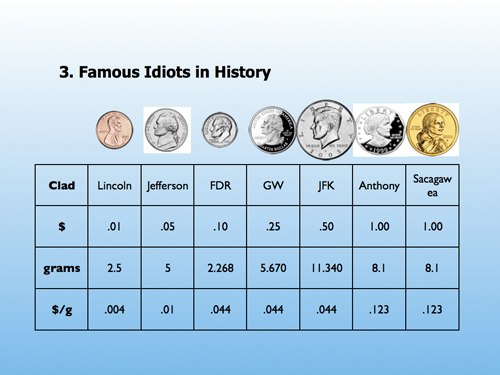
I run this interlude in every age group. Awhile back some thieves got busted with a lot of nickels. The conversation on this one can’t be beat and eventually wraps itself around the idea that high cash value is great but has to balanced against the weight of a coin.

So you head over to Wikipedia and pick up coin images, then over to the treasury page detailing coin weights and you’re asking questions and taking bets constantly:

  • Which would you steal right now? Knee-jerk reaction.
  • Who’s on the face of a half dollar?
  • Which is the lightest coin?
  • [etc]

Then you have them calculate the ratios and you notice that one fantastic thing about the dime, quarter, and half dollar (consulting Slate if you’ve gotta) and you preface the whole thing with, “Let’s become smarter thieves.” Riveting.

Pick’s Theorem

Pick’s Theorem calculates the area of irregular, weird shapes using a grid for reference. I realized as the class bell rang I was only using boring irregular shapes (quadrilaterals that didn’t shake down into the usual categories) so I ran online, searched up Google Images for a fossilized footprint, put one dot down, and then copied-and-pasted-and-distributed-space-evenly the hell out of it until I had the picture above. All in a coupla minutes.

No image credit. I suck at that.

Fabulous Opener Numero Uno

Cherish the openers which a) span but one question, b) inspire fifteen minutes of sturdy work & discussion, c) incorporate real-world visuals, and e) play off their self-regard as savvy consumers.

Fabulous Opener Numero Dos

Those scamps took this one farther than even I wanted to, talking about subtracting the door’s and the window’s area from the surface area of each room, etc., etc.

Also, the third question didn’t show prices until I advanced the slide, so for a few seconds, we all argued violently over nothing more than carpet swatches, namecalling over color and texture.

Alright:

Well hopefully that settles that. I’ll see you all in a year or so.

How Teaching Movies Fail Me

Teaching movies suffer just like all movies do from weak actors, murky cinematography, and didactic, lazy writing. I’d argue that teaching movies hold a lower batting average than most, but you’d call me fussy, so I’ll note, instead, two extremely specific, substantive ways teaching movies fail me:

  1. Wrongheaded pedagogy. In The Wire we’re meant to smile when Prez cancels literature review (boring!) for another lesson loosely connecting gambling to math (fun!).

    Or in another episode, when Bunny Colvin creates a separate class for a group of unruly kids, the sole purpose of which is socialization, because, paraphrased, “they can’t learn.”

    Or Chalk, which propagates the philosophy that students oughtta do the teacher’s job.

    Or Freedom Writers, whose failings are notorious around here.

    When these films and programs speak truth to the reality of teaching in America, it’s often accidental. More often than not, they do us some terrible PR, depicting this job for bystanders and prospective teachers as something it isn’t.

  2. Noxious pandering. Call it the “Oh Captain, My Captain” moment, endemic to the genre, which pits an unctuous, narrowminded dean …

    … against a beneficent but unconventional teacher …

    … with a bunch of disadvantaged doe-eyed students between them. And it’s like, how do you think a situation that contrived is gonna turn out?

    Every time this sequence shows up (usually within the last reel) I feel like a stranger has started massaging my back. I don’t need that.

Mr. K

My question, then, is whether there are any depictions of teaching you find worthwhile, or whether youโ€™d relegate everything to the same trashheap as Kindergarden Cop?

I have found the most interesting depictions of teaching in movies and tv wholly unconcerned with teaching.

As in The Wire, which depicts Carver’s transformation from an overbearing, self-important cop to a community police who knows where the kids hang out, who motivates, talks to, and looks after young offenders instead of writing up their every humble misdemeanorIf TMAO doesn’t watch The Wire, he oughtta., who believes, paraphrased, that “until the bracelets fit, there’s still room for talking.”

Or in The Office, which on a weekly basis speaks more truth to the exigencies of befriending, interacting with, and motivating your subordinates than any teaching movie I’ve ever watched.

None of this is to say I hated Chalk. I don’t know if its wisdom was entirely intentional but one short scene involving a stolen box of chalk warrants an entire graduate seminar of its ownEducation deans & conference organizers: you know where to find me..

I’m certain, though, that teaching lends itself poorly to dramatization. Our triumphs are often ephemeral โ€“ here and gone again โ€“ and sometimes exist only in the hindsight of an appreciative former student. The work isn’t cinematic โ€“ we aren’t piloting X-Wings into the Death Star here โ€“ and it’s often an interior, intellectual pursuit.

Why, then, do we insist on dramatizing a profession which defies dramatization?

Unfit For The Grind

This whole year I’ve been focusing on these kids who have these discipline issues and these kids who don’t care and I realize now it’s the kids who do care that really matter to me … and that I really miss a lot.

confessed to the camera without irony by teacher-cum-assistant-principal, Mrs. Redell, in Chalk, a movie which is to teaching what Major League is to baseball.