Year: 2008

Total 265 Posts

Presentations: Before/After

Two edubloggers, Damian Bariexca and Ben Wildeboer, posted classroom presentations within minutes of each other, both having updated them for student engagement and visual prettiness.

Wildeboer:

Bariexca:

[fixed names; thanks, h.]

The Principle Improvement

Their “before” slidedecks are dense with information. Their “before” slidedecks function as effective summaries of their lectures, which is a trait shared by absolutely every lousy slidedeck ever.

Their “after” slidedecks are image-heavy and information-light. They’re simply projecting images – no effects, no animation, no bullets – and, though we can debate the appropriateness of the images and the value they add to the lecture, no longer are Bariexca or Wildeboer trying to corral their entire talk within a 640×480 screen, which is death.

I Pity Them

But I pity these boys. I can predict their descent into madness ’cause I’m living it daily.

First, they’ll grow bored of punching keywords into FlickrCC. They’ll start searching out primary sources: satellite images, images from AP, Reuters, and Google searches.

Then they’ll start noticing extensions to their classroom content in the world around them and start snapping their own photos, creating their own Venn diagrams, building hyper-relevant discussions around those images.

Then these parasites will move to moving pictures, downloading clips from YouTube, from TV shows, building discussions around video.

Then, when they start bumping against that ceiling, they’ll make video content themselves and, from there, they’re properly screwed.

The Critical Question

But why use images at all?

What value does a submerged scuba diver add to Wildeboer’s discussion of the Earth’s crust? What value does a vampiric Hasidic Jew add to Damian’s discussion of anti-SemitismSeriously, wtf??

To some extent, their images merely season lectures which already tasted fine. Now that they’ve pushed past bullet points, it’s time for them find images which entertain and engage.

For My Part

Though I haven’t found the end of this rabbit-hole, I know I wouldn’t be half the teacher without this ability to put any image I want in front of my students.

Like today, discussing similar figures and scale-drawn maps, we hunted the Meyer family treasure across San Francisco’s financial district using some stitched-together Google Maps:
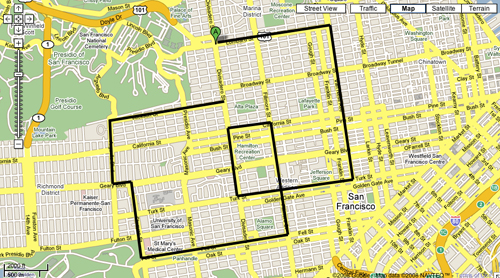
A student came in late and I caught him up by shuffling back through the slidedeck, getting him started, all with a wireless remote, all from his desk.

Afterwards I asked myself, how did this happen before?, and I couldn’t say.
What Correlates?

I want to know: what in your life correlates to job satisfaction?

It wasn’t always this way for me but once blogging became a daily fix, it fed my job satisfaction, which then fed my blogging. It isn’t coincidence, then, that a brief hiatus here corresponds to another of my miserable on-the-ledge moments out thereA moment which, uncharacteristically, I handled outside this forum. You’re welcome..

For better or worse, this dy/dan thing here has become a pretty accurate barometer for how much I enjoy teaching, a realization which leaves me wondering, what correlates for you?

Polls are open.

You Get To Fire A Math Teacher

A little sadism for your Sunday. Benjamin Baxter puts forward two math teachers:

  1. The competent geometry teacher who knows not much more than first-semester calculus, one who has quite a lot of charisma.
  2. The resident whiz who knows his math stuff – whatever that entails – but lacks so much charisma. Think Steven Hawking.

And says, for budgetary reasons, you’ve gotta fire one of them. Any thoughts, toss ’em his way.

For my part, I think it’s obvious. You fire the shorter teacher. Always.

[Update: My response to this somewhat absurd hypothetical will come as a surprise to no one.]

This girl is dangerous.

As much as you’d like to believe there are only two crowds here – one crowd of competent ed-technophiles and another of ignorant ed-technophobes – there is a crowd of teachers milling about the faculty lounge that gets this stuff, that enjoys this stuff even, but that needs a sales pitch less emotional and more practical when it comes to classroom integration.

Enter Dina Strasser’s seven skeptical questions, which lays our inner monologues out for everybody else. I swear, if y’all would just read and link and del.icio.us this up, I’d never have to write about my classroom tech reservations again. Hers are that comprehensive.

  1. Does this value-added, teacher-independent learning relate DIRECTLY to my content objectives and standards?

    Sorry. “Universally related” or “indirectly related” just doesn’t cut it–this is the open door for uncritical idolatry. For example, I have never understood the lumbering Godzilla-like argument that because our kids are “digital natives,” we should de facto use tech in school. Why? If using tech is as natural to them as breathing, isn’t this like asking us to teach kids to breathe?

If you’re a tech coordinator, -evangelist or -salesperson, you’d do well to read the rest and realize that, if you can’t sell your particular product [Twitter, Skype, Ustream, whatever] to a tech-savvy teacher who has outlined her every objection in advance, then you will find deaf ears everywhere else as well.

So Happy Together #4

Make the marriage of your digital projector and laptop a happy one.

One Idea:

Use visual callbacks to refresh their memory.

Like this:

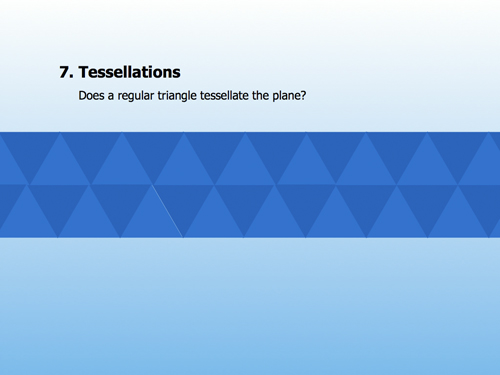
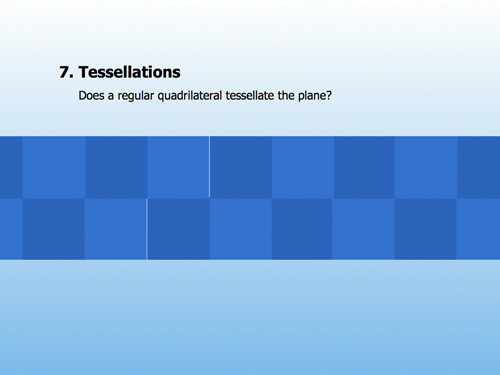
We’re talking about tessellations, how squares and equilateral triangles tile your bathroom floor without gaps.

I put up a square / equilateral triangle in Keynote and after they draw the tessellation on their paper, I hit a button and the same thing animates on the screen.

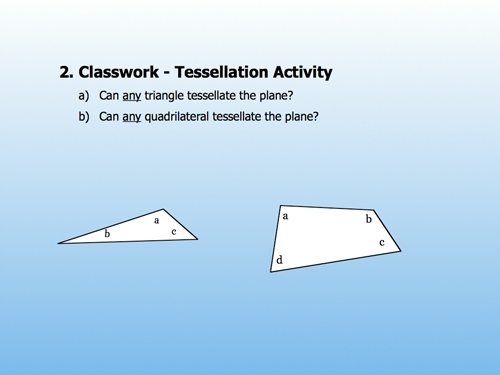
The next day I want to talk about the general case.

Without my digital projector, I’d say, “Okay, so you guys remember yesterday how we saw that an equilateral triangle tessellated the plane? Will your garden-variety, no-account scalene triangle do the same thing?”

No one would contradict my first assumption but only, like, 50% would really remember.

With a digital projector, though, I just copy & paste a slide from the previous day, strip off its animations, and there I have an effective visual callback to the last lesson.

Just like the “Previously on Lost ” introductions, this technique functions even when pushed weeks into the past.

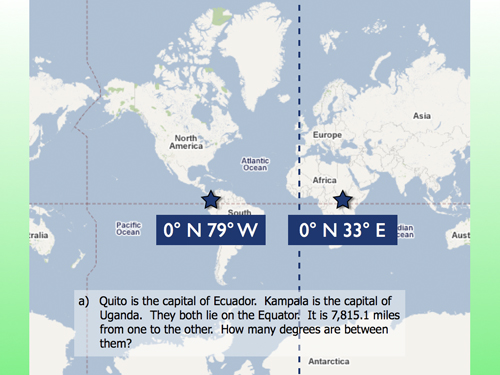
“Remember when we were looking at distance around the Earth last month?”

And they do.

Previous Editions: