Month: March 2009

Total 15 Posts

What Can You Do With This: YouTube URLs

Here are some YouTube URLs.

http://www.youtube.com/watch?v=0DiAjL72FVE
http://www.youtube.com/watch?v=s37PU6f2ZfU
http://www.youtube.com/watch?v=UhwXPsTaRgc


http://www.youtube.com/watch?v=NSXlV_1hzSk
http://www.youtube.com/watch?v=TWbcsEDrmFE

See the pilot for instructions.

BTW: Give it up for Megan:

1) How many videos can YouTube hold before running out of space in the identifier? Did they plan well? Are they going to run out of space? How fast are videos being added? Do videos ever go away and free up these strings?

2) Are those โ€œv=โ€ strings case-sensitive? How does that change the total possible combinations?
3) What characters does Youtube use in the โ€œv=โ€ string? How does adding one allowed character change the total possible combinations?
Tell Me Why We Don’t Do This, Again

Henry Abbot:

The NBA is working on something truly splendid. A video rulebook. The idea is that, eventually, there will be an online, multimedia showcase of what is legal and what is not. It will help to settle many an argument.

Until that’s ready, there are all kinds of video clips available and the NBA uses them all kinds of ways. As part of ongoing training, the NBA recently sent referees a series of clips showing different kinds of travels.

The idea that a teacher could call up a gallery of, short clips of say, “classroom dialogue” or “authentic questioning” or “silent, sustained reading” โ€“ examples both good and bad โ€“ probably shouldn’t seem like the vainglorious pipe dream it does to me right now.

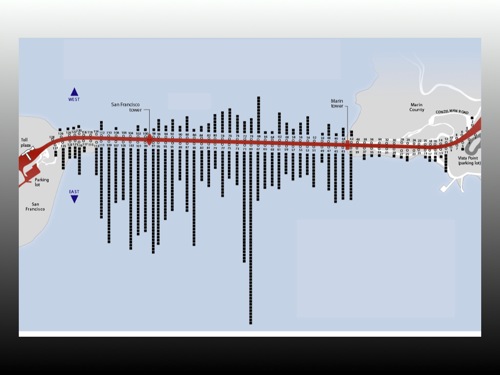
Golden Gate Suicides

This series and the accompanying infograph make for fascinating class discussion. I stripped the graph of most of its identifying features โ€“ captions, legends, and titles โ€“ tossed it onto my students without introduction or fanfare, and had them intuit those features back to life.

This year, more than any year before it, I am comfortable leaving an interesting question unanswered. This is to say that my students will debate a question like, “Where did people commit suicide most often? The 69th what?” and, as the conversation exhausts itself, they can’t count on me to step in with the answer. This is to say the opposite, that as the conversation exhausts itself, I will shrug and advance the slide to some new work, content to leave the question unanswered.

I don’t have any evidence to suggest this approach to learning will a) increase your Algebra test scoresIn fact, if you apply this detached stance to core curriculum โ€“ adding fractions or solving the quadratic equation, for instance โ€“ I can guarantee you the opposite., b) help the US compete with the Indian subcontinent, or c) any of that. I only know that i) my students seem less afraid of wrong answers and more patient with irresolution, ii) they seem, as learners, less certain and more curious, iii) I enjoy teaching more, and iv) the next time we attempt to define an Unknown 1) I will hear from more new voices while 2) the old voices will be all the more eager to kick the Unknown in the teeth before it limps away yet again.

A Fifth-Year Teacher’s Creed

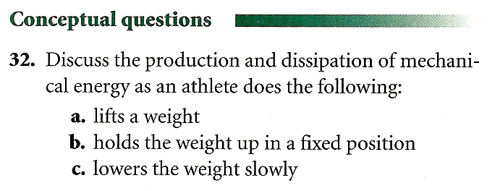
I checked out a copy of our Holt, Rinehart, Winston Physics textbook and the situation is grim. The text stabs forcefully at conceptual development with questions like this:

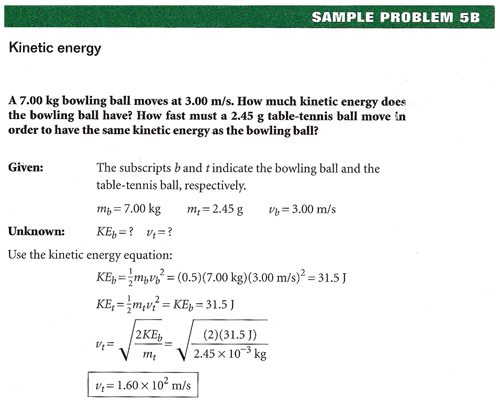
But these interludes of open-ended, critical inquiry are preceded by example problems like this:

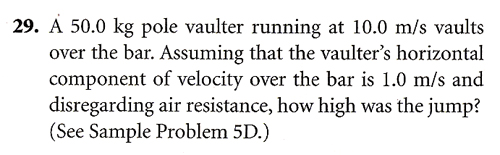
… which are meant to drive practice problems like this:

Which kills me, of course. Basically, the students are taught to identify the relevant formula, match the given information to variables in that formula, and solve for the unknown variable. Helpfully, all the given information will find its way into the formula somewhere. Helpfully, the practice problem will reference the relevant sample problem in case the student forgot the relevant formula.

What we have here, essentially, is a compelling passage of conceptual development thoroughly undercut by practice problems which promote thuddingly linear and literal inquiry. Essentially, we have Holt tossing cupfuls of water onto a raging fire while Rinehart and Winston dump gallon after gallon of gasoline onto it from the other side. I mean, we aren’t even pretending to prepare our students to apply this stuff creatively, to the world around them. Because out there, in the world, no one will helpfully tell them what chapter of the book they’re looking at, no one will helpfully reference the relevant sample problem.

And so I tell myself:

Be less helpful.