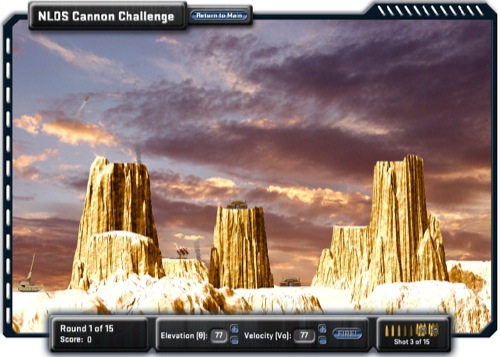
This is a classic game. It’s been around in various forms longer than I’ve been alive. Choose your velocity, choose your angle, cross your fingers, and fire. Discovery has simplified the game nicely, removing some noisy variables like wind speed, which you’ll find in other versions.
I first saw Discovery’s incarnation several weeks ago and have been on-and-off obsessed ever since by the question: what can I do with this? The point of this post is to throw up my hands and report: nearly nothing. I have no idea what the students do here.
I mean, it’s far from worthless. If a student can get past level ten, then she clearly has some understanding of angle and velocity and the dialog between the two. She might even ask herself some interesting questions, like, which angle gives you the longest range? But I won’t drag the laptop cart across school for those small potatoes, for that two-step lesson plan of 1) guess and 2) check.
Here is the most rigorous, reasonable question this game can ask, a question which it is fundamentally incapable of answering: can you develop a method for hitting any target in one shot? This is a question either a) Discovery didn’t think of or b) Discovery thought of but, for whatever reason, didn’t make accessible to students.
Either way, it’s frustrating. It’s frustrating that:
- there isn’t a grid for determining coordinates;
- the units aren’t defined;
- there isn’t a timer for determining parametrized equations;
- banner advertising reloads in the middle of the projectile’s flight, making a mess of my makeshift timer.
- you’re firing from the tip of the cannon, not the base of it, which adds mathematical noise;
- the layouts change at random (ie. my level three isn’t the same as your level three) which crushes my one workaround here, copying level screenshots into Geogebra.
- I think, though I can’t be sure, that you’re blowing up huts and tents in some levels, which, gross. Seriously.
All of which is frustrating. The game uses mathematical notation for angle and initial velocity. It comes packaged with its own assessment systemYou get 100 points for each unused shell. The student with the most points (likely) has the best algorithm and calculations.. This thing is so close to being useful.
Which makes it an interesting answer to Scott McLeod’s question, where are the Internet resources for your subject area? Because this game isn’t from some arcade site which I’m hopelessly trying to bang into a lesson plan. It’s from Discovery, which isn’t exactly apathetic to the needs of educators. Why didn’t the thing come with a lesson plan?
My takeaway here is that the people who know the Internet and the people who know instructional design aren’t the same people and they aren’t talking to each other enough. We are left to our own devices.
BTW: Just a little over a year later and Colleen King comes through for the team: Tactical Rescue Missions for Intergalactic Good. Great work.