Month: April 2009

Total 25 Posts

Jason Dyer’s Redesign Of My Redesign Of Darren Kuropatwa’s Design

This is great. This is the culture of criticism we need.

I don’t know if Jason has redesigned my slides (since they’re all intact) so much as he has extended them in a particularly meaningful way. We motivated the concept of range by fixing the means, telling the kids implicitly, “you can’t use that anymore.” Now, Jason inserts this slide, which fixes the mean and the range, asking the kids, “now what can you do with this?”

This approach to skill development works both with fancy visual application problems and with skill acquisition. Rather, than 1) defining some concept like “range,” and then 2) using it in example problems, we instead 1) discover the limitations of our current tools and then 2) invent new ones. These mathematical operations didn’t arise just to employ degenerates like me. They arose because we needed them.

To the extent that Jason seems to think we should skip range altogether, I disagree. (Why not talk about it?) To the extent that he thinks we should engineer a situation where range is no longer useful, where the students must develop stronger tools like variation and standard deviation, I say nice job.

Swap “Design” for “Edublogging”

Khoi Vinh is the design director for the New York Times online. He has written a tremendous piece about the state of online design criticism that mirrors my assessment of the state of online teacher criticism down to the last word:

Sometimes I wonder, then: given that everyone in design seems to more or less know everyone else, are we really having the kinds of meaningful, constructive, critical discourses that we really should be having? Are we too quick to take offense at the opinions of our peers? Or are we pulling our punches too much when discussing the merits of the work that our peers turn out? To put a finer point on it: are we being honest with one another?

Redesigned: Darren Kuropatwa

Darren Kuropatwa:

I’d genuinely appreciate any suggestions you may have about improving this particular slide deck or my approach in general.

I can’t resist that kind of invitation. Tom Woodward recently performed a complete presentation redesign for Alice Mercer but I don’t have that kind of stamina. I have selected, instead, just one slide. Whether Darren agrees with my notes or not, this kind of exercise is supremely useful for anybody looking to nail down her own aesthetic. (ie. How would you handle Darren’s slide?)

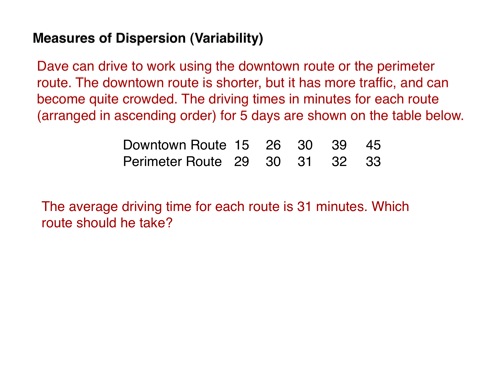
Darren’s Slide

My Revisions

Problems I’ll try to solve:

  1. There is a lot of text, most of which should be spoken.
  2. There is a lot of information, which should be unpacked over several slides. The marginal cost of extra slides is $fr.ee. We’ll use that.
  3. There aren’t any visuals, and visuals are what make projectors and presentation software worth the trouble.

First, when I recommend visuals, I am not recommending this:

or this:

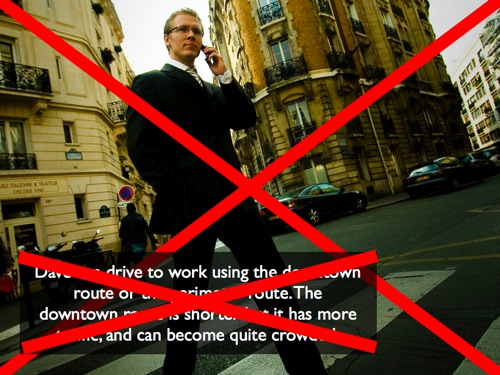
I am recommending a real visual. People recognize high-bandwidth, meaningful imagery when they see it and stock photography isn’t that. I am also recommending that Darren speak the text he has on the screen, striking up a conversation between him and his class.

To review the changes so far:

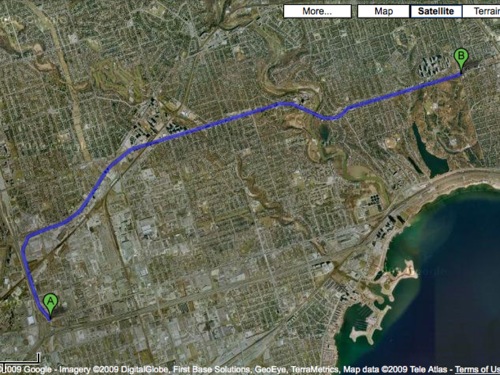
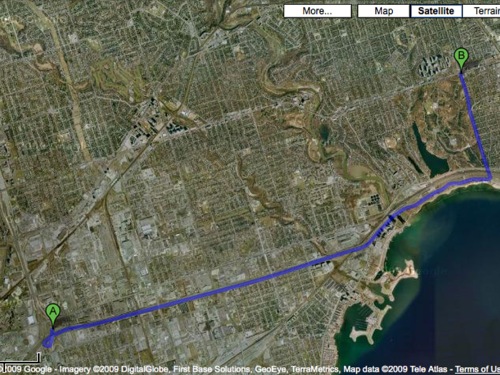
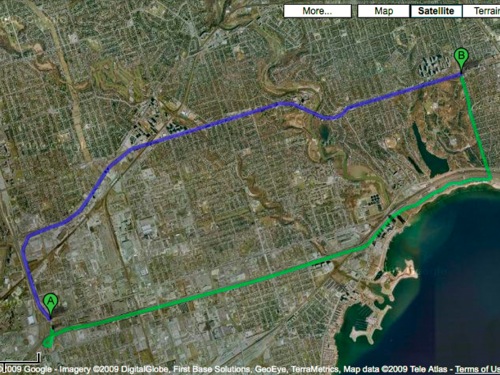
Darren has a visually compelling prompt on his hands (“Which route does Dave take?”) with no visuals. What is the best way to illustrate this? I fired up Google Maps and located Toronto, which is where I assume all Canadians live, and forced two routes from the same location. Take screenshots.

He could put the routes on separate slides or, using some intermediate Photoshop, color-code them on the same slide.

At this point, I’d ask the class to tell me which route Dave should take. Just a guess. No math on the screen. Just a bet. Which is faster? Maybe they know the local topography. Maybe they know the traffic. Maybe they know the two-lane roads. Kids who are timid in mathematical discussions will be emboldened to participate here. They can do this one.

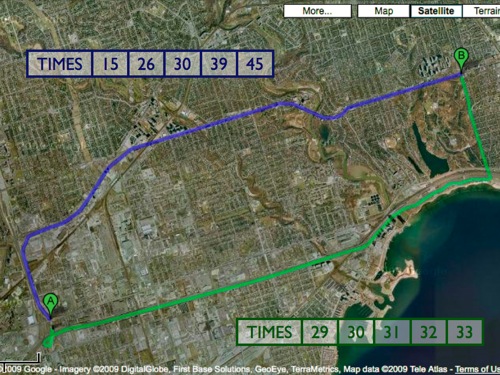
You tell them that Dave drove each route for one work week and timed the trips. You ask them to tell you the best route.

This is where Darren nails it. He knows his students will go straight for mean, which they just learned, but he has forced both means to 31 minutesa fact which Darren tells his students in the text of the problem, a fact which I would withhold and let them discover for themselves. Necessity is the mother of all invention, and they need to see the necessity for measures of dispersion.. This will propel an interesting question, “Okay, so now how do we decide?” Students will mull it over and eventually decide that the blue route is more unpredictable while the green route is more consistent, which will motivate the definition:

Thanks. This sort of exercise helps me define my own aesthetic and reconnects me to what I love about visual literacy in the math classroom so I’m grateful to Darren for his explicit permission to mess with his workPersonally, I think that anytime anybody posts their slides publicly like this, their work should be fair game for reproof, correction, and instruction. Those who think otherwise are squandering the enormous professional development opportunity we have with these blog things..

Photo Credits:

  1. Speedster.
  2. Mister D.

Be More Interested

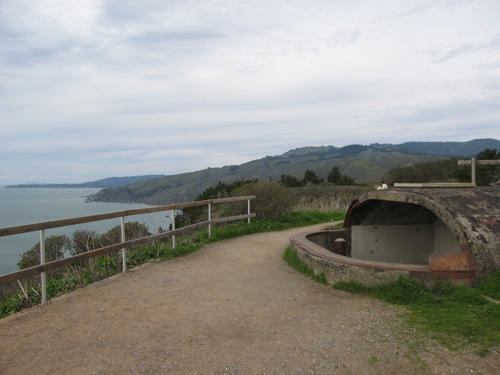
“What is the point of this bunker?” belongs to my favorite subset of classroom questions, The Question Whose Answer Looks Insultingly Easy. No question goes farther to disrupt and expand a student’s perception of the world than the one which, moments ago, she was absolutely sure she knew the answer to.


Muir Overlook Emplacements from Dan Meyer on Vimeo.

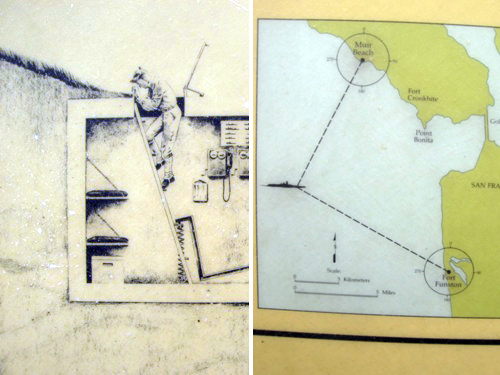
Personally, I thought it was a gun emplacement, as most of my students will, but the information kiosk told me otherwiseBTW here are my high-res photos and video zipped up..

The point of this post isn’t really to ask, “what can you do with this?”That lesson plan, involving triangulation and some a/v simulations, pretty much writes itself. The point of this post is a rejoinder to How To Be A Boring Teacher.

All pretenses of modesty aside, I facilitate classes this year that apply tenacious inquiry to goofy conceptual digressions and difficult standards-based math alike. At this point in the year, a small handful of students are still frustrated that the point of our class isn’t to reproduce example problems from the textbook but the rest are shockingly patient with irresolution. I am never less than stunned at the dereliction of duty they tolerate in their teacher, that they let me set them adrift on unfamiliar intellectual tides while I watch from shore, doing nothing more helpful than asking some elliptical questions. I’m shocked, basically, that these kids don’t roast me over a spit every time I ask, “So what can you do with this?”

Much of this happened accidentally. Much of the alchemy eludes me but I know that one of my essential teacher actions here is that I model my own interest constantly, that I make the messy process of reconciling my own curiosities a matter of classroom record as often as possible.

I can only do this if I make a habit of bringing that process into their classroom. So I keep a camera on hand and use it often. I bring the world and all my messy questions about it into my classroom through a digital projector whenever I canThis, from my experience, is the real gift of a digital projector, not the ability to overlay text on top of a photo.. The net effect has profoundly reshaped my classes and my priorities.

I no longer care if they are interested in me. That is a young teacher’s game. I care that they are interested.

They’re On To Me

Jessica, last week, working through a classwork assignment:

Mr. Meyer, where does this go in PowerSchool? Because I check and my grade doesn’t change.

Christy, next to her, jumping in:

It doesn’t. I checked. But I’m sure he’d take away points if we didn’t do it.

Which, um, isn’t exactly true.

Perhaps I’ll mention some day before the end of the year that none of the classwork they’ve done all year long has had any direct positive or negative effect on their grade, that the only direct effect of their practice has been on the level of waste material in our recycling bin.

That admission might provoke an interesting conversation about the point of the practice. Or it might provoke riots.

More likely is that I’ll chicken out of that conversation until a student distributes printed copies of this blog post to the entire class. That will be fun.

[BTW: It took five weeks, it turns out, for a student to call me out.]