Also: Why WCYDWT?

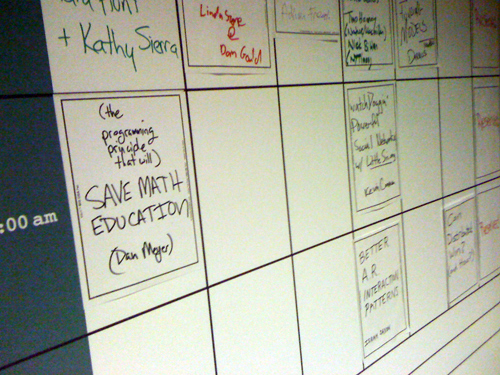
On the first night of Foo Camp, 250 attendees introduced themselves by name, affiliation, and three hashtags, and then descended on a gridded wall-tall conference schedule, scribbling down session titles, selecting venues, folding similar sessions into one another, scheduling roundtable discussions with people they had only met thirty minutes earlier over food.
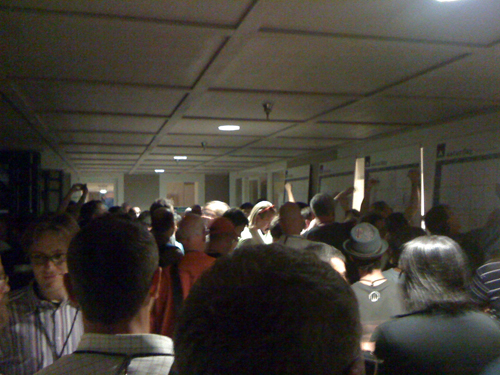
The crowd was thick so I commandeered a Segway and steered it full-bore into the scrum, scattering people long enough to slide a session onto the closing day’s schedule: The Programming Principle That Will Save Math Education.
That’s three opportunities in three months (counting the webinar I’m conducting in October) that my patrons at O’Reilly have given me to throw a half-baked idea casserole at a bunch of really, really smart people and walk away with something quite a bit tastier.
The debate at an earlier session on the future of education was idealistic and high-minded with participants from all sectors trying to reach consensus (in sixty minutes) on merit pay, standardized testing, class size, unschooling, home schooling, charter schooling, public schooling, and probably several other intractable issues I’m now forgetting. I tried to approach my session, then, from two more assailable angles:
- math curriculum, which, for whatever it does right, doesn’t a) put students in any kind of place to apply mathematical reasoning to the world around them, or b) do anything to encourage patience with problems with complicated inputs and messy outputs, which is to say, most problems worth solving. Math curriculum, speaking generally, does the opposite of those two things.
- after we develop a model for good math curriculum, we don’t know how to share it.
The outcomes of merit pay and standardized testing will be decided in protracted, gruesome battles between various unions, legislators, and chancellors. The challenge of sharing good math curriculum, however, is one that the people attending my session – an intimidating array of talent, knowledge, and funding – could solve over lunch.
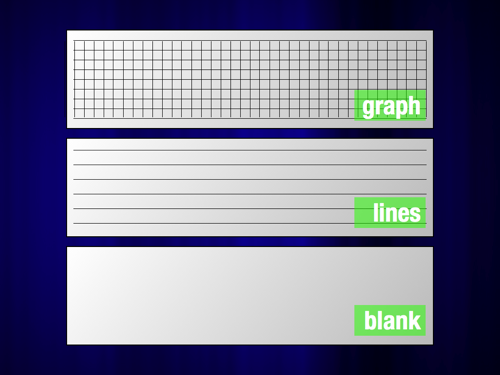
O’Reilly gave a blank notebook to the weekend’s participants. Not lined. Not quad-ruled. Blank. We talked about how you’d only give out lined or quad-ruled paper if you were sure the average attendee wouldn’t want to doodle.
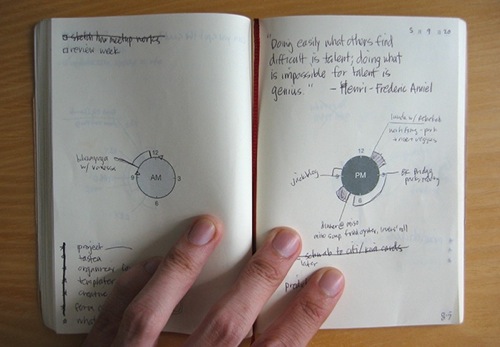
I showed the participants how the Muji chronotebook shuns calendars and hour-blocks, opting instead for the least constrained approach to scheduling possible, a small clock in the middle of the page. This is the rule of least power, the programming principle that can save math education.
I won’t waste space here recapping my session notes. I drew heavily from these six posts:
- The Rule of Least Power: An Initial Approach
- Why I Don’t Use Your Textbook
- WCYDWT: Glassware
- WCYDWT: 2008 World Series of Poker
- Flight Control / Lesson Plan
- BetterLesson Reviewed
But I realized this: I flog WCYDWT media from whatever forum I’m offered not because I think WCYDWT media is the evolutionary pinnacle of math instruction. I do think WCYDWT is leagues better than the curricular norm, particularly compared to the kind of curriculum offered by the largest textbook publishers. More crucially, though, WCYDWT is the best model I know for classroom math instruction that can also leverage Internet distribution. I can use global publishing tools to infect other math teachers with these videos and photos. I can’t do the same thing with netbooks. I can’t do the same thing with physical manipulatives. I don’t know a better model of math instruction that I can also aerosolize so easily.