Year: 2009

Total 161 Posts

Excellent Math Blogging

These two are fresh. If you subscribe now, you can say you were into them before they got big.

1.

Tony Alteparmakian is a 2009 Leader in Learning enacting Chris Lehmann’s vision of classroom inversion (though I don’t doubt they came to the idea separately). Their idea is that we should send our students home with what used to constitute classroom time โ€“ the lecture โ€“ and spend classroom time on labs and teacher-led enrichment of that material.

Obviously, that vision comes fully loaded with complications but Tony is resolving them one-by-one in a how-to series that has only just started.

Also, I dig his redesigns. It’s hard to argue with slide transformations like these.

Before:

After:

2.

Sean Sweeney is an extra-value meal. In one corner of the edublogosphere you have the edtechnologists, the district IT staff, the ICT professionals, the policy wonks, etc., all asking huge, important questions about merit pay, technology integration, assessment, online schooling, etc., and posing reckless hypotheticals about limitless resources with nothing less than the future of education at stake, and all of it makes me grateful for guys like Sean who are driving 90MPH up the right lane, offering educators something they can use in the classroom right. now.

I’m talking about his quadratic catapult project. Or his Graphing Stories remix. Or his exercise in grocery store estimation. And that’s his output over two weeks.

This is math-instruction-as-artistic-expression and it’s cool as hell to watch.

“A Trash-Talking High School Math Teacher”

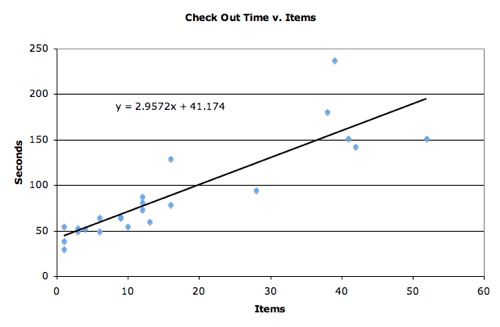
The story broke online: the express lane isn’t faster. Jaws hit the floor. It made a few laps around the blogosphere while the MSM played catch-up. 72 hours later, I was in front of a camera, explaining the regression to a reporter for CBS in San Jose who in turn challenged me to a race down the checkout lines.

Here is that (two-minute) clip:

Click through to view embedded content.

Three takeaways:

  1. Slow news night.
  2. Everyone has an opinion on this one. Most people also have a demographic they are particularly loathe to find ahead of them in line.
  3. This visceral, widespread reaction to nothing more than a) a clear picture, and b) a concise question will do nothing to make my WCYDWT evangelism less insufferable. Apologies in advance. This isn’t the only way to teach, but it is a fun way.

What I Would Do With This: Groceries

[following up from here]

All other things being equal, which lane is the fastest?

This problem has obsessed me for years. It’s my DaVinci code. It’s my love for math, for mathematical reasoning, for the relentless deconstruction of something that seems simply intuitive into data, models, and computation.

This is also my love for WCYDWT media.

Perfunctory Pitch For WCYDWT Math Instruction

You have here a simple question that anyone can access. Doesn’t matter that you’ve never run a linear regression in your life. If you’ve ever shopped for groceries, if you’ve ever stood in line with a candy bar, a soda bottle, and a matinee starting across town in ten minutes, you have an opinion here. And I can use that.

The question is simple and so is the answer but the justification is extremely complicated, which is exactly how I’d like to balance the learning experience. We will argue. There are easily a dozen variables affecting the line speed that have nothing to do with the number of customers in each line or the number of items in their baskets. You could assign some field research here. I spent ninety minutes last week just watching, counting, and timing groceries as they slid across a scanner.

The question is also scalable. We can remix this single image into endlessly difficult scenarios (or easier scenarios) that will push a student’s hypothesis to the crumbling point and back again.

A (Broad) Lesson Plan

Gather the data. Or supply the data. Graph the data. Develop a model. Test the model. Talk about the effect of outliers. Assign weight to outlying variables.

I threw some questions on a worksheet five years ago, fairly predictable stuff like “what does it mean when a point is above the line of best fit?” At this point, though, I’m hesitant to constrain the activity even that lightly. I’d almost rather pick a fight with a student who finished early and let the rising pitch of that conversation fold in a few more learners.

Other Remarks

  1. Check is slower than credit which is slower than cash. Students are sometimes surprised that cash is faster than credit. From my observations, the fastest cash transaction will outpace the fastest credit transaction by a wide margin but there is also huge variance in credit transactions. I mean, some people have absolutely no idea what they are doing with that thing. The same can’t really be said of cash.
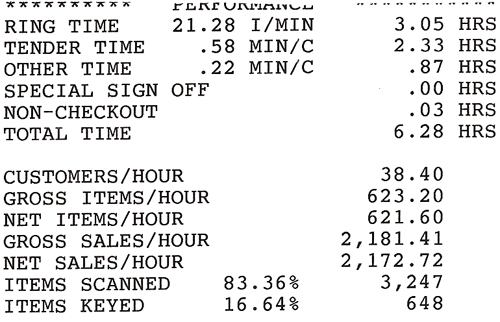
  2. The store manager hooked up some checkout data, which was awesome. At first, he declined my request for numbers while agreeing to let me float around the store. Then he brought back the mother lode: checkout scanner data from a single six-hour shift. The data was aggregated in a few unhelpful ways but no way do I mind this particular excerpt, which gives away the store:
  3. The y-intercept is non-zero! This never fails to trip my fuses. It should take you zero seconds to purchase zero items but you can’t ignore the fixed time cost of the pleasantries (“Hi. How are you doing? Do you need any help out?”) and the transaction itself.
  4. The express lane isn’t faster. The manager backed me up on this one. You attract more people holding fewer total items, but as the data shows above, when you add one person to the line, you’re adding 48 extra seconds to the line length (that’s “tender time” added to “other time”) without even considering the items in her cart. Meanwhile, an extra item only costs you an extra 2.8 seconds. Therefore, you’d rather add 17 more items to the line than one extra person! I can’t believe I’m dropping exclamation points in an essay on grocery shopping but that’s how this stuff makes me feel.

Here’s the Photoshop template, which you’re welcome to remix with new numbers or, even better, revamp into something altogether less offensive to the eye.

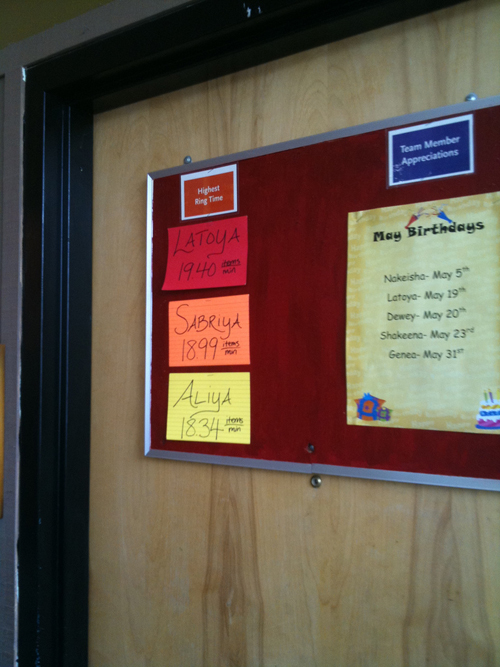
[BTW: check out this fun snap from Dan Callahan of the Whole Foods staff bulletin board.

Too Hot For USC

I was profiled for USC’s Master of Arts in Teaching program last month. The interview covered my (short) professional bio, advice for new teachers, along with a question asking me how awesome I thought my own master’s program was. I’m pretty sure they canned my interview off my qualified response to that last question but there were elements of the interview I liked (and haven’t ever discussed at this blog, like my lifelong struggle with Restless Leg Syndrome) so I am posting it here.

USC: What and where do you teach?

DM: I teach high school math โ€“ a mix of Algebra, Geometry, and remedial math. I teach math to a lot of students who don’t enjoy math.

USC: How long have you been teaching?

DM: I just finished my fifth year. The fifth year is much more fun than the first. There isn’t any comparison, really.

USC: What inspired you to teach?

DM: I never wanted to teach. Now I’m a third-generation fourth-generation teacher. [Mom informs me my great-grandfather taught in a one-room schoolhouse. –dm] Both from a spirit of childhood rebellion and because I saw my dad work incredibly hard to support my family on a single teaching income, this job was never my ambition. I wanted to make movies but I was exceptionally untalented at filmmaking, a fact which various film school admissions boards also confirmed. In my final year of a mathematics degree, I interned in a pre-calculus classroom where I found myself exceptionally empathetic to the struggle of the learner and moderately gifted to resolve that struggle. Therefore, teaching. Because I wasn’t terrible. Put that on a mug. Of course, I moaned for three years that my passions and abilities hadn’t aligned. After my second year I made another unsuccessful leap at filmmaking. After my third year, my passions and my abilities aligned a little more, and it was hard, after my fourth year, to imagine doing anything but teach.

USC: What classroom methods are most helpful in pushing students towards their goals?

DM: I started using a digital projector in my third year teaching. In terms of methodology, nothing before or since has affected student achievement more. Runners up, however:

  1. I assign one homework problem per night. The longer I have taught, the less time I waste on discipline, which has made it easier to get enough done in class to let us take the evening off.
  2. I measure student achievement on a series of skill rankings, which are fluid and updated weekly. This has struck me as more accurate than a series of comprehensive unit exams.

But that’s methodology. And functional methodology in a toxic classroom culture is a bullet train to nowhere. I have made a lot of intentional steps, then, to promote “curiosity” as a cultural value of my classes.

USC: What is the one thing you wish you’d known when you started in the classroom? (i.e. advice for new teachers).

DM: Your students will excavate with profound determination and speed every social anxiety you thought you buried. It will take them minutes to decide that you are insecure about your appearance. Do not wonder if they notice your post-adolescent pimple. They do. They will exploit these anxieties as often as you allow them to. Determine quickly what matters to you and rid your psyche of the rest. Interest yourself in your students as often and as genuinely as possible. Love this job. Love your students. I’m not kidding about that last one even though I’m positive my 21-year-old self would have scoffed at that kind of attachment. Take it from me, please: you do not want to be the teacher I was when I was 21.

USC: If you have a masters in education, what did your training teach you that was most helpful in preparing you to enjoy and thrive in a classroom today?

DM: I hold the teacher preparation program at UC Davis in high regard. My coordinator, Allan Bellman, selected a cohort of chatty, introspective educators who responded to their profound, daily incompetence by talking and talking and talking. And when we stopped talking, Bellman asked good questions that got us talking again.

The same school awarded me a master’s degree, for which I now receive a modest yearly stipend from my school district. In terms of “enjoying and thriving in a classroom today” or even in terms of “students learning more from their teacher” that money is not well spent. I enjoyed the program. It taught me to think about my practice in more academic terms. But I thrived in my job and enjoyed it not even a little bit more after I finished the program. Find a good community of good teachers. Find them online if you must. Read blogs. Write a blog. Tweet, as a last resort.