Year: 2009

Total 161 Posts

Compass & Straightedge

Summer school right now involves six hours of Geometry instruction followed by three hours of planning for the next day’s Geometry instruction, which basically leaves me fully tapped for tweeting, blogging, smiling, anything but sleeping. I’d say something laced with regret here but the fact is I enrolled some truly incredible students who challenge me and crack me up for the better part of those six hours. These kids make for light work.

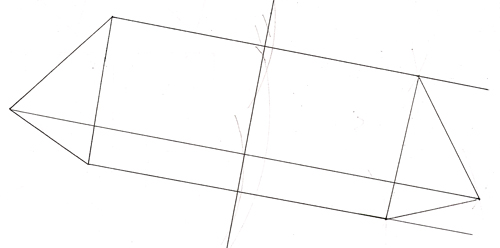
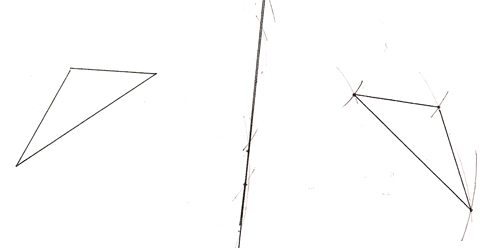
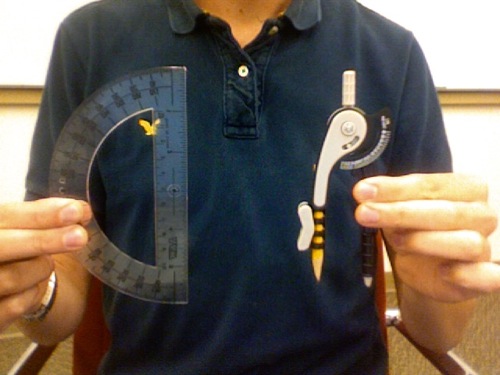
Their proficiency does cause its own kind of trouble, though, because my strongest and weakest students space themselves out dramatically over six hours, requiring all kinds of differentiation. My favorite recent method, particularly with today’s investigation of reflections, is to say, “okay, now do that with just a compass and straightedge.”

I had a method in mind but several students each did me one better.
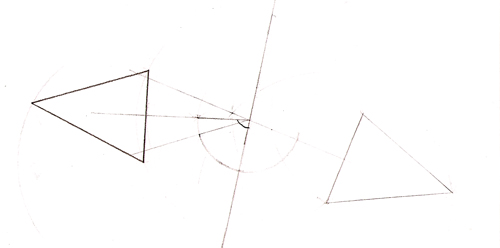
One student made kind of stunning use of SSS congruency. Another dripped sweat all over the page constructing perpendicular bisectors, copying angles, copying sides in an incredible (but functional) mess. Another used the method I chose but did it in three fewer arcs.

I have five more days to enjoy this.

[BTW: I have determined that at least 20% of this is garbage.]
The Aesthetic

Michael Paul Goldenberg, WCYDWT spokesmodel:

When they want to see more methods, they’ll let you know. When they become discontented with their ideas of proof, they’ll let you know. And it WILL happen. Because there will always be kids who ask themselves and their peers: “Why does that work? Why does that make sense? How do you know?” And that’s all we need to nurture in them: their own natural curiosity, rather than suppress that and replace it with curiosity about only the following: What does the teacher think? What does the teacher want me to say or do? What do I need to do to get an A?

I like this.

California

Todd Seal earns the melodramatic title of his post, How Will We Survive?:

My library has already been cut. We will have no bookroom clerk, making novels almost an impossibility and replacement costs much higher than previous years for sure. We will lose one adviser, the person we send students to when they are problematic. We will have a total of fifteen more students each day, meaning that weโ€™ll teach five and a half classes for the same pay as we usually get for teaching just five. The reproduction clerk is gone, meaning that we all will have three-hundred copies per month, end of discussion, and weโ€™ll have to allot time to make those copies ourselves instead of dropping them off and picking them up later. The whisper has it that our athletics director will go away. Thereโ€™s even talk of moving to two administrators, dropping from our current three. All these things mean that folks will be placed back into classrooms, where the newly christened teachers will be the first on the chopping block. This news comes before what are rumored to be even larger final budget cuts. I can only imagine what further decimation will happen after that.

The First Day Of Summer School

Five uninterrupted hours of Geometry differentiated between credit recovery students and enrichment students turns out to be exactly as easy as everyone predicted it would be. After misjudging time-on-task about a dozen times and grossly overestimating our ability to construct an orthocenter by Just Playing With It, I did something at the end of class that I didn’t hate.

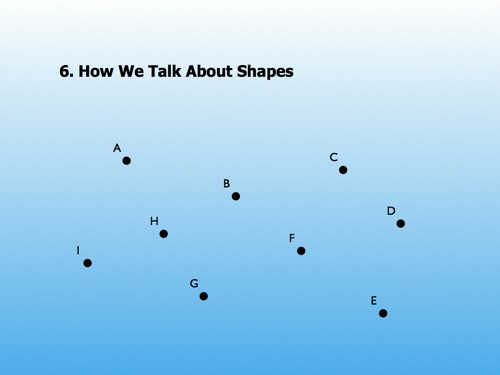
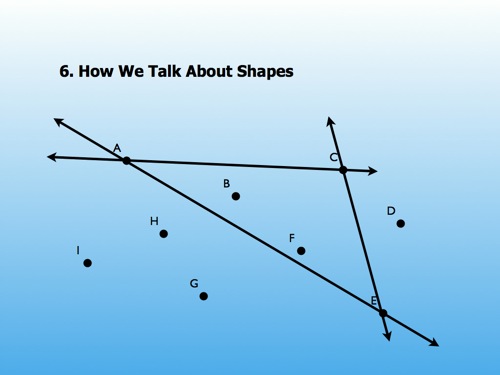
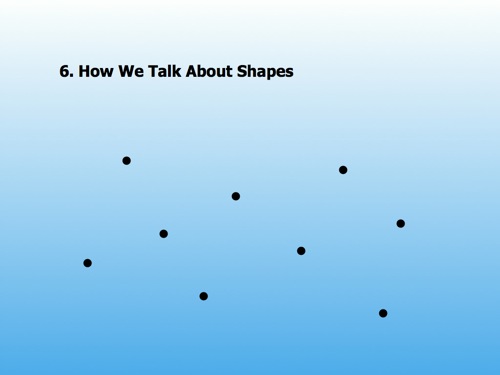
I put up this slide and asked Mika to pick a point out. I asked her to tell Jason across the room which point she was thinking of. She stumbled and stammered a bit. “It’s sort of to the left of the one that’s near the center,” etc.

And then I added labels.

And it became a little clearer why we label points. Mika relaxed. Everything looked easier.

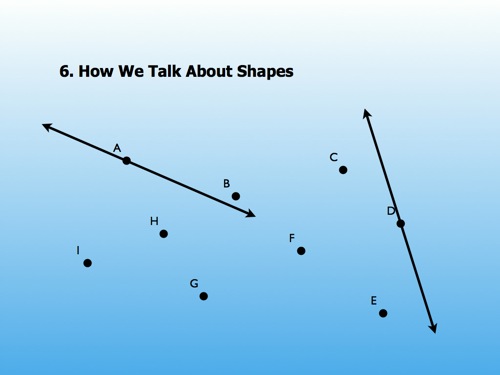
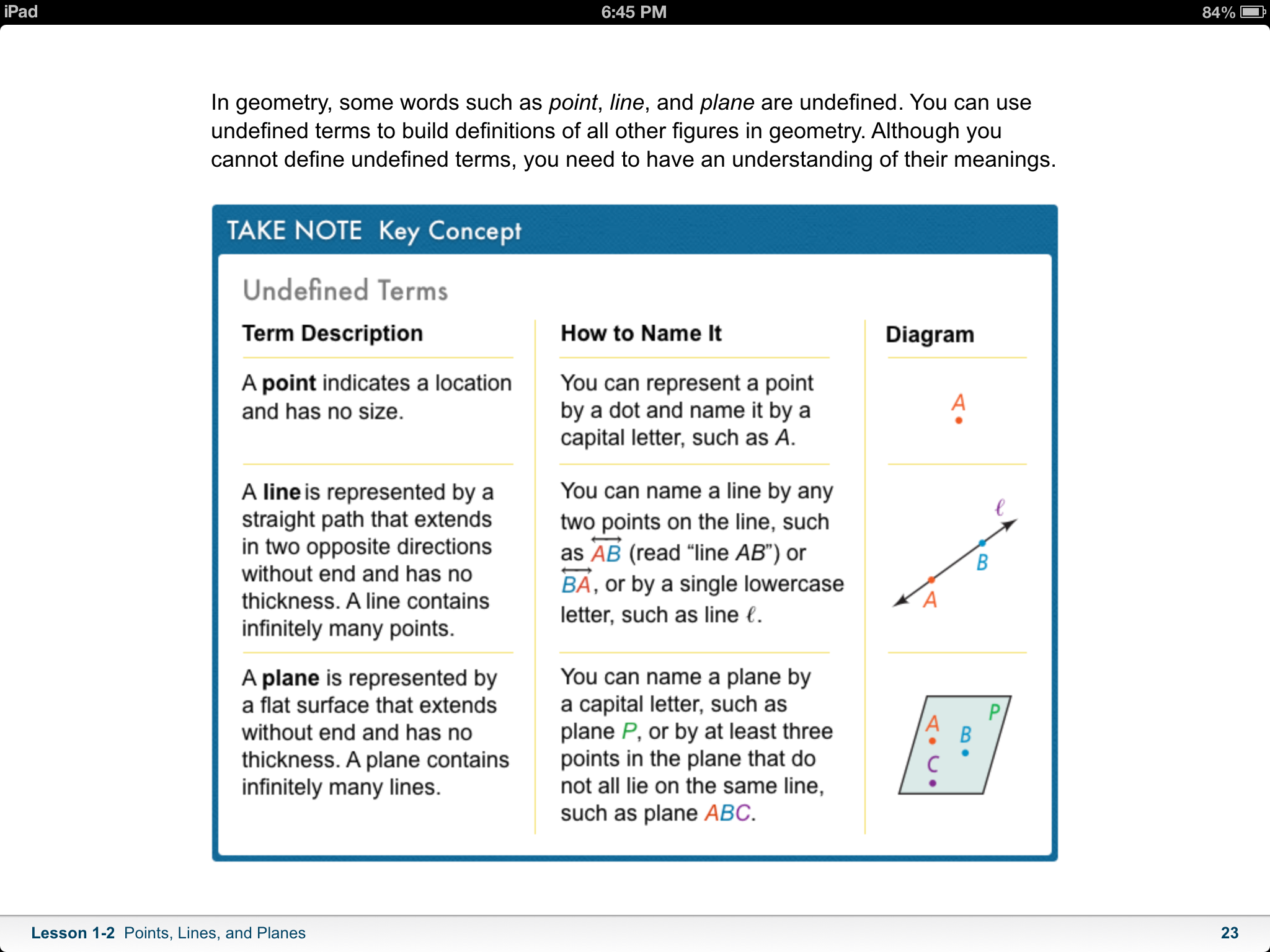
In 2007, I told my students that we name lines using two letters and I gave several examples. Today, I asked Mike how he would tell Kelsie across the room which of these lines he was looking at. First, it was easy.

Then it was difficult.

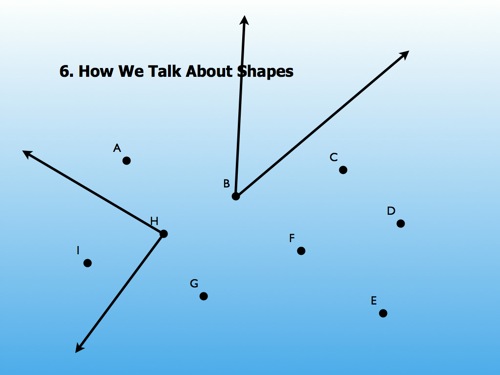
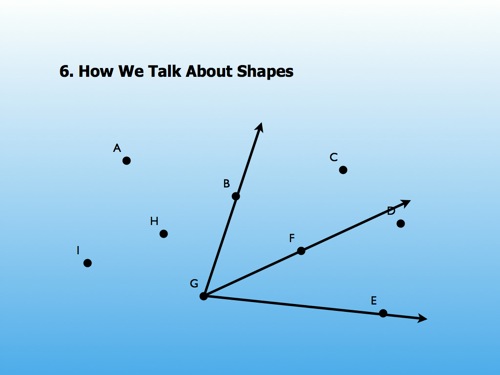
The same went for how we name angles.

This math thing is easier to approach if I ask myself, what about this concept is useful, interesting, essential, or satisfying, and then work backward along that vector, rather than working toward it from a disjoint set of scattered skills. There is probably a book I should read somewhere in all of this.

Postscript

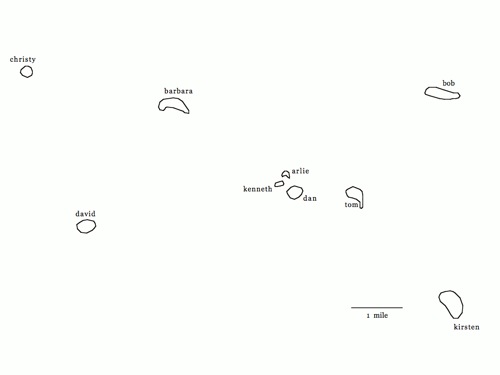
Also: I didn’t hate our opening exercise in which I gave each student a) a compass, b) a straightedge, and c) a map of the Meyer family’s South Pacific archipelago, Meyeronia, and d) five questions. [pdf]

  1. How many miles is it from Kenneth to Christy?
  2. Which island is farther from David? Barbara or Christy?
  3. List all the islands that are three miles from Kenneth.
  4. Find a location in the water that is the same distance from Tom & Bob. How many are there?
  5. Find a location in the water that is the same distance from Tom & Bob & Kirsten. How many are there?

Download

Flavors:

2012 Nov 24. Of course you could just take the concept straight on โ€“ defining the terms and defining the notation. No one would have any idea what purpose that notation served or why you’d need two letters to define a line. The concept would be just something else to memorize. But you could do that.

Does Size Matter?

While maybe not reflective (on its own) of any massive change in my pedagogy since I started teaching, the growing size of each year’s lesson folder does reflect my growing tendency toward visual mathematical multimedia.