Sort of.
Sort of.
I can’t really leave teaching on better terms than these.
I never coached tennis. I never sponsored a club. I didn’t attend the plays or games or concerts I always felt I should have. I regret that. I never watched a freshman class graduate, never saw them from the start of high school to the finish. I regret that most of all.
But I have made amends with classroom management, time management, and compensation, the challenges which, at various points over five years, had me talking to admissions officers at schools of engineering and medicine. After five years, I am unequivocally a “happy” teacher.
I regard this professional transformation (from miserable to happy, incompetent to competent) with complete stupefication. The arc of a new teacher’s development is short and bends in any number of directions. My own was filled from beginning to end with lucky coincidences, chance mentors who appeared and disappeared at the exact moment I most needed them, hobbies from my childhood which came back around to pay off huge dividends in my classroom. I can’t explain any of it. I know I could do it all over again and arrive a completely different teacher.
I need to get a fix on some larger issues of teacher development and I can’t do that from the ground level here, from the classroom, with blog posts scattered around and squeaked out in the fifteen-minute interval after lesson planning ends and before my wife gets off shift. I am enrolled in in the Ph.D. program at the University of California, Santa Cruz, for the fall, to what end I don’t yet know. But I’m ready to spend half a decade or more pursuing the answer to a single, confounding question.
If you have never rolled a cup across a flat surface and marveled at how precisely it returns to the same place you rolled it from, it’s possible you’re the wrong audience for this post.
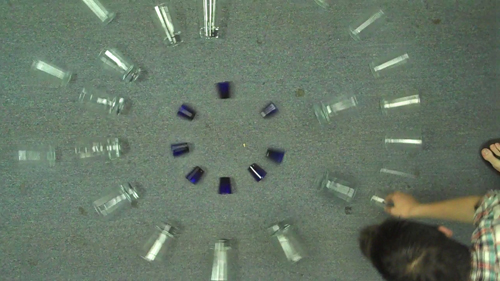
There is math here, certainly, but I have made it a goal this year to stall the math for as long as possible, focusing on a student’s intuition before her calculation, applying her internal framework for processing the world before applying the textbook’s framework for processing mathematics.
Bad First Question
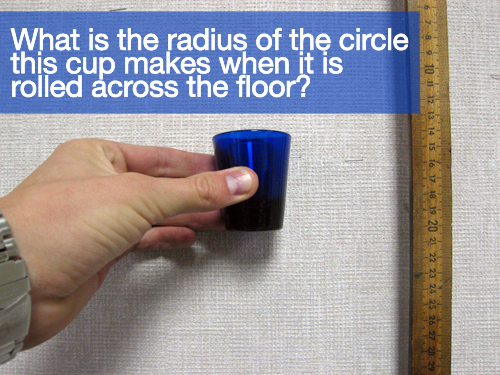
This one sucks the air right out of the room. We’re into the math immediately, having bypassed several easy opportunities to pull in our students who hate math
Jason’s First Question
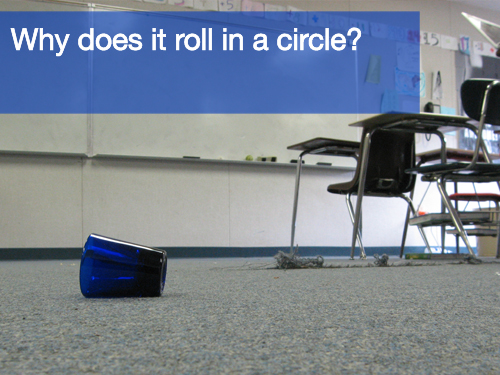
Jason Dyer suggests handing out plastic cups, letting students roll them around, then asking “why do they do that?” I have no problem with this approach. I would like to start from a position of stronger student investment, though.
My First Question
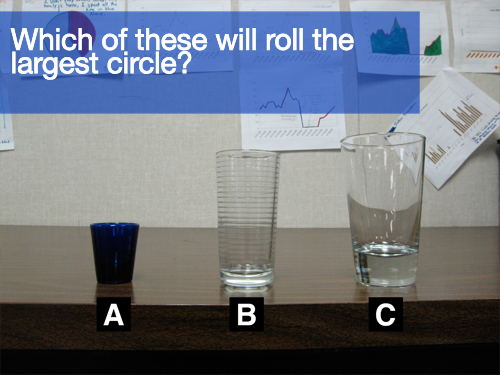
Have them roll some plastic cups around. Then toss up this slide and ask them a question that has a correct answer, yes, but which attaches little stigma to the wrong answers. It’s an educated guess and different students will make persuasive cases for all three of these. Ask them to write their guesses down, to put them on the record
A Lesson Sketch
The conversation can then proceed along some interesting lines where you ask the student to:
We do all of this before we start separating triangles, before we write up a proof, before we generalize a formula. We ask for all this risk-free student investment before we lower the mathematical framework down onto the problem.
Degenerate Cases
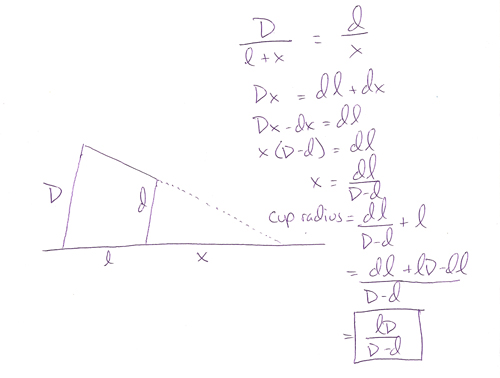
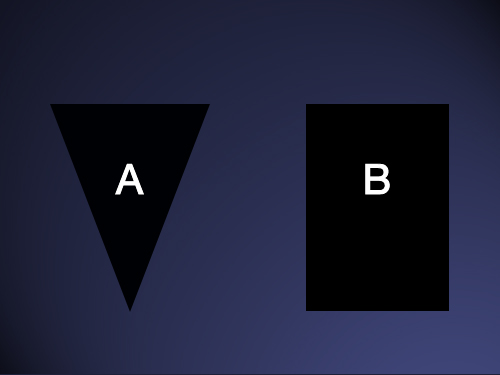
A cool feature of this formula is how well it handles degenerate cases. For example these two:
Iterate
From there you can pull out of your cupboard (digital or otherwise) any random set of cups and the students should be able to predict the roll-radius within a small margin of error.
And the framework grows stronger.
A Parting Swipe At Textbooks
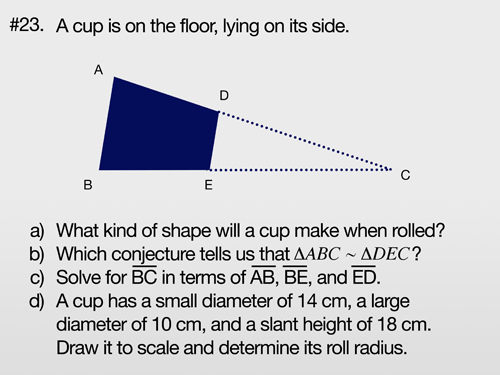
I didn’t dig this out of a textbook
[Updated here with my response.]

Two things:
[BTW: I updated the original image because josh g. is exactly right.]
Darren Draper posts a slide for review:
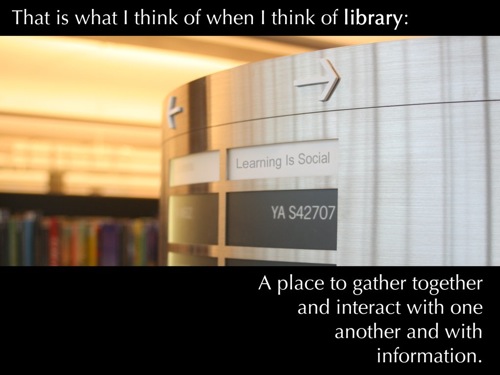
Michelle Baldwin, dissenting from the comments:
In considering Dan Meyer’s arguments, I don’t really agree with him. At all. It’s all about finding the “right” photo to enhance the text.
Is that what presentation is all about? Witty aphorisms and inspiring photos?
You have a thesis. Let’s assume there are very real, really real real-world implications to your thesis. Why not cut to that chase? Why make an abstract matter like edutechnology even more abstract with dramatic photography and 140-character pullquotes from your Twitter feed?
In this case, if learning really is social, please show me examples of that social learning. Or show me examples of how dangerous it is when that learning is taken out of a social context. If you find it difficult to connect your thesis to video or screenshots or sound clips (“multimedia,” basically) then it’s possible you are chasing down the wrong thesis or that your thesis doesn’t lend itself to a presentation medium
I like that Darren modified the stock photography (adding the “Learning Is Social” placard) to connect it better to his thesis than the average stock photo slide but I wonder if we’re approaching the question, “What is presentation?” along two different vectors.
