Year: 2009

Total 161 Posts

What We Want Isn’t Out There

Todd Seal, the best ELA blogger you don’t subscribe to, responds to Scott McLeod’s recent provocation (paraphrased), “Can you identify 10 excellent web sites for your grade / subject area, and if not what’s wrong with you?”

Todd: What we want isn’t out there. My typical search finds me cobbling lots of different pieces together with an idea I’ve had for the last two years along with a little something I got from watching SNL this weekend attached to the core of an idea I got from a discussion with some friends last month. I rarely find resources online that fit right into what I’m doing or that hit on what I want to address. I wish they were out there, but not even Discovery Education or any of the lesson plan warehouse sites cut it. Lots of chaff to sort through there and I worry about my return on time invested.

If I had to compile a list of sites essential to my day-to-day practice, you’d find Google Search, Google Reader, Google Images, and not a whole heckuva lot else. I spend much of my planning time lately curating media of the kind Todd lists in his awesome run-on sentence there: TV shows, photos I find, photos I take, video I capture, iPhone applications, current events, commercials, and, if I must, my assigned textbook.

I curate this media. I arrange it sensibly and structure questions and activities around it. It’s time-consuming and it’s challenging and the only way I can remotely justify the expense is by posting those lesson packs here, for others to download, deploy, and improve upon, thereby propping up an initially weak return on my investment.

As magical as these Internets are, I haven’t been able to outsource that curation to one website, or ten.

Global Math Geeks

Darren Draper takes on What Can You Do With This? as a professional development exercise in TechLearning:

I think we’d do well as educators to consider this and similarly engaging forms of online learning to challenge teachers in their pursuit of up-to-the-minute professional development. Our teachers need to be challenged, and not just by the kids. By engaging in a little self-directed, peer-provided rigor, I think that instructional practices can improve.

Obviously, I agree. I’m also sure this is nowhere near the best we can do.

Are You A Sucker For Product Placement?

Watch this YouTube video, which is sweet and wistful all the way up until you realize it’s selling flavored sugar water:

The question I asked my students was, “when did you realize it was selling you Coke?” and “how many times did you see Coke throughout?”

The kids who are unfortunate sponges for product placement didn’t notice it was a Coke ad until the end. Savvier shoppers spotted the Coke billboard halfway through.

These classroom conversations are fun and useful and I’m glad we make room for them in math. I have given up posting my show and tell media here but if you’d like a feed of photos and video I show in my classes every day, I have tagged them here.

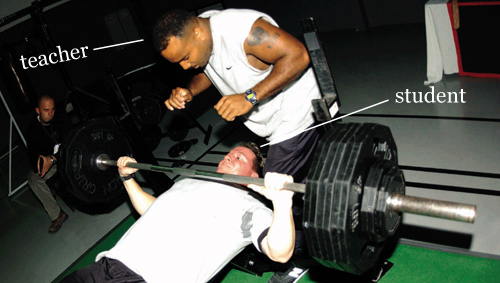
Weightlifter / Spotter

The good teacher knows if the learner learns through the ears, the eyes, or the hands just like the good spotter knows where the lifter wants support – at the wrists or under the elbows or on the bar. The good spotter is unhelpful; the good spotter doesn’t intervene at the first sign of struggle but realizes that the struggle is essential, that the struggle is the entire reason they are there, and waits as long as possible before intervening.

The good teacher puts weight on the student’s intellectual bar and lets her struggle under that weight as long as possible, asking questions to help her cut through the confusion, just like the spotter shouts encouragement at the lifter.

Mostly I envy the spotter. The job is so (comparatively) easy. The spotter steps in just as the lifter begins to collapse and not a moment before. That moment is nowhere near as obvious in teaching where what the learner says she needs and what the learner actually needs often are not the same thing, where it isn’t visually obvious that the learner is too perplexed or not perplexed enough.

And, my word: we’re spotting thirty people at once.

[Photo credit]

Picking Up The Gauntlet

If you read nothing else, my summary judgment on stock photography closes the post.

Tom Woodard

Ten minutes after I threw down the gauntlet Tom Woodward picked it back up and whacked me with it:

Once again, help me make this better. That goes for images, argument, facts – whatever.

My response.

John Pederson

John Pederson, apropos of nothing I wrote, has developed a sudden, sloppy crush on typography, one of the artistic disciplines that hasn’t changed in several centuries, so that’s great. Because if you don’t know how to work with type, Prezi and CoolIris won’t save you.

Darren Draper

Darren Draper posted two variations on the same theme, asking would I really prefer a white background to a stock fast-food worker.


vs.

My answer is no, I prefer the stock photo, though I am glad there are a few other options besides those two. If those were your only options then go with stock photography. But carefully. The trappings of stock photos are a) exaggerated lighting, b) exaggerated framing, and c) exaggerated content, all of which give the content of your slide a lot of competition for attention.

I saw recently, for one example, a frightened kid shot under harsh lights with Scrabble tiles spelling out F-E-A-R censoring his mouth. The accompanying quote concerned Internet filtering or something. The quote was interesting and provocative but completely overwhelmed by the stock photo.

Dean Shareski

Dean perplexes me, saying I’m “stirring up trouble” with my last post. I realize this is just Dean’s usual Canadian bonhomie but, come on. Here is Dean’s commenter, Mark Kowalski. Take it away, Mark:

Even as a teacher, public critique of a person’s work is an odd experience. Maybe our social norms on feedback and politeness have gone too far one way?

If that “one way” is toward norms equating “criticism” with “insensitivity,” then I agree.

Angela Maiers

Angela has linked up a Slideshare presentation and asked for feedback.

Credit where credit is due. Y’all have taken Garr Reynold’s style and run with it for quite some distance. I have two concerns.

First, there are instances when the stock photography is so exaggerated or stylized that it distracts from the purpose of the presentation. In this example, I promise you I am not pondering the consequences of Angela’s quotation. I am scared to death of that toddler. Someone sign that kid to the Lakers but get him away from me.

Second, there are instances when the stock photography Angela has selected a) interprets the quotation for me or b) tips me to Angela’s interpretation when she’d probably rather I develop my own interpretation and add it to the discussion or presentation wiki or whateverTo cite my recent obsession, stock photography can easily be too helpful..

I didn’t mind this next one at all, an understated image that doesn’t constrain audience interpretation. The fact that I’m reduced to judging stock photography on how little it hurts a presentation oughtta concern us, however.

Alice Mercer

Alice has linked up her presentation files and asked for feedback. Take it away, people.

Summary Judgment On Stock Photography

Ditch it. Show me something real, not artificial. Serve the quotation up on a simple background with good typography and then show me some video or a photo or some audio captured naturally, in the wild, that hints at but doesn’t clonk me over the head with your point. And then let’s talk about it.

In Darren’s case, I would look for video of high school dropouts interviewed about their career paths since they left school, including, for the sake of intellectual honesty, some success stories. Find that. Or make that. Embed that. Let’s talk about that. Not about some Google Image or FlickrCC search I could have performed myself.

I realize this is several hundred times harder than typing keywords into a search engine but, as with personal hygiene, you get out of it what you put inMaybe y’all think I’m some sort of crank in these posts. But when someone uses their digital projector to curate and build conversations around interesting media they captured or aggregated themselves you really can’t imagine my enthusiasm..